










































eHealth and Innovation in Women's and Children's Health: A Baseline Review
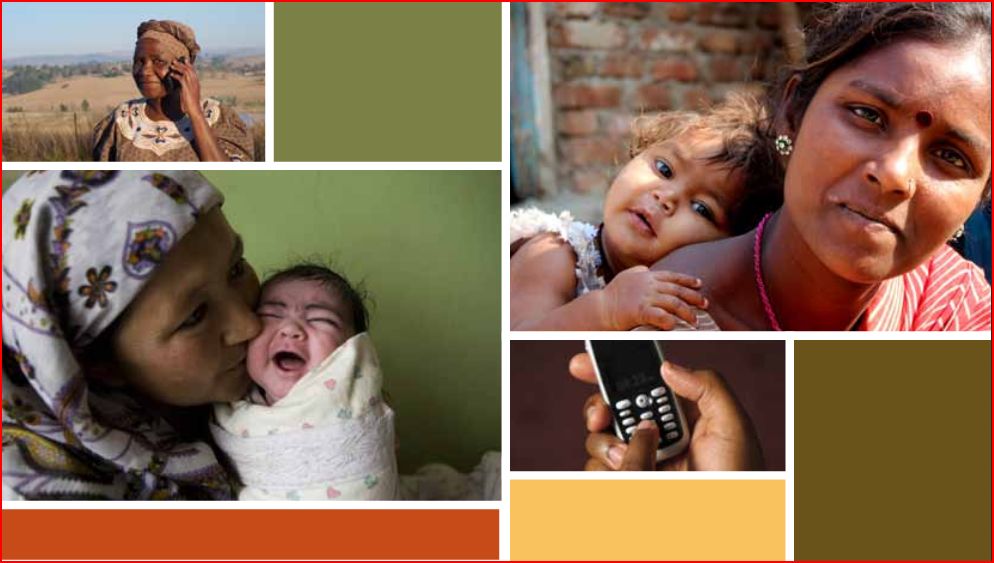
"This report shows how, on a daily basis, eHealth innovations are improving access to care and assisting women to take control of their own health...[T]hrough the use of ICTs, health-care professionals and the women and children they care for, are better able to share important health information as well as communicate amongst themselves more easily and effectively."
From the World Health Organization (WHO) and International Telecommunication Union (ITU), this report shares the results of a survey that studied the impact of information and communication technology (ICT) - specifically, eHealth - on women's and children's health in developing countries. It highlights findings focused on the development of national eHealth policies, the monitoring of key indicators, and the implementation of electronic information systems. Recommendations for the way forward are proposed.
The 2013 survey of Commission on Information and Accountability for Women's and Children's Health (CoIA) countries by the WHO Global Observatory for eHealth (GOe) involved over 300 eHealth and maternal and child health experts in 64 of the 75 CoIA responding countries, which together have 98% of the world's maternal and infant mortality. This baseline review focuses on the first 4 CoIA recommendations:
- "Vital events: By 2015, all countries have taken significant steps to establish a system for registration of births, deaths and causes of death, and have well-functioning health information systems that combine data from facilities, administrative sources and surveys.
- Health indicators: By 2012, the same 11 indicators on reproductive, maternal and child health, disaggregated for gender and other equity considerations, are being used for the purpose of monitoring progress towards the goals of the 2010 Global Strategy for Women's and Children's Health.
- Innovation: By 2015, all countries have integrated the use of Information and Communication Technologies in their national health information systems and health infrastructure.
- Resource tracking: By 2015, all 75 countries where 98% of maternal and child deaths take place are tracking and reporting, at a minimum, two aggregate resource indicators: (i) total health expenditure by financing source, per capita; and (ii) total reproductive, maternal, newborn and child health expenditure by financing source, per capita."
Examples cited of how eHealth is being used to support women's and children's services include:
- Supporting vaccination campaigns and social mobilisation through the use of mobile phone messages;
- Using eLearning to help raise standards of basic midwifery and community nursing care as well as developing common medical registries of pregnant women and neonatal information;
- Development of a telemedicine network, linking major maternity hospitals to provincial and county hospitals for teleconsultation, teleeducation, and telementoring for surgery;
- Collection of data on HIV-positive pregnant women from national HIV/AIDS programmes; and
- Distribution of laptops and handheld devices with internet connectivity to community clinics and health workers to capture data on CoIA indicators.
Amongst the findings (characterised in the report as "encouraging"): 94% of countries have a national policy or strategy for women's and children’s health, and over 90% are monitoring most of the key indicators on women's and children's health. Sixty-nine percent have implemented, at least partially, an electronic information system to register births, deaths, and causes of death. Fifty-six percent of countries report that eHealth is supporting major women's and children's health initiatives.
However, "[w]hile progress is being made, there is much more to be done to improve inter-sectoral collaboration and promotion of eHealth. This report highlights the many difficulties that stand in the way of eHealth adoption with the aim of overcoming them. These challenges can include lack of government commitment in some cases, lack of skilled health professionals and expertise in others, and lack of funding and infrastructure almost everywhere. The report makes a number of recommendations. Among the most important are for countries to promote inter-sectoral collaboration in their efforts, to include electronic data collection as part of an integrated plan for implementing eHealth services for women's and children's health, and to adopt eHealth programmes for reproductive, maternal, newborn and child health (RMNCH). They are also urged to develop eHealth policies and strategies and to act on barriers that impede progress."
Annexes include:
- Annex 1 includes 3 national case studies of eHealth related to use of: text messaging to accelerate early infant HIV diagnosis in rural Zambia; ICT to track pregnancy, ensure proper maternal care, and provide services for newborns and infants in Uttar Pradesh (UP), India; and a text messaging alert system to improve maternal and child health in Rwanda. Each of these case studies includes information on context, ICT tools and mechanisms used, project descriptions, impact data, and lessons learned. Qualitative evidence of impact is also provided. For example, speaking about the web-based Monitoring Information System (MIS) and Interactive Voice Response System (IVRS) created for UP's eHealth programme "Aargoyam" (meaning "a state of disease-free health"), an Auxiliary Nurse Midwife (ANM) in Karmalipur village, UP, said this: "A lot of changes have come about since Aarogyam. We now receive regular updates on whether the doctor will be available and when the vaccines have to be administered. If our beneficiaries don't pick up the calls, it would be redirected to us, giving us an indication that vaccinations had to be followed up in that particular case. The number of beneficiaries has certainly increased because of this and the impact is visible in the increased involvement of ASHA [Accredited Social Health Activists] and anganwadi officials as well. Also, now we find that beneficiaries take the initiative to come to us them selves, after receiving the calls, even if the ASHA is not available." This is notable because "Amroha contains two of the blocks identified under the 107 high-risk block strategy (2010) of the Indian Government's national polio eradication. Deep-seated socio-cultural factors have led many people in these blocks to refuse polio vaccination for their children."
- Annex 2 provides details on the survey methodology.
- Annex 3 summarises in part the information provided by the countries in their replies to the GOe survey, focusing on those questions that refer to the use of ICT in the monitoring of CoIA indicators under Recommendation 2, as well as to the application of ICT for recording vital events and tracking health expenditures, under Recommendations 1 and 4, respectively. The country insights also provide information on the status of national eHealth strategies development in responding countries that are currently working on a strategy or that have already adopted one, as well as on the barriers to eHealth implementation identified by the country respondents. To contextualise the information obtained from the survey, these country insights include statistics on the penetration of mobile cellular services, wireless and fixed broadband, where existent, and the level of internet usage at the individual and household levels. In addition, key health statistics linked to the MDGs 4 and 5 are provided.
- Annex 4 provides a summary of survey responses.
WHO website, August 7 2014. Image credits (left to right): ©AJ Cotton, Dreamstime; ©Pinky Patel, Photoshare; ©WHO; ©David Alexander, Photoshare
- Log in to post comments