










































Formative Research on the Breaking the Silence E-Entertainment Strategy
Date
Summary
As part of the "Breaking the Silence" project, the organisation Ojo X Ojo Multimedia and its allies Fundación Imaginario, Citurna Producciones, La Iniciativa de Comunicación, and the Universidad del Norte developed a communication and social mobilisation strategy that was designed to support the truth and reconciliation work of the Truth Commission in Columbia following the signing of a peace treaty with the FARC (Revolutionary Armed Forces of Colombia) guerillas. Breaking the Silence used the entertainment-education (EE) methodology, which combines educational content and entertainment in order to increase knowledge about a topic, generate informed debate, and provoke behaviour change. In particular, Breaking the Silence seeks to facilitate deep reflection and broad dialogue in the educational community about what happened in the armed conflict in Colombia, including its structural causes. It is designed to interrogate the conceptions, feelings, and cultural references that contribute to the normalisation of violence as a means to solve conflicts, including the armed conflict, and to contribute to transforming them through dialogue and reflection. The project is intended primarily for adolescents and young people between 12 and 17 years of age, but also aims to reach parental figures (fathers, mothers, and caregivers) and teachers and directors of educational institutions. (See Related Summaries, below, below for more information on Breaking the Silence.)
A number of preliminary steps had to be taken in order to develop this EE project, as outlined below:
1. Formative research
The objective of the formative research was to understand the knowledge and attitudes, as well as social and cultural norms, that need to be changed or reinforced in the intended audience (the educational community) so that they can understand the value of truth and move towards reparation and the non-repetition of the conflict. This evidence would then inform the central messages, stories, and characters - culturally appropriate for the different regions of the country - of a family-oriented television series for the intended audience. Data collection was done through qualitative techniques - specifically, focus group discussions (FGDs) and in-depth interviews (IDIs) with the three population groups: teachers and school administrators, children and young people aged 12 to 17, and parents and caregivers. Participants were selected from the 10 macro-regions established by the Truth Commission, with the aim of covering different territories, socio-economic situations, and the experiences of educational institutions in relation to violence, conflict, and post-conflict. A total of 138 people participated: 132 of them in 20 FGDs and 6 in IDIs. There were 46 children and young people aged 12 to 14, 45 teachers and school administrators, and 47 parents and caregivers.
In the formative research, different categories of analysis were established for each audience:
After the formative research and in accordance with the EE methodology, the team's efforts were directed toward the collaborative construction of a message brief. The message brief aims to define the main themes to be addressed by the strategy and the key messages to be promoted through the different communication components, formats, and platforms.
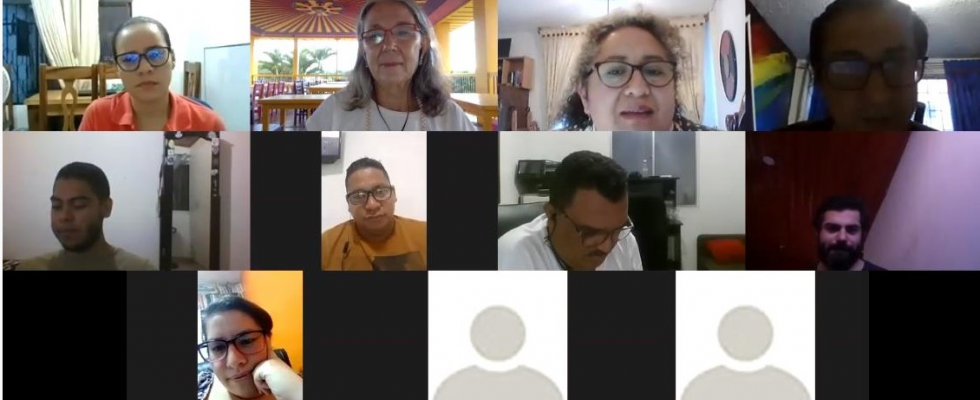
The methodology used to prepare the brief was online dialogues between the team and external advisors, as well as peer validation of the ideas that emerged. More than 20 working sessions were held due to the difficulty of constructing messages around the complex issues of trust and reconciliation.
During these sessions, questions and statements were developed on each of the themes, which were then translated into key messages for each audience. The more final document was then worked on and validated in a workshop with experts who refined and enriched the working document with their experiences and knowledge.
3. Laboratories for co-creation of pedaegogical tools
In accordance with the preconditions of the Truth Commission, four members of the Ojo X Ojo team became part of the driving group that guided the laboratories for the creation of educational tools to be used in schools. The objective of this two-way relationship was, on the one hand, to help with the organisation of the laboratories, and on the other, to learn firsthand about the opinions, experiences, and motivations of teachers from all over the country with regard to the challenges of educational practice in post-conflict Columbia.
4. Partnership with The Communication Initiative and thematic site
In this first phase of creating the strategy, Ojo X Ojo managed an alliance with The Communication Initiative and its regional process, The Communication Initiative Latin America, which since 1998 has been facilitating the creation of communities of practice and the exchange of information and knowledge through a web platform focused on development issues (with close to 40,000 subscribers in Latin America, 12,000 of them in Colombia).
This alliance made it possible to use La Iniciativa de Comunicación's web platform, its electronic newsletter "Son de Tambora", and its online dialogue tools to support the knowledge management process. The teachers and other participants in the Truth Commission's Pedagogical Tools Co-creation Laboratories and the teachers who participated in the FGDs and IDIs were added to the database of subscribers to The Communication Initiative. A dialogue group - Agora - was created through which participants' opinions and contributions, as well as newsletters with relevant knowledge, could be sent and received.
The Communication Initiative web platform has the ability to create thematic sites, or sites specialised on a topic. The thematic site Communicating Rights in the Post-Conflict was created and has been used to host the reviews produced, which is very relevant to this process. The toolkit and strategies of the same name are permanently available there. Communicating Rights in Post-Conflict is the result of a joint effort between the World Bank and the United Nations Educational, Scientific and Cultural Organization (UNESCO), with funding from the World Bank's Nordic Trust Fund.
A number of preliminary steps had to be taken in order to develop this EE project, as outlined below:
1. Formative research
The objective of the formative research was to understand the knowledge and attitudes, as well as social and cultural norms, that need to be changed or reinforced in the intended audience (the educational community) so that they can understand the value of truth and move towards reparation and the non-repetition of the conflict. This evidence would then inform the central messages, stories, and characters - culturally appropriate for the different regions of the country - of a family-oriented television series for the intended audience. Data collection was done through qualitative techniques - specifically, focus group discussions (FGDs) and in-depth interviews (IDIs) with the three population groups: teachers and school administrators, children and young people aged 12 to 17, and parents and caregivers. Participants were selected from the 10 macro-regions established by the Truth Commission, with the aim of covering different territories, socio-economic situations, and the experiences of educational institutions in relation to violence, conflict, and post-conflict. A total of 138 people participated: 132 of them in 20 FGDs and 6 in IDIs. There were 46 children and young people aged 12 to 14, 45 teachers and school administrators, and 47 parents and caregivers.
In the formative research, different categories of analysis were established for each audience:
- Conceptions of conflict and conflict management;
- Conceptions of justice;
- Conceptions about the possibility of getting to the truth about facts and cases of violence;
- Positions and attitudes regarding the armed conflict, its actors, and the peace process;
- Sources of information, conversation, and positions on the armed conflict and the peace process; and
- Feelings about reparation, forgiveness, and reconciliation and perceptions of the future.
- Colombia is at least two different countries: one in the countryside and one in the city.
- But it is much more diverse than that: for example, La Guajira and its people are very different from Córdoba and its people. But in turn, "its people" - the men and women of these districts, their families, and their ways of relating to each other - are very different geographically, socially, gender-wise, economically, etc. (that is, according to the different social groups to which they belong). People's sense of belonging, which ranges from family, friends, school, and church to the national, regional, and global world, shapes their identity and conditions the ways they relate to others. They bring people closer or create a distance in cases when people are perceived as different, and this phenomenon has serious consequences. In the focus groups, the project saw how much of this sense of belonging influences one's attitude towards conflict, peace, forgiveness, and reconciliation.
- There are different ways of relating to the armed conflict that depend on: the way it was experienced, either directly or indirectly; the information one has about the armed conflict and its history; and the sources of information and the ability one has to compare information from different sources. The way in which the armed conflict, the different actors, the peace process, and the possibility of constructing and evaluating the truth varies to a large extent according to these factors.
- The above factors also influence the way people understand social transformation and the armed conflict, as well as people's relationship to peace, forgiveness, and reconciliation and, indeed, to the possibility or not of non-repetition of the conflict.
- People need to understand their conditioning in order to develop critical thinking: They need to learn to be self-critical in order to understand the role conditioning plays in their thinking about others and to semi-quasi-pseudo "overcome" that conditioning. Reason is, however, not the only thing needed to understand the other. Emotion is also needed, which predisposes people to listen to and understand, and to empathise with the other. Without being aware of one's conditioning, it is difficult to understand one's willingness to listen, to understand, to comprehend the other. All this should also not be done alone, but with others. By being with others, one learns to be with others, and not to run away or disregard the people one does not understand.
After the formative research and in accordance with the EE methodology, the team's efforts were directed toward the collaborative construction of a message brief. The message brief aims to define the main themes to be addressed by the strategy and the key messages to be promoted through the different communication components, formats, and platforms.
The methodology used to prepare the brief was online dialogues between the team and external advisors, as well as peer validation of the ideas that emerged. More than 20 working sessions were held due to the difficulty of constructing messages around the complex issues of trust and reconciliation.
During these sessions, questions and statements were developed on each of the themes, which were then translated into key messages for each audience. The more final document was then worked on and validated in a workshop with experts who refined and enriched the working document with their experiences and knowledge.
3. Laboratories for co-creation of pedaegogical tools
In accordance with the preconditions of the Truth Commission, four members of the Ojo X Ojo team became part of the driving group that guided the laboratories for the creation of educational tools to be used in schools. The objective of this two-way relationship was, on the one hand, to help with the organisation of the laboratories, and on the other, to learn firsthand about the opinions, experiences, and motivations of teachers from all over the country with regard to the challenges of educational practice in post-conflict Columbia.
4. Partnership with The Communication Initiative and thematic site
In this first phase of creating the strategy, Ojo X Ojo managed an alliance with The Communication Initiative and its regional process, The Communication Initiative Latin America, which since 1998 has been facilitating the creation of communities of practice and the exchange of information and knowledge through a web platform focused on development issues (with close to 40,000 subscribers in Latin America, 12,000 of them in Colombia).
This alliance made it possible to use La Iniciativa de Comunicación's web platform, its electronic newsletter "Son de Tambora", and its online dialogue tools to support the knowledge management process. The teachers and other participants in the Truth Commission's Pedagogical Tools Co-creation Laboratories and the teachers who participated in the FGDs and IDIs were added to the database of subscribers to The Communication Initiative. A dialogue group - Agora - was created through which participants' opinions and contributions, as well as newsletters with relevant knowledge, could be sent and received.
The Communication Initiative web platform has the ability to create thematic sites, or sites specialised on a topic. The thematic site Communicating Rights in the Post-Conflict was created and has been used to host the reviews produced, which is very relevant to this process. The toolkit and strategies of the same name are permanently available there. Communicating Rights in Post-Conflict is the result of a joint effort between the World Bank and the United Nations Educational, Scientific and Cultural Organization (UNESCO), with funding from the World Bank's Nordic Trust Fund.
Source
Translated from the Spanish write-up on the CILA website: Investigación Formativa de la Estrategia de Eduentretenimiento Romper el Silencio on March 6 2023.
- Log in to post comments