










































India Polio Communication Update, October 2012
Date
Summary
"Clearly, this partnership between countries and sharing of expertise and know-how can go a long way to eradicating polio globally."
This is one of the messages shared in an update, one of a series produced by the United Nations Children's Fund (UNICEF) India in consultation with polio partners as part of the global effort to eradicate polio. India was officially removed from the list of polio-endemic countries in February 2012, yet, as this update makes clear, work - including communication-related work - to eradicate polio globally in order to protect India's children and others is far from over.
The following topics are covered in this issue:
- India, Polio-affected Countries in Global Exchange - As noted here, per a call issued in the Independent Monitoring Board (IMB) of the Global Polio Eradication Initiative (GPEI)'s January 2012 report, the India polio eradication programme is supporting polio-infected countries through the application of lessons learned. It has sent staff to support remaining endemic countries, hosting visits from neighbouring governments and from within the polio partnership, and sharing programmatic best practices, including: programme management, methods to maximise coverage during rounds, media advocacy strategies, monitoring and evaluation formats, communication and training materials, and ground-level tools to increase the effectiveness of front-line vaccinators and social mobilisers. Several examples of UNICEF India's missions to and from endemic countries are described, such as one that involved building the capacity of radio jockeys at a media workshop on polio in Kabul, Afghanistan.
- Pakistan, India Share Experience to End Polio - A delegation led by Pakistan Prime Minister's Special Representative on Polio visited India in May 2012. At the start of the visit, facilitated by the Bill and Melinda Gates Foundation, the Pakistan delegation met GPEI partners World Health Organization (WHO), Rotary International, and UNICEF to learn how these agencies, despite their different roles, are working in tandem to roll out concerted polio eradication efforts. In addition to showing interest in how robust monitoring and evaluation of the programme are executed, the Pakistan delegation sought to learn about India's migrant and mobile strategy and media management for the programme. The delegation asked about the Social Mobilization Network (SMNet) and how it was built and executed in India. The details of this exchange visit are described; one element included the delegation meeting Imams, who have played a vital role in community mobilisation for polio immunisation in reaching every last child with oral polio vaccine (OPV). They also witnessed how the community was mobilised to attend booths set up for OPV administration on the first day of the polio campaign. It is noted that, thanks to this experience, "[t]he battle against polio in Pakistan has taken the next step." As reported here, meetings are taking place within the government at various levels, right down to the provinces, built on India’s technical support and ground experience.
- Afghanistan Team Observes June Polio Campaign - A group of polio managers from Afghanistan, including national and provincial immunisation heads and UNICEF and WHO country team members, visited India to observe the sub-national polio immunisation campaign in India in June 2012. In addition to participating in meetings such as the daily evening debriefing meetings organised during the polio vaccination rounds, the 3 Afghanistan teams visited villages and brick kilns, spent the day with border vaccination teams and with mobile teams at railway stations, and observed the commitment of religious leaders closely engaged with the polio programme to mobilise the community.
- Rotary India Supports Endemic Countries - Rotary has built platforms in an effort to enable the sharing of information among polio-affected countries. For example, Rotary helped involve Pakistan's cricket icon, Shahid Afridi, to boost polio eradication activities in the country, especially in the Khyber region. Afridi, himself a Pashtun, has dedicated himself to polio eradication as the nation's Polio Champion. Following the Indian model, Rotary has also involved ulemas and other scholars. For instance, Dr. E.G.P. Haran, honorary consultant to Rotary's India PolioPlus Committee, visited Pakistan in April 2012, when the National Immunization Day (NID) activities were underway. Amongst other activities, he discussed experiences from India and Bangladesh and shared copies of NID manuals, as well as guidelines that were followed in reaching the 107 highest-risk blocks of Western Uttar Pradesh and Bihar. Many of the ideas have now been incorporated into Pakistan's plan of action for intensive focus on the high-risk districts. Rotary also shared prototypes of information, education, and communication (IEC) material with its counterpart in Pakistan and discussed ways in which Rotarians and Rotary clubs participate actively in social mobilisation activities on booth days to ensure that no child is missed.
- CORE India's Support to Nigeria's Polio Program - Deputy Director of CORE Group Polio Project (CGPP) India joined Nigeria's Polio Communication Review in September 2012 as part of the team of communication experts. The team visited Kano, one of the high-risk states, to assess how effectively community engagement by mobilisers and volunteers of different partnerships and the Voluntary Community Mobilization Network (VCM Net) was able to catch up on missed children and improve acceptance of the vaccine. "The India programme can contribute in terms of training and skill building of VCM Network staff since Nigeria shares similar challenges in communication that India faced, like questions raised by non-compliant families on vaccine safety and availability of other civic services."
- Mission Nigeria from WHO - WHO India's National Polio Surveillance Project has sent 2 missions of 16 Surveillance Medical Officers to Nigeria for a period of 3 months to provide strategic support. Amongst other ideas, the WHO India team advocated for greater involvement of traditional leaders for increasing programme acceptability. They also worked with their counterparts to get state officials/elected representatives and local leaders involved in polio campaigns.
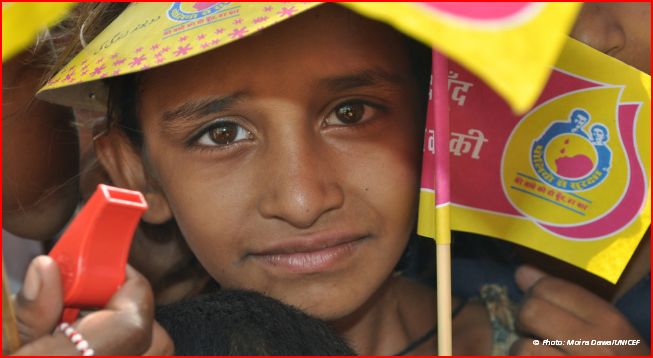
- Global Poverty Project Team in India - In 2011, the Global Poverty Project (GPP) was responsible for ensuring polio was on the agenda at the Commonwealth Heads of Government Meeting in Perth, Australia. The GPP followed up this effort by organising a concert for 60,000 attendees to highlight issues, including polio. However, key members of the GPP were yet to see 2 drops of the OPV be delivered into children's mouths. So, in June 2012, a GPP team participated in the polio activities in Ghaziabad in Uttar Pradesh and Patna in Bihar. One of the members of the delegation wrote on the GPP website: "As we walk through the streets on the way to the immunization booths in Ghaziabad, we are soon surrounded by the shouts and laughter of the Bulawa Tolis ('calling groups'). Armed with their Rotary flags and whistles, these brigades of children are deployed to fetch other children to the immunization booths." All along the way, the team saw advocacy in the form of colourful posters on street walls and shops including messages from celebrities. In Bihar, the GPP team walked through urban slums and experienced first-hand the conditions that vaccinators and social mobilisers work in, interacting with families at risk and sensitising them about the importance of hand washing, exclusive breastfeeding, and other good sanitation practices - along with vaccination.
Source
UNICEF India Country Office website, August 16 2013. Image credit: © Photo: Moira Dawa/UNICEF
- Log in to post comments