










































India Polio Communication Update, March 2012
Image
SummaryText
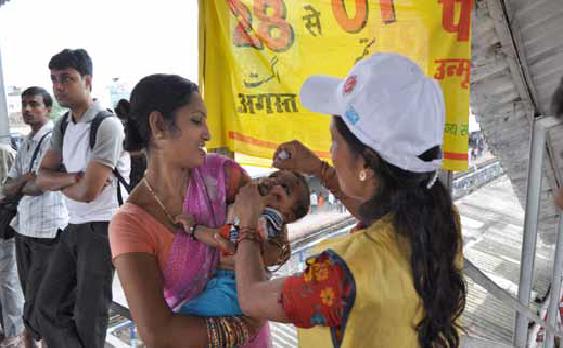
This update, which is one of a series produced by the United Nations Children's Fund (UNICEF) India in consultation with polio partners and is circulated by email as a PDF document, offers updates on communication efforts underway in India as part of the global effort to eradicate polio. The following topics are covered in this issue:
- India's success reduces polio-endemic countries to historic low of three - On February 25 2012, India was officially struck off the list of polio-endemic countries by the World Health Organization (WHO), having gone more than one year without reporting any cases of wild poliovirus. To commemorate this achievement and discuss strategies for the way forward, Rotary International worked with the Government of India to organise a 2-day summit. The role of partnership and advocacy in the effort was a key focus of the summit.
- For the first time ever, one year without polio cases in India - "The key challenge now is to ensure any residual or imported poliovirus in the country is rapidly detected and eliminated, while maintaining polio eradication as a key health priority in India until global eradication."
- Bollywood megastar Amitabh Bachchan launches new Polio Communication Campaign - UNICEF Goodwill Ambassador for Polio Eradication, Mr. Bachchan puts the onus on the parents to seek protection against polio for their children with the tagline "mere bachche ko do boond har bar" or "two drops for my child every time" and the new logo, depicting a couple and a child taking two drops of oral polio vaccine (OPV).
- Fighting poliovirus across borders in Uttar Pradesh and Bihar - Along the Indo-Nepal border, a major challenge for mobilisers has been convincing parents from across the border to get their children vaccinated for polio, given many visiting families only speak Nepalese. To address this language barrier, 18 Nepalese women have been deployed as transit mobilisers at the Jogbani border in Purnea, Bihar. These women were given a day-long training on communication skills and polio messages and oriented on their roles and responsibilities as transit mobilisers, before being deployed to the border.
- Tackling resistance in Agra and Varanasi - UNICEF's Social Mobilization Network works to make polio vaccination available to families opposing it due to rumours, myths, or out of a quest to bargain for better facilities. In Agra and Varanasi, where there are pockets of resistance, UNICEF engaged additional mobilisers at district and block levels. In addition, in Varanasi, male mobilisers were deployed to counsel refusal families. In both districts, the Social Mobilization Network recorded refusal households and shared this data with district authorities and local influencers. Intensive counselling sessions were held with these resistant families along with Imams, Ulemas (religious leaders), and during Eid-e-Milad-un-Nabi.
- Medical students support polio drives - "[T]he Social Mobilization Network engaged students of S.N. Medical College, Agra, to support house-to-house vaccination teams in resistant pockets. The students interacted with families, talked about the safety and compelling need for OPV immunization, and advised families on preventive and curative measures for sickness. This counseling by the young, enthusiastic students has been extremely effective in converting resistant families. Their support has helped further instill the local community's confidence and trust in the polio eradication programme."
- Formula 1 star Fernando Alonso joins the race against polio - In India for the country's inaugural Formula One (F1) race, Alonso spent almost an hour interacting with children in a hospital - immunising 5 infants with oral polio vaccine and speaking about the importance of ensuring that all children are vaccinated.
- Sehwag, Sammy aim to Bowl Out Polio - In November 2011, on the day before the cricket competition West Indies vs. India Test match, also the opening day of the week-long polio campaign, the cricketers administered oral polio vaccine to children and urged parents and caregivers to "Bowl Out" the poliovirus from India forever.
- Radio jockeys, announcers turn polio advocates - "Tapping the strength of electronic media - particularly radio - in mobilizing listeners, UNICEF on behalf of the Government of India and partners organized a series of workshops for Radio Jockeys and Presenters of FM and Primary Channels. These workshops trained 114 radio jockeys from 14 private and 2 primary channels in weaving messages on polio and associated health issues into the programmes of commercial radio channels."
- Engaging youth for polio advocacy - This feature describes Youth for Polio Eradication (Y4PE), an initiative launched by UNICEF in 2011. As part of Y4PE, partnerships have been initiated with national-level youth bodies; as a result, a number of activities have been organised in polio high-risk states, including sensitisation drives/events in urban slums and villages, issue-based rallies, debates, and art competitions. In Bhalasva slum cluster in Delhi, storytelling events engaged young children through Rotary's comic books on polio prevention. As part of a massive rally, more than 100 participants traversed the city on bicycles, waving bright yellow flags and carrying posters and placards with messages on the importance of polio vaccination and routine immunisation. Art competitions were organised in two schools in Delhi and Haryana, where students made colourful posters highlighting the importance of polio vaccination. Harnessing the power of social media in connecting with the youth, a Facebook page for Y4PE was designed and uploaded with the latest polio-related news, pictures, videos, and links.
Publishers
Publication Date
Languages
English
Number of Pages
13
Source
Email from Lieven Desomer to The Communication Initiative on March 28 2012.
- Log in to post comments