










































Women's Political Participation - Making Gender Equality in Politics a Reality
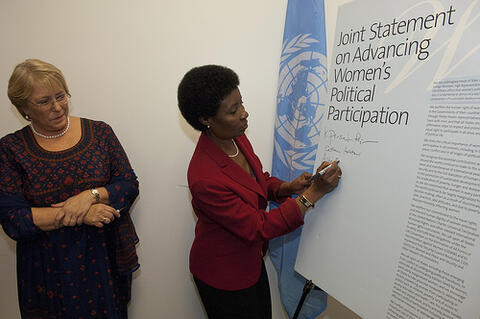
At the 66th session of the United Nations (UN) General Assembly in September 2011 in New York, United States, women political leaders from countries around the world made a strong call for increasing women's political participation and decision-making, globally. Stressing that women’s participation is essential in all contexts - during peace, through conflict and post-conflict, and during political transitions - the leaders signed on to a joint statement, as a call to action, with concrete recommendations on ways to advance women's political participation.
This advocacy initiative drew on an in-person breakout session at an international event in order to bring high-level women together to advance a common voice in support of including women in democracy and governance. Participants included: H.E. Dilma Rousseff, President of Brazil; The Honourable Kamla Persad-Bissessar, Prime Minister of the Republic of Trinidad and Tobago; H.E. Hillary Rodham Clinton, Secretary of State of the United States of America; Rt. Hon. Baroness Catherine Ashton, High Representative of the European Union for Foreign Affairs and Security Policy and Vice-President of the European Commission; H.E. Roza Otunbayeva, President of the Kyrgyz Republic; Lilia Labidi, Minister of Women's Affairs, Republic of Tunisia; Helen Clark, Under-Secretary-General and Administrator, UN Development Programme; and Michelle Bachelet, Under-Secretary-General and Executive Director, UN Entity for Gender Equality and the Empowerment of Women. (To read these women's speeches and to watch a video from the event, click here.)
Participants at the event signed a Joint Statement On Advancing Women’s Political Participation. It reads, in part: "We, the undersigned Heads of State and Government, Foreign Ministers, High Representatives, and senior UN officials affirm that women's political participation is fundamental to democracy and essential to the achievement of sustainable development and peace....We call upon all States, including those emerging from conflict or undergoing political transitions, to eliminate all discriminatory barriers faced by women, particularly marginalized women, and we encourage all States to take proactive measures to address the factors preventing women from participating in politics, such as violence, poverty, lack of access to quality education and health care, the double burden of paid and unpaid work, and to actively promote women's political participation, including through affirmative measures, as appropriate."
Women, Rights, Democracy and Governance.
Join the discussion with the Twitter hashtag #WomenLeaders
"World Leaders Draw Attention to Central Role of Women’s Political Participation in Democracy", UN Women Press Release, September 19 2011; and UN Women website, accessed February 21 2012.
- Log in to post comments