










































Where Are the Women? The Conspicuous Absence of Women in COVID-19 Response Teams and Plans, and Why We Need Them
CARE
"The solution, and the challenge, is not to simply add women to existing structures, but to transform those structures to allow for women’s meaningful participation."
As the media, civil society, and the international community have recognised, the COVID-19 crisis is disproportionately affecting women and girls. According to CARE, this fact makes it all the more important that their voices are equally included in the decision-making spaces and processes where responses are formed. CARE conducted research aimed at examining how gendered national COVID-19 responses have been and whether, during early stages of the COVID-19 response and recovery, it is possible to draw correlations between more gender-balanced national leadership and more gender-equitable COVID-19 responses.
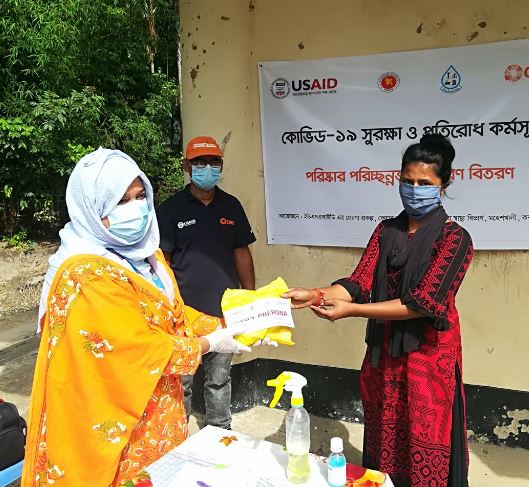
CARE believes that women's participation makes humanitarian responses more effective and inclusive. Women responders can often:
- recognise the need to incorporate the unique concerns of women and girls, such as gender-based violence (GBV) prevention and response programmes or sexual and reproductive health (SRH) services;
- gain access to marginalised populations;
- engage and build trust with different groups, and use social capital and networks to reach other women;
- provide safe spaces that raise women's voices and support women's leadership; and
- consider a crisis' longer-term implications for gender equality and potentially help make interventions more gender-transformative and sustainable.
Despite evidence suggesting the value of women's contributions, they are often not valued, recognised, or supported by the humanitarian system. Women humanitarian responders report that the work they do is not taken as seriously and that their voices are not as well respected as those of men. And women face the same barriers to their participation in the humanitarian system they do in society, writ-large, such as a lack of consideration of the caring responsibilities that still largely fall to women and that can impede their civic participation.
To assess where the women are in the COVID-19 response, CARE conducted a rapid analysis of 30 countries from the Global South and Global North. CARE reviewed publicly available materials from governments, international and national organisations, and media articles, and in some cases drew on information from in-country contacts, to glean details on the gender makeup of COVID-19 response teams and how gender-inclusive each country's response has been thus far. In brief, CARE found that:
- The majority of national-level committees established to respond to COVID-19 do not have equal female-male representation. Of the countries surveyed who had established such committees, 74% had fewer than one-third female membership, and only one committee was fully equal. On average, women made up 24% of the committees - but they make up 70% of the global health and social care workforce.
- In 7 countries, CARE could not find evidence that the government had made funding or policy commitments for GBV, SRH services, or women-specific economic assistance.
- 54% of countries appear to have taken no action on GBV, and 33% do not appear to have addressed SRH in their response, despite clear evidence of the impact of the crisis on these issues.
- 76% of the countries surveyed have made at least one policy commitment that supports women, but one policy is not enough, says CARE.
- Countries that have more women in leadership, as measured by the Council on Foreign Relations' Women's Power Index (WPI), are more likely to deliver COVID-19 responses that consider the effects of the crisis on women and girls. On average, the higher the country's score on the index, the more likely it was to craft a gendered response.
- Governments with lower levels of women's leadership are at risk of creating COVID-19 response plans that do not consider the disproportionate impact of the pandemic on women and girls, and of failing to implement policies that support them.
- Local women's rights and women-led organisations and leaders are not being included in decision making around the humanitarian response, or receiving their fair share of funding.
The analysis shows that further research is needed to understand the different ways in which women's leadership interacts with the crisis, including the factors that enable or constrain governments from implementing more gendered responses and how to track and measure whether women can meaningfully participate in the crisis response. Also, longer-term research is needed to understand how and why women leaders may have been able to make a difference.
Subsequent sections of the report discuss, based on CARE's experience of working to strengthen women's voice and leadership, what is already being done - for example, in Jordan, Women's Leadership Councils composed mostly of refugee women have been spreading awareness in their communities on health precautions and on positive communications to curb psychological stress and domestic violence - and what further actions can be taken now, particularly in regard to the humanitarian community of which CARE is a part. (A text box on page 24 of the report shares CARE's approach to women's voice and leadership, which is guided by 10 principles - e.g., recognise marginalised women as change agents and experts on what is in the best interests of their community.)
CARE calls on governments and international donors to increase women's leadership at all levels of COVID-19 response structure. In CARE's experience, bolstering women's leadership in emergencies requires targeted funding and approaches to address barriers related to agency and relationships, as well as structural barriers that systematically discriminate against women and girls through inequitable social norms, customs, values and exclusionary practices and/or laws, policies, procedures, and services. To support localised, women-led humanitarian responses, international donors and non-governmental organisations (NGOs) are encouraged to ensure that partnerships are based on equal power sharing, so that local actors, who know the context best, can devise and implement responses that meet their communities' needs. CARE also urges these groups to make available fast, flexible funds to women's rights organisations, women-led organisations, and female first responders.
Specifically, CARE recommends that:
National governments should, for example:
- Apply a gender equality quota to COVID-19-related decision-making bodies and processes and further women's active and meaningful participation in these.
- Work with diverse local women-led and women's rights organisations, movements, and leaders to identify the barriers to women's participation and leadership in decision-making structures, and determine actions to address and dismantle those barriers.
- Create gender-balanced COVID-19 response mechanisms at all levels.
International donors and United Nations (UN) agencies should, for example:
- Actively champion women's leadership in COVID-19 responses in humanitarian settings - e.g., by ensuring that local women's rights and women-led organisations have meaningful representation in relevant COVID-19 response coordination bodies.
- Recognise that women are on the frontlines of health and humanitarian action and support their leadership, and fund them accordingly.
- Work to meet the Grand Bargain commitment to channel 25% of humanitarian funding directly to local and national actors, prioritising women-led and women’s rights organisations, including in the UN COVID-19 Global Humanitarian Response appeal.
International NGOs should, for example:
- Work with diverse women's rights and women-led organisations, movements, and leaders to identify the barriers and possible solutions to their participation and leadership in decision-making structures.
- Support, with collective advocacy and funding, women's groups and civil society leaders and their organisations who are calling for their national governments to implement more gender-equitable, effective responses to COVID-19.
- Increase partnerships with women's rights and women-led organisations, in the spirit of advancing UN Sustainable Development Goal (SDG) 5 on gender equality and women's and girls' empowerment and meeting Grand Bargain and Charter for Change commitments.
Click here to download the Executive Summary in French.
Click here to download the Executive Summary in Portuguese.
Click here to download the Executive Summary in Spanish.
CARE website, July 31 2020. Image credit: ©CARE
- Log in to post comments