










































The State of Press Freedom in Southern Africa 2019-2020
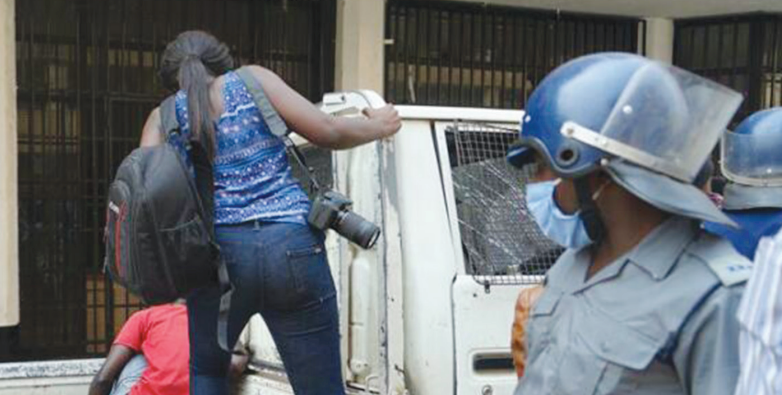
"A free and secure media is needed to support the region in the provision of access to information for socio-economic development, poverty eradication, and regional integration."
This regional report offers an overview of the state of press freedom in Southern Africa, focusing in particular on violations against journalists and media workers, the state of gender in the media, the state of digital rights, and the impact of COVID-19 on the media landscape. Based on research conducted in Angola, Botswana, Eswatini, Lesotho, Malawi, Mozambique, Namibia, Tanzania, Zambia, and Zimbabwe, authors from the region provide comparative overviews from the region and individual summaries of the situation in the ten countries. The report was published by Media Institute for Southern Africa (MISA) with support from the United Nations Educational, Scientific and Cultural Organization (UNESCO), the Swedish Embassy in Zimbabwe, Fojo Media Institute, and International Media Support (IMS).
As explained in the report, "Vibrant and critical media is the hallmark of any democratic society. To achieve its fundamental watchdog role of holding those in power accountable, providing reliable information to the public and facilitating debate among citizens on issues of public importance, including democratic processes, the state must uphold and guarantee freedom of expression and access to information rights which enable journalists to do their work. However, the landscape and operational environment for the media in Southern Africa has been characterised by upheavals, accentuated by the Covid-19 pandemic and the advent of the digital age, which have threatened the viability and sustainability of the media. Many of the countries still possess obsolete legal and policy frameworks that unnecessarily hinder the work of journalists and media practitioners, despite having constitutional guarantees on freedom of expression, media freedom and access to information. This has further been punctuated by physical and verbal attacks, harassment and assault of journalists and in some cases raiding of media houses."
The report makes the point that access to information is a fundamental right in Africa as in other parts of the world and is supported by the Declaration of Principles of Freedom of Expression and Access to Information in Africa, which was adopted in November 2019 by the African Commission on Human and Peoples' Rights (the African Commission). However, "the safety of journalists and media workers continues to be a huge challenge with increasing reports of attacks such as arbitrary arrest and detention, jailing, physical assault, crippling fines, use of or introduction of laws that are inimical to freedom of expression and even killings, which are used as weapons to silence critical journalism in many countries around the world."
The report is divided into the following sections:
Section 1: Overview and Assessment - This chapter assesses to what extent countries are adhering to the principles of the Declaration of Principles of Freedom of Expression and Access to Information in Africa, which establishes standards under which the rights to freedom of expression and access to information, both online and offline, should be upheld. It covers the legal and political landscape, attacks on journalists and the media, access to information, COVID-19, gender, and censorship and internet shutdowns.
Section 2: Digital Rights in Southern Africa - This section elaborates on several factors that are influencing the exercise of digital rights in Southern Africa, covering: legislative provisions; internet access and affordability; threats to digital rights such as internet shutdowns, surveillance, and censorship; disinformation and propaganda; digital literacy; online gender-based violence; and digital rights during COVID-19.
Section 3: Gender in the Media: Female Journalists and Women in Media - This chapter discusses the state of gender and media in the Southern Africa press as it pertains to the following two dimensions:
- The balanced representation of gender in media houses as professionals, which is related to the proportion of men and women employed in the media, the type of assignments they are given, the role women have in decision making, and opportunities given to men and women professionals.
- The politics of gender representation in media contents, which relates to portrayal of women and men, their reported role as active participants or passive observers, low- or high-profile sources, their attribution as offenders or survivors, and their representation in the news and current affairs or in the other ("soft") news. Attention is also given to how COVID-19 has impacted on gender in and through the media.
Section 4: Country Reports - In this section, authors from each of the ten countries offer a summary of the state of media freedom, covering topics such as media ownership, media freedoms, gender, online freedom, censorship, access to information, persecution of journalists, media reforms, community media, media sustainability, and the impact of the pandemic.
Section 5: Media Freedom Violations - This section features a table that outlines details of the media freedom violations in each country in 2019 and 2020, including threats, banning, arrest, arson, closure, and seizure of equipment.
84
MISA website on January 26 2022. Image credit: Idah Mhetu
- Log in to post comments