










































Knowledge and Perceptions of Polio and Polio Immunization in Polio High-Risk Areas of Pakistan
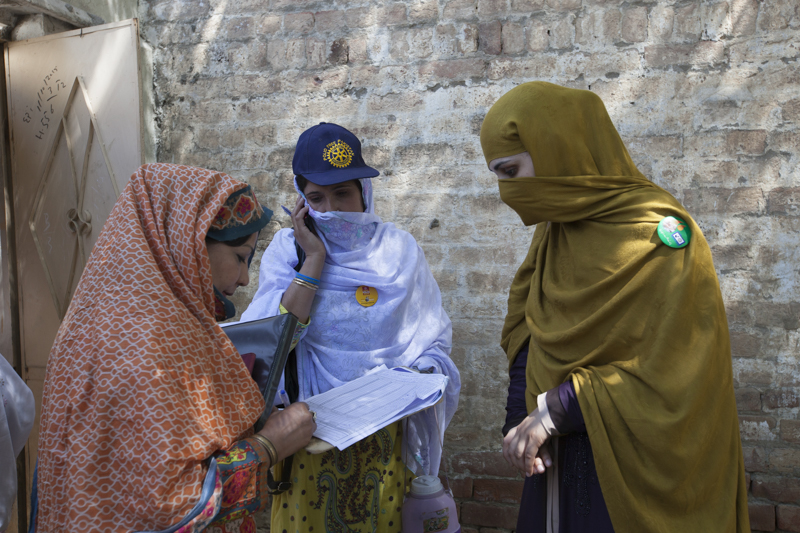
Aga Khan University (Habib, Soofi, Ali, Hussain, Tabassum, Suhag, Ahmed, BhuttaAnwar)
"The Polio Eradication initiative faces many challenges that demand responsive and socially acceptable communication interventions in Pakistan."
This mixed methods study was conducted in high-risk areas of Pakistan to identify knowledge, attitudes, and practices (KAP) about polio vaccine and its eradication, and to estimate coverage of routine immunisation and oral polio vaccine (OPV). It covers the main reservoirs of poliovirus in areas that are difficult for polio teams to reach and where people contend with intractable conflict between the Pakistan army and religious militant groups. The hope is that the findings of this study can help inform strategies - including communication-centred ones - for programme direction and implementation.
Pakistan remains the last reservoir of endemic poliovirus transmission in the world and is a threat to achieving global polio eradication. Polio has been circulating in the Pakistani regions of Karachi, Northern Sindh, Quetta, and Federally Administrative Tribal Areas (FATA). Misconceptions about the OPV - e.g., that polio immunisation is a covert family planning strategy - as circulated by leaders of religious and extremist groups and organisations in Pakistan are a central reason for immunisation refusals. Violence against (even killings of polio workers) has also emerged as a huge challenge that threatens the polio eradication initiative in Pakistan. Security concerns and rumours about immunisation meant that for 3 years (2012-2014), no polio campaign operated in some parts of FATA.
Given these misconceptions and barriers to extending vaccine coverage, between May 2012 and September 2012, the research team collected quantitative data at the household level and qualitative data in focus group discussions (FGDs) and in-depth interviews (IDIs). Working in polio high-risk areas of Pakistan, the researchers surveyed 10,685 households in high-risk union councils of Karachi, 2,522 in Pishin district in Balochistan, and 2,005 in Bajaur in FATA. The survey team (hired locally and extensively trained) conducted all the interviews in native languages with prior permission of respondents.
The team learned that some knowledge of polio is universal: 97% of respondents in Pishin, 95% in Bajaur, and 94% in Karachi had heard about polio. Although health providers, including doctors, lady health workers (LHWs), and vaccinators, are meant to be the primary sources for imparting accurate information about polio and its immunisation, survey respondents reported having learned this information about polio from television and the radio: TV for the majority in Pishin (45%) and in Karachi (87%) and radio for the majority in Bajaur (77%). FGD participants and IDI influencers and decision makers revealed that the main reliable and preferred sources of information for general and child health care included healthcare providers, 'Ulama' (religious leaders and scholars), schoolteachers, radio, doctors, mosque announcements, and awareness camps. When polio programme staff conducing FGDs asked respondents, they identified religious leaders as the main sources of information on health matters for community members. Information sources typical elsewhere were not available in some hard-to-reach tribal areas.
This study also looked at knowledge about different causes of polio disease. The majority of the respondents in Pishin stated that it occurs because of Allah's will (38%), and the most common causes described by Bajaur residents included drinking dirty water (49%), eating dirty food (40%), and contaminated air (36%). Unexpectedly, 48% of people in Karachi did not know the causes of polio, even though their literacy rate was highest of the 3 study sites. During FGDs, community participants identified poor communication and mobilisation strategies, poor performance of polio staff, family planning misperception, lack of awareness, and carelessness of government, society, and parents as the main reasons for continued virus circulation in the area.
Survey results showed that between 78% and 92% of the respondents considered polio to be a health problem. FGDs added perspective: Even where the majority of respondents considered polio a serious disease, few community respondents in FDGs considered it to be serious - based on misconceptions. The data on preventive measures showed that about 48% of respondents in Pishin, 77% in Bajaur, and 99% in Karachi recognised immunisation as the main preventive method.
When asked about safety of OPV, the highest proportion (72%) of participants living in Karachi considered polio vaccine to be completely safe in comparison to 50% in Pishin and 62% in Bajaur. On the issue of refusal of OPV, refusal was highest (20%) in Pishin, followed by Bajaur (17%), and Karachi (5%). Most reasons cited for refusal were based on the misconception that polio vaccination was associated with sterility (Pishin 48.6%, Bajaur 66.7%, and Karachi 36.2%). This misconception about sterility was compounded by other misconceptions, including: the vaccine is not 'halal' or impermissible under Islamic law (highest in Bajaur, 25%), vaccine is not safe (highest in Karachi, 19%), and vaccine contradicted religious beliefs (highest in Bajaur, 16%).
FGDs and IDIs revealed that misconceptions about the relationship of OPV to sterility, vaccine content, and concerns about "community fatigue" (a response to repeated OPV campaigns) together play a role in making polio eradication efforts unpopular. Other factors detracting from community compliance with immunisation programmes include lack of trust of implementing agencies, lack of awareness of the importance of vaccination, and community perceptions that vaccines are not effective.
Results also indicate that 15% of the children in Pishin, 18% in Bajaur, and 7% in Karachi did not receive OPV during the last National Immunization Day (NID). In Pishin, 37% of households refused to vaccinate their children. The most frequent reason given in Bajaur, where 38% children were not vaccinated with OPV, was the unavailability of child at home during polio vaccinator visit. In Karachi, 29% children did not receive OPV due to absence of polio vaccination teams from their duty. These lapses may be explained by the security threats to polio workers and broader, ongoing conflicts.
Results showed that 92.1% of children in Pishin, 94.7% in Bajaur, and 96% of the children in Karachi were immunised against polio. The most doses of OPV were given at birth, with the highest rate in Karachi (79.5%). Survey data on routine immunisation status of children showed that retention of immunisation cards was very low in all study areas. Reasons for low retention include low literacy rates and respondents' lack of awareness of the importance of keeping the immunisation card. Coverage was low as well: 25.6% of the children in Pishin, 35.1% in Bajaur, and 20% in Karachi were reported unimmunised.
In this study, 46.8% of mothers in Karachi reported that they have the autonomy to make the decision about whether their child will be immunised; in Pishin and Bajaur, this proportion drops to 11.1 and 20.2%, respectively. Otherwise, men make this decision.
Reflecting on the study, the researchers suggest: "These findings clearly support recommendations that for polio eradication, different modes of information, education, and communication strategies must be adopted: an approach that is good for an urban area like Karachi might not work in patriarchal societies of FATA. Thus, we recommend focusing communication strategies based on local needs and customized to take into account regional and religious cultural concerns of each area....To accelerate polio eradication we must:
- keep in view the factors interfering with immunization;
- develop effective advocacy based on knowledge of local characteristics; and
- promote behavior change and communication strategies initiatives."
Journal of Public Health Policy 38(1). DOI: 10.1057/s41271-016-0056-6. Image credit: Courtesy Rotary International/Khaula Jamil
- Log in to post comments