










































Experiences in Conducting Participatory Communication Research for HIV Prevention Globally: Translating Critical Dialog into Action through Action Media
Independent Consultant (Parker); FHI-360 (Becker-Benton)
"Communication to address public health concerns is typically developed through expert-led didactic approaches that, at best, engage audiences at the end of the development cycle through pretesting of communication concepts. Action Media provides an alternative approach that can be utilized to inform communication by integrating community perspectives at the outset....The approach is directly linked to enabling ownership, critical thinking, and mobilization of knowledge for change."
This paper explores a communication-focused participatory action research methodology - Action Media - that has been applied to HIV and other aspects of health communication in diverse settings and with a range of audiences over the past two decades. As a contribution toward addressing what the authors perceive as a dearth of information on systematic methodologies for developing communication and their application and outcomes in real-world contexts, they here outline their experiences in the development, implementation, and refinement of Action Media in Africa, the Caribbean, and Asia.
The introduction to the paper explores tensions in the development of health communication: There are approaches that focus on technical efficiencies of delivering messages conceived by health experts directed to influence individual behaviour change, which are different from but also coexist with approaches that locate health communication within socio-ecological frameworks. Conceptual frameworks for the latter include social and behaviour change communication (SBCC) approaches, which consider the links between interpersonal factors and contextual dynamics, and communication for social change (CFSC) approaches, which draw on participatory dialog and empowerment models that trace back to the work of Paolo Freire in the 1960s. There other tensions, too. For example, among communication theorists, there has been concern about the emphasis placed on rational health models, which tend to be based on biomedical models, in contrast to Afrocentric frameworks that acknowledge that the meaning of health is shaped by diverse cultural factors. Concerns have also been raised about the tensions between Western emphases on individual empowerment, which coincide with a focus on media campaigns, and Afrocentric emphases on collective empowerment with a focus on dialog, group communication, and social networks. While health communication approaches oriented toward biomedical logics are premised on obtaining understanding of scientific concepts to support health, participatory approaches focus on audience perspectives in the first instance and might involve, for example, community members documenting their narratives through visual and audio-visual technologies, utilising images and vignettes and contributing stories to engage with health and social issues within their immediate contexts.
In this context, the motivation behind the Action Media methodology is this: Developing communication to support health and well-being of vulnerable communities requires a multifaceted understanding of local perspectives of contextual challenges and potentials for change. Action Media is derived from principles of action research - a process involving "collaborative ways of conducting social research that systematically satisfies rigorous scientific requirements and promotes democratic and social change" (Greenwood D, Levin M., 2007). The methodology involves engaging with audience representatives to understand health vulnerabilities and risks, determining health and development priorities, exploring language and esthetic interests, identifying media and communication preferences, and codeveloping communication concepts that are meaningful, relevant, and appropriate to the live experiences of participants. Findings are then applied to communication strategy, refining communication products and approaches, and communicating at scale. In practical terms, the approach employs a sequence of interactive sessions involving communicator researchers and participants from one or more communities that face social or health challenges. Sessions focus on understanding audiences through their engagement with these challenges and leading to shaping of relevant communication concepts that can be linked to mobilisation for change.
As the authors explain, the research enquiry that led to the development of Action Media took place in the 1990s in the context of a South African academic study, whereby HIV-vulnerable youth living in communities in Johannesburg and Soweto were engaged to determine the extent youth could be involved in crafting HIV communication concepts. A particular emphasis was to explore how the power dynamics between a communication researcher and research participants could be negotiated, taking into account divergences in language, literacy, and social context. (For example, in Action Media, while questions are posed by researcher-facilitators, participants have the opportunity to pose and address questions of their own. Participant empowerment is also aided by an emphasis on informal enquiry, including opportunities for warmth and laughter derived through reflective dialogs, as well as utilisation of energizers, games, and role-plays.) The interactive sessions led to poster concepts that were closely related to participants' environments. For example, among the concepts developed was an image depicting a condom in colors of the national flag, which had recently been adopted as part of the political transition in 1994, with the slogan "Viva condoms". From the perspectives of participants, this concept was linked to protecting one's country and showing that the new democracy was committed to the health of all citizens. In the period through to the present, Action Media has been applied with diverse audiences globally, including people who inject drugs, men who have sex with men (MSM), sex workers, persons living with HIV, persons of low literacy, persons affected by gender-based violence, and various youth and adult groups. Engagements have taken place in countries in sub-Saharan Africa, the Caribbean, and China to address health-related vulnerabilities such as HIV, Malaria, reproductive health, water sanitation, and hygiene.
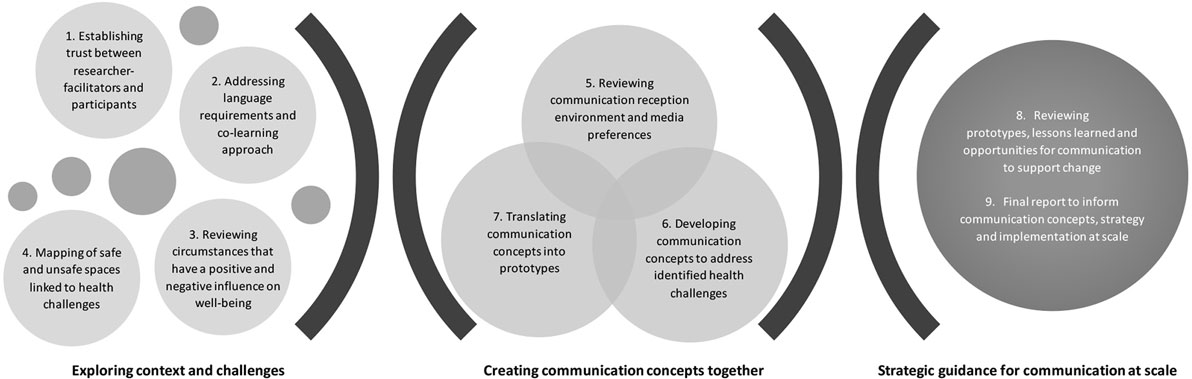
In summary, processes include (1) introductory exercises to acquaint participants and facilitator-researchers with each other and to foster trust; (2) sharing proposed formats of interaction and co-learning, languages of preference and translation, and addressing ethical concerns including freedom of expression, mutual respect, and confidentiality; (3) review of the context and circumstances of participants lives, including aspects that have a positive and negative influence on well-being; (4) a community-mapping exercise exploring safe and unsafe spaces related to health; (5) review of the communication reception environment and media preferences, including folk media; (6) engaging with slogans, proverbs, phrases, songs, and other communication concepts relevant to addressing health challenges; (7) translation of communication concepts into prototypes; (8) reviewing prototypes, lessons learned, and opportunities for communication to support change; (9) compiling a final report to inform communication concepts, strategy, and implementation at scale.
While the outcomes of Action Media have generated diverse learnings, the authors share, in a detailed section of the report, selected findings from work in the field drawn from published and unpublished research reports documenting Action Media processes. This research has largely been initiated by international and national non-governmental organisations to explore predetermined health concerns with specified subpopulations, contributing to the design of communication concepts, campaigns, and programmes, in study countries and beyond. Throughout these implementations, Action Media has revealed links between focal health concerns and other vulnerabilities that were not apparent through mainstream research. This includes determining priorities, identifying barriers and facilitators for change, understanding processes of mobilising knowledge in relation to context, determining appropriate communication approaches, and integrating indigenous language and cultural perspectives into communication concepts. A particular contribution of the approach is establishing processes that allow for the research to be conducted cross-culturally and in diverse linguistic contexts - for example, through language translation during large group discussions, with discussion in small groups being entirely conducted in the formal or informal language of choice of participants without the presence of a researcher-facilitator. Emerging communication strategies include support to systematic action and long-term mobilisation. Notwithstanding the focused engagement with small group representative of health-vulnerable subpopulations, Action Media findings have informed large-scale communication interventions.
In the section of the paper titled "Exemplars", the authors state that the finding (discussed earlier in the paper) that people who inject drugs were oriented toward altruistic communication to address drug overdose among friends and peers, as well as supporting cessation of drug taking and drug rehabilitation, highlights the value of Action Media in fostering critical thinking toward problem-solving that includes addressing prosocial concerns. This contrasts with individual-focused persuasive approaches directed towards injecting drug users that address HIV only within a biomedical framework. Furthermore, Action Media with marginalised MSM and sex workers in The Caribbean exposed power relations that impeded capacities to address HIV vulnerabilities and risks. The Jamaican sex workers' slogan "Mi smart, mi sexy" additionally contributes to a sense of unifying pride and validation through attachment to concepts of being clever and sensible, while also being sexually desirable. As a form of qualitative research, Action Media teases out underlying concerns and challenges through critical reflection, thereby working against assumptions that HIV-vulnerable subpopulations have an affinity for risk-taking. For example, health communication directed toward fisher folk in Uganda has tended to involve unproductive stereotypes, such as portraying fisher folk as being reckless risk-takers. Action Media illustrated how values that were conventionally attached to masculinity of fisher folk were critiqued through concepts validating cowardice over courage by using the slogan "cowards live longer". To address violence against women in South Africa, Action Media was conducted in two settings; emerging creative concepts led to the development of a multicolor logo depicting intertwined arms and hands, with the slogan "Prevention in Action". With respect to community mobilisation through this programme, while communication products such as T-shirts, bags, buttons, and stickers did not convey detailed information in and of themselves, they substantially supported a deeper understanding of response that was regularly enacted. For example, the sticker bearing the Prevention in Action logo and text reading "violence free home" communicates simple information in the first instance but is transformed into a complex system of meaning when it is attached to the door of a private residence. This includes meaning for the residents themselves, as well as visitors and observers.
These examples illustrate the importance of developing communication products and resources that allow for meaning to be developed and shaped over time and in relation to context. This process contrasts with health communication that seeks to achieve common comprehension and preferred fixed meaning through communication activities and products within campaign-defined timeframes. The authors conclude that Action Media provides a systematic and replicable approach to inform the development and implementation of health communication programmes.
Frontiers in Public Health June 2016 | Volume 4 | Article 128. http://dx.doi.org/10.3389/fpubh.2016.00128
- Log in to post comments