










































Communication for Transformation: Action Media - Global Experiences and Practice
FHI360
The action media methodology, developed in the 1990s to inform HIV communication between youth in South Africa, has since been reiterated and applied to many countries, diverse audiences, and a range of issues. The approach focuses on how audience representatives engage with health issues both as individuals and within small collectives and how these insights can be utilised to mobilise change. (Editor's note: For more on this methodology, see Related Summaries below.)
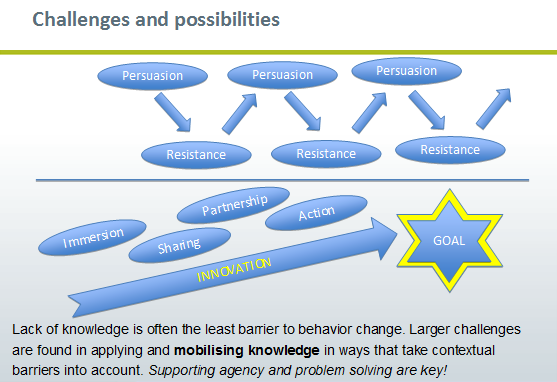
As Becker-Benton and Parker explain, action media arose out of a concern about "top down" messaging and assumptions made by communicators about health contexts. Initiated as an academic inquiry into whether audiences could be closely drawn into the communication development process, it explores how to share understanding, deepen knowledge, link meaning to culture and context, and integrate audience perspectives and creativity. It is distinct from vertical approaches that are "expert"- driven and that typically reflect a rationalist and scientific world view. The top-down nature disconnects from the "target" audience, which is the emphasis. Reach and reception are the foci rather than meaning as a process. This approach overlooks cultural perspectives and situational constraints, underestimates indigenous solutions and cultural logic, and is didactic, authoritative, and simplistic.
Action media is a communication-focused qualitative research approach, guided by research principles and ethics (including a research protocol). Fifteen participants engaged over a period of 3 days (5 three-hour sessions in total). They took part in a stepwise participatory action research process that is collaborative and that emphasises dialogue and critical thinking in a trusting, relaxed atmosphere. The process integrates communication specialists, researchers, and artists and takes language and culture into account.
Becker-Benton and Parker provide several examples of the use of action media around the world. For example,
- A study of injecting drug users in China that used this methodology showed that drug use was initiated "out of curiosity" or to "show off". It is a means to escape unhappiness, and users have a pessimistic/fatalistic/cynical world view (as revealed in their use of slang terms, for instance). Discrimination, incarceration, overdose, HIV transmission, and death are concerns, yet there is also a focus on resuscitation and helping others overcome addiction. Thus, materials (e.g., posters) were developed to communicate that people who help others also help themselves.
- Mapping of stigma, discrimination, sadness, secrecy, and vulnerability to violence on the part of men who have sex with men (MSM) and sex workers (SW) in the Caribbean showed the value of cellphone screen savers, messages, slogans, jingles, and songs that conveyed concepts discretely. Slang terms in slogans connected to the way MSM and SW spoke among themselves; unity was key.
- It was found among fisherfolk in Uganda that fatalism is prevalent; risks to HIV (linked to alcohol consumption) are outweighed by risks of drowning in the lake.
- Among pregnant women and fathers in Burundi, emerging concepts showed an interest in telling stories that followed a sequence, showing resolutions. Proverbs and songs deepen interest and promote concepts.
- An action-media-derived logo and slogan provided an anchor to support taking action whenever violence against women (VAW) was encountered. Actions taken were widely shared to provide examples of how VAW could be addressed, leading to a community-wide mobilisation of "violence free" homes and communities.
- Low-literacy audiences are interested in non-facilitated games and problem solving that integrate local language and proverbs and that have minimal text. A community conversation toolkit is now in use in 8 countries to support critical thinking and prompt community action.
- In Ghana, there is a high level of individual knowledge of sanitation and breast feeding, but a lack of collective commitment and action. Partnership between couples and community members was found to be integral to problem-solving. Proverbs and songs are motivational and share thought-provoking "cultural logics" and examples of action. These findings provided support to an expanded national campaign.
In summary, action media focuses on making meaning and drawing out situations and insights that are hidden from view when using conventional approaches. Anchor concepts allow for prototypes to be developed in a short time frame. It provides robust alternatives to "persuasive" communication and stimulates dialogue to action. Action research with small representative groups produces concepts scalable to national/regional level, and it can be integrated into SBCC approaches by Health Ministries.
Editor's note: This handout from the presentation (Word format) offers an outline of the action media protocol (over a 4-day period) and a description of the planning steps. Strategies are presented, such as: "The idea is to create a fun, relaxed atmosphere with mutual trust established early on. Encourage all participants to speak and participate....Participants work in groups of the same participants each. The small groups are participant led and without (co)facilitator presence. This enables free discussion and use of preferred language. Small group participants continue with the same membership throughout the exercises. This builds trust and team collaboration."
SBCC Summit website, March 3 2016.
- Log in to post comments