










































Eveil (Wake-Up)
The Eveil project is comprised of 3 phases.
- Phase 1: Officially launched by the Ministry of the Control of State and USAID/Guinea Director in July 2008, this first phase focuses on democracy and governance, including: anti-corruption in public services, forest exploitation, law enforcement, education, and participation in local governance.
- Phase 2: a health campaign focusing on maternal and child health.
- Phase 3: an agriculture and wildlife protection campaign.
- Five 5-minute audio infomercials on corruption in public services, education, forest exploitation, parents' involvement in parent-teacher associations, and farmers' involvement in farmers' unions.
- Three 6-minute video infomercials (with 2-minute adapted video spots) on corruption in public services, education, and corruption in forest exploitation. In addition to being broadcast on Guinean national television and radio as well as on private and community radio stations, these infomercials were listened to/viewed in community discussion groups. The radio and TV infomercials were packaged, respectively, in CDs and DVDs - with inserted discussion guides.
- Four posters, printed each at 5,000 copies, were produced on corruption in public services, education, forest exploitation, and corruption by law enforcement. These posters have also been adapted into billboards posted in high-traffic intersections of the capital city, Conakry.
- A series of 4 cue cards, printed each at 10,000 copies, were produced on the roles and responsibilities of parent-teacher associations, COGES, farmers' unions, and civil society in general (with information on how to start a civil society organisation, or CSO).
- A practical guide of the Awaken Guinean - Guide du Guinéen Réveillé - with general information on the roles and responsibilities of Guineans and the Guinean government, how to vote, labour law, etc. Ten thousand copies of the guide were printed for distribution to Guinean households and CSOs through the municipalities.
- Promotional materials were produced, including T-shirts, baseball caps, and key chains with the logo and slogan.
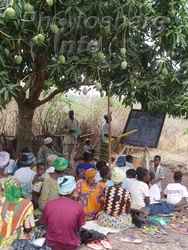
The first phase involves 2 major components, which are designed to reduce corruption and increase citizen participation: the community component and the mass media component. The community component includes theatre and community radio programming with messages addressing: citizens' rights and responsibilities; corruption in public services, schools, and health centres; and forest exploitation, as well as the roles of parent-teacher associations and health centre management committees (COGES). It also addresses health clients' rights, and the roles and responsibilities of parents, students, and teachers.
The mass-media component of the first phase includes the following activities:
Democracy and Governance, Corruption, Natural Resource Management, Education, and Health
According to the organisers, the logo of the communication strategy represents the objectives of the project and shows happy, healthy children coming out of school, on a background showing the Ziama forest, and the map of Guinea. The slogan of the strategy is Une meilleure Guinée pour nos enfants passe par toi et moi - "A better Guinea for our children goes through you and me". The campaign logo has been adopted into an overall project public relations and branding strategy.
Association nigérienne de lutte contre la corruption (ANLC), CCP, USAID, Research Triangle Institute (RTI), World Education International, ManoRiver Women's Peace Network, Centre National d'Appui et de Formation pour le Developpement des Ressources Humaines (CENAFOD), and Government of Guinea.
Email from Amelie Sow-Dia to Soul Beat Africa on January 10 2009 and CCP website, May 14 2010.
- Log in to post comments