










































Development Effectiveness: Pushing the Elephant in the Room Uphill!
In order to improve the effectiveness of our very small contribution to the development struggle I have just reviewed a document called "Busan Partnership for Effective Development Co-Operation". It is the outcome from the work of the 3,500 people who participated in the 4th High Level Forum on AID Effectiveness in late November. The document prescribes their way forward for us all to be much more effective. I sought guidance. There is lots of good advice. (See James Deane blog for his detailed analysis).
The problem is that at the same time as this meeting of 3,500 of the best and brightest in international development was taking place I had managed to sneak some time at home on my daughter's Ipad and checked out the very cool National Geographic Global Maps App. One map in particular popped my eyes right open.
There are two reasons for that rare reaction: first, that the data I saw so brilliantly presented by the National Geographic is something we all intuitively know; and, second, that it is data so many in Development so blindly ignore.
From 1960 to 2009 the average global GDP (Growth Domestic Product) was 113%. The average level of economic growth for all countries in that period was just over double.
The National Geographic map with this data is relative. The greater a country's economic growth level the larger it appears on the map. My own very small country physically, New Zealand, is a heck of a lot bigger in this map. The USA, Western Europe and Japan are massive.
And Africa looks really small.
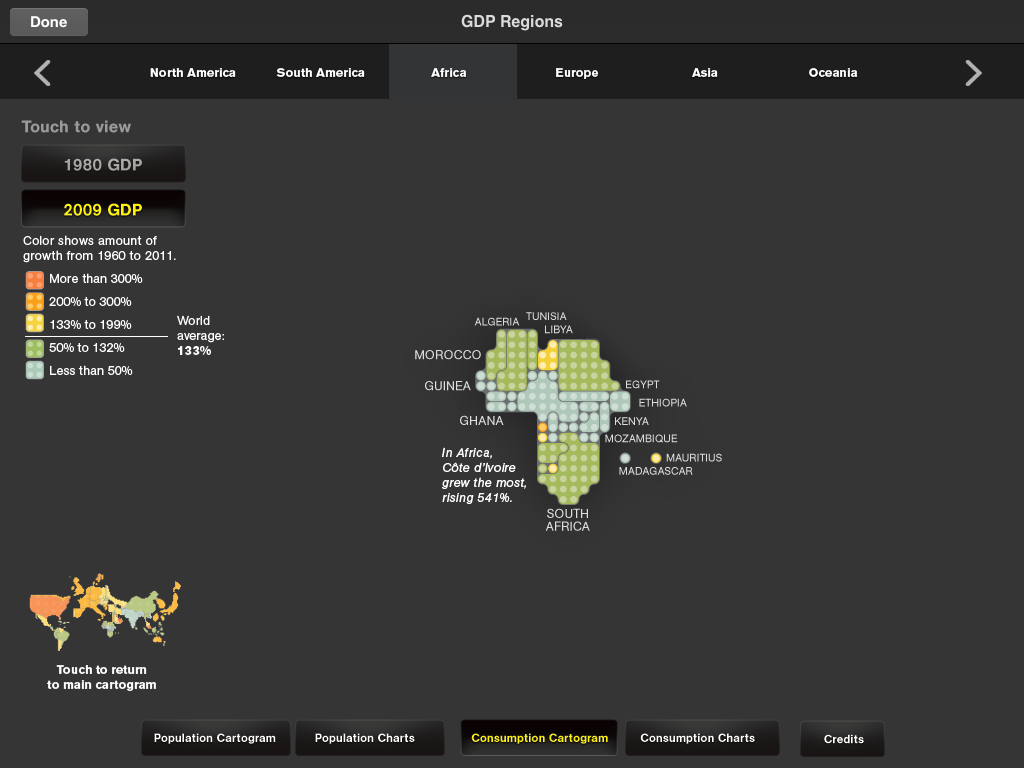
The legend on the left of the map tells the story. With helpful colour coding for each country it is very clear that almost every Africa country was below the global GDP growth average. Many of them are way below - in the less than 50% GDP growth category.
I have reproduced the Africa map below.
From the perspective of AID effectiveness we have just seen the elephant in the room - and we are going to have to push it uphill. The countries whose populations experience the most pressing health, education, gender, poverty, AIDS, environmental, and myriad other development issues have economically grown at the slowest rates. Their collective wealth is slipping behind - badly.
And of course there is no news there! We all know that. It is patently clear that the biggest AID Challenges are in the economically poorest countries. But it is equally clear that the greater the level of internal financial resources available in a country then the more likely that they will experience development success! But we have the opposite condition: the countries with the biggest development challenges are gettng economically poorer, minute by minute, month by month, year by year, compared to the economically wealthier countries.
There is not one jot of reference or attention to this, or anything even remotely similar, in the "Busan Partnership for Effective Development Co-Operation" outline of how AID can be more effective. It is as though AID has been corralled into its own pen. Only within that pen can effectiveness be described and prescribed. The bigger picture - the context for AID related to effectivness - is of no apparent matter.
Why in the Busan deliberations and pronouncements was there such an exclusively inward looking focus on the mechanisms of AID itself? Why was there no contextual, data driven, overview of the setting for AID effectiveness? Not AID funding levels and flows as such (that is internal stuff). But the changing (deteriorating) nature of the development challenge within which AID funds are one part of the dynamic. GDP growth is a vital part of that.
By not asking such questions - and providing some strategic guidance related to them (eg what are key factors behind the growing GDP inequity between countries and what can be done) - we reduce questions of AID effectiveness to manouvering in a room with shrinking space as the elephant(s) take up more and more room. And the floor tilts upward to make the task even more difficult.
- Log in to post comments