










































Pushing the Boundaries: Understanding Women's Participation and Empowerment
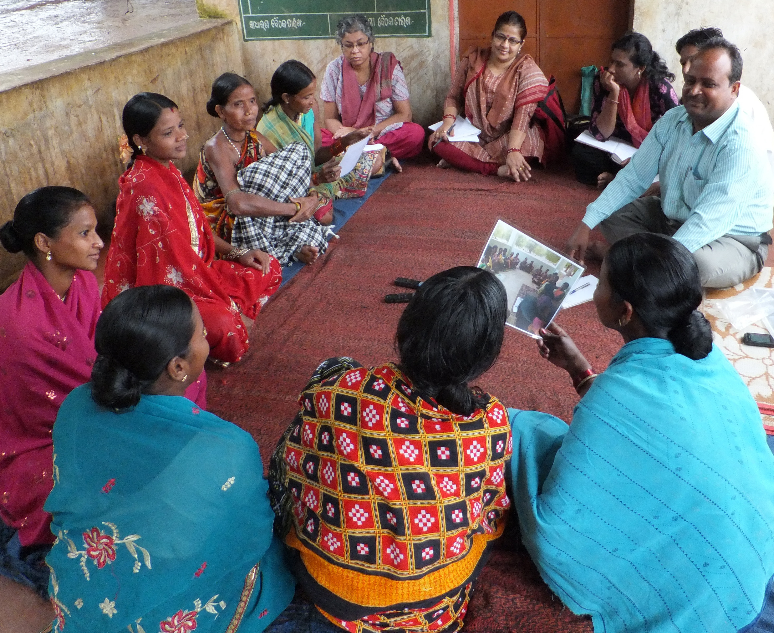
"For women to be able to push the boundaries of power it is essential for them to have the opportunity to participate, to organise and discuss issues affecting their lives, to explore concepts of women's rights and to analyse how power operates in their lives."
Trócaire undertook a 3-year multi-country research project on women's participation and empowerment in Democratic Republic of Congo (DRC), India, and Nicaragua. Empowerment was defined in the research as the process of pushing against the boundaries to shape new fields of possible action by increasing the capacity of those with less power to engage with those with more power. Empowerment is conceived both as a process and as an outcome, serving different purposes: supporting women to engage with existing societal structures and enabling women to challenge the status quo and social norms that prevent their equal participation. The research, which involved implementing governance and gender equality programmes through local partner organisations, set out to better understand how participation contributes to processes of empowerment and the reduction of oppressive power relations between men and women, as well as citizens and the state. This overview describes the research, shares key research findings across the 3 countries, and explores the boundaries for action. It is accompanied by country-specific reports, which may be accessed at the links below.
The gender programmes included in this research study are specifically focused on preventing gender-based violence (GBV) by supporting women's empowerment. The projects address the underlying attitudes and behaviours that perpetuate gender inequality. Working with men, women and community leaders, issues such as male control, the division of labour within the household, violence, and protection of women's human rights are explored as ways to change attitudes and behaviours which perpetuate gender inequality. Training on rights is a fundamental part of all of the projects observed in this research, and one of the two main strategies used by Trócaire in supporting women's participation.
The research focused on what enabled women to participate in informal community decision-making spaces. An analytical framework was developed to guide this research, which defined 3 core concepts: participation, space, and power (see pages 11-13 for conceptual details, and pages 19-20 for more on closed, invited, and claimed/organic "spaces"). A qualitative methodology was designed to facilitate women and the Trócaire partners to identify the issues of greatest interest and concern to them and to describe in their own words their experiences of participating in different spaces. Participatory tools were used by partners with groups of women in 2-4 research sites in each of the 3 countries. The research was carried out between 11 and 14 months in each community to allow the women to develop the confidence to speak honestly and openly. Moreover, the methodology was designed to capture the voices of these participants, through the use of audio clipping, video recordings, and diaries that the participants controlled themselves. According to the report, the process itself generated changes in the women and the way partners understood and worked with the issues. It facilitated Trócaire's thinking about what participation and empowerment mean in different contexts and how to ensure that the work on this is enabling real change, especially in women's ability to influence structures and decisions that shape their lives.
Through listening to women, who are participating within decision-making spaces, analysing their experiences, and the social and political barriers that hinder their participation and examining the enablers that support participation, the research maps out the women's different "empowerment journeys". These are very varied. Some women only take the first step of leaving the house, but this marks an important shift in their lives. For the majority, greater self-esteem enables them to express themselves in different spaces; some even become leaders, recognised by their community for their participation. Many actively lobby their governments for access to basic services like electricity and water, and a few even mobilise other women to start their own journeys. The research finds that participation and empowerment are in a mutually reinforcing relationship: women's participation within different decision making spaces can support women to gain power but also, feeling empowered can lead to women participating in new ways or spaces. Participation in groups, especially women-only groups, can support women to build confidence and skills, helping them to influence decisions within their households and the wider community.
A number of barriers persist despite women's participation and changes in empowerment. These are all underpinned by gender norms, which are contextually specific but across the 3 countries were seen to result in different forms of: male control over women's mobility, resistance to women's participation within public spaces and unequal division of labour between men and women. To be able to change power relations, these underlying gender norms must be addressed alongside support for women to gain confidence and knowledge, as it is these fundamental norms that perpetuate women's marginalisation from public decision making. The nature of the spaces also affect women's participation and the likelihood of their participation supporting their empowerment by limiting or enabling their ability to influence decisions and re-address the power imbalance between both men and women and citizens and the state.
The research explored the context of women's experiences of participation by analysing: who created the space, who makes the decisions, who can participate, and who is excluded. Rigid hierarchies limit the opportunities for women to influence decisions and concentrates power in the hands of a small number of individuals, often men, reinforcing the status quo of male dominance. Programmes can reinforce this by training leaders and expecting a "trickledown effect", which may just further embed the authority of an elite group. Infrequent meetings reduce the opportunity for women's voice to influence decisions by limiting the amount of time with decision makers. Some spaces, generally those created for interaction between citizens and local governments, only call meetings once or twice a year; they are so infrequent that the physical opportunities for participation are drastically limited. A space might provide the opportunity for women to express their needs, and they might even be heard by local authorities or community members, but unless they have the power to influence decisions, their participation is tokenistic, serving the rhetoric of citizen participation without delivering influence of change.
The research reveals that strategies for promoting women's inclusion in decision-making spaces and increasing their control over their lives need to address the underlying gender norms that perpetuate women's ongoing marginalisation. In addition, programmes need a nuanced understanding of the spaces that exist and the power dynamics that affect them, within a context, to avoid supporting participation in disempowering structures. Women's empowerment journeys do not necessarily correspond to the lifecycle of a programme. Supporting empowerment involves challenging individual, social, and cultural norms that are instilled from birth and supported through laws, policies, religious beliefs, and local practices and requires a long-term approach to programming.
Recommendations for promoting women's participation and empowerment gleaned from the overview report (see the individual country reports for specifics) include:
- Precede empowerment programmes with an analysis of the political landscape, social norms, and gender equality/power relations to select spaces that meet women's needs on a personal, legal, and social level. Allow this analysis to inform whether which spaces to work in and what the starting point should be.
- On the basis of the context analysis, design pathways to influence within existing spaces or through new ones. Programmes should tackle the underling gender inequality that facilitates exclusion of women from decision making.
- Challenge spaces/decision-making bodies that are disempowering or avoid engaging with them and de-facto legitimising their position.
- Create and support safe spaces within which women can take the first steps towards empowerment.
- Design programmes that respond to the specific practical (as well as social) needs of all women within the community and ensure that no group is excluded from participating due to practical reasons.
- Support literacy and education for women, as part of a wider approach to strengthening their self-confidence and resilience.
- Acknowledge and celebrate successes in gaining access to services and supports when they occur. This has the power to challenge negative social norms regarding women's role in public life and to further women's empowerment by strengthening their confidence and power within.
- Support collective action that focuses on advocacy and lobbying, mutual support, and peer-to-peer learning.
- Consider providing some material support to women to allow them to attend decision-making fora, either to support them with transport costs or to alleviate the pressure associated with childcare.
- Accept that change is gradual, and empowerment is a long-term process. Tailor targets and indicators to reflect that true empowerment happens continuously and takes many years to fully realise.
- Protect women from the negative consequences of participation: Supporting women to challenge gender norms can put them at risk of violence - psychological as well as physical.
- Engage men and the wider community: Individually, women start to push the boundaries of action within their families and/or communities as a result of their new knowledge, confidence, and experience. However, men must be engaged in this process - in their capacity as individuals and as members of families and communities.
Click here for the 48-page report in English PDF format.
Click here for Repousser Les Limites: Comprendre la participation et l'autonomisation des femmes [French, 56 pages, PDF].
See also these country reports:
Trócaire website, August 16 2016. Image credit: SEARCH
- Log in to post comments