










































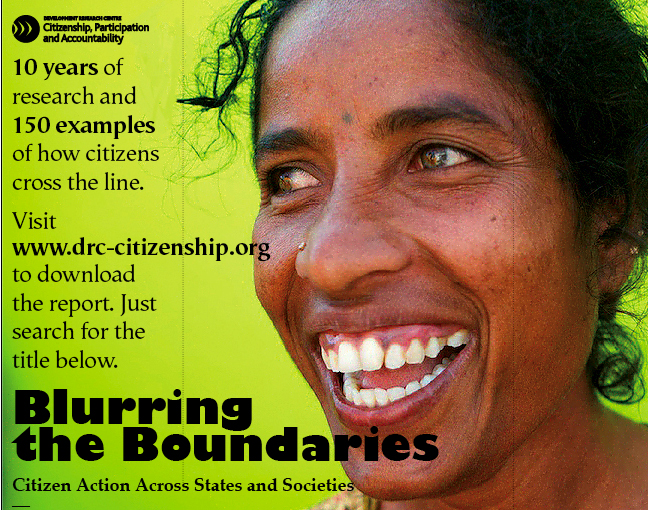
Blurring the Boundaries: Citizen Action Across States and Societies
"A simple yet important discovery was made in the process. The most effective citizens are the most versatile: the ones who can cross boundaries. They move between the local, the national and the global, employ a range of techniques, act as allies and adversaries of the state, and deploy their skills of protest and partnership at key moments and in different institutional entry points."
From the Development Research Centre on Citizenship (Citizenship DRC) of the Institute of Development Studies (IDS), this summary of findings from the decade beginning in 2000 is intended as a synopsis of and reference guide to the Citizenship DRC’s work, including materials on theory, case studies, and policy recommendations. The document also contains a final section with advice on how to take a citizen-led approach to development.
Rather than approach the designing of institutional structures so that markets, elections, legal frameworks, and civil society organisations are working, the Citizenship DRC found that to empower citizens, especially women and minority groups, starting with the perceptions of citizens themselves and asking how they interact with and view the institutions that serve them, an actor-oriented approach, was fundamental."Research of this kind challenges tendencies within international development to assume that an identical conceptual lens can be used to explain phenomena universally....Using a meta case study approach...the researchers coded over 800 instances where citizen engagement was linked, by a series of observable outcomes, to the processes of development, state-building and democracy-building....In general, the research lends further support to a study by the Overseas Development Institute that concluded that donor assumptions and expectations on what participation can offer are too great, or at least that there needs to be more effort to establish a middle ground of attitude and behaviour indicators that are a direct outcome of citizen voice and accountability activities."
Findings include the following:
- Citizenship is learned through action.
- The benefits of citizen action accumulate with time - "People learn how to take legal action, how to organise meetings, how to attract media attention. They build and strengthen alliances and relationships."
- Citizens can be makers and shapers of services - "From this perspective, citizens are treated as consumers who exercise their power by deciding where to spend or invest their money, or by playing a watchdog role to hold service deliverers accountable."
- Sustained and equitable progress depends on citizen capabilities - "Apart from winning a change in the letter of the law, citizen campaigns can also lead to more democratic decision-making procedures..."
- Movements for accountability face their own accountability issues - "[Q]uestions...emerge about who speaks for whom. As civil society organisations and citizens face pressure to mandate a small number of representatives to negotiate on their behalf, the possibility arises that some voices will be silenced."
- Social mobilisation extends and deepens democracy - "When citizens act, they sometimes generate benefits to society that form the preconditions for the proper functioning of democratic institutions....They acquire an awareness of their rights,...political processes and core civil and democratic values, such as tolerance, a belief in dialogue and deliberation, trust, solidarity and reciprocity."
The Citizenship DRC’s research looked at how people begin to engage politically with the state in ways other than, or in addition to, voting and participating in political parties. "These are through:
• local associations and non-governmental organisations (neighbourhood associations, cooperatives, trade unions, religious groups, etc.);
• state-sponsored participatory forums (health councils, forest management committees, area planning councils, etc.);
• self-organised social movements and campaigns."
The document examines citizen participation in states where violence occurs. Strategies to cope with, respond to, or resist the violence and those who perpetrate it include: partial withdrawal or self-censorship; peaceful coexistence with violent actors; and establishing parallel governance or security structures. As stated here, participatory and action research can help to identify local strategies.
The document identifies six factors that have an influence on whether citizen engagement takes on the positive, self-reinforcing dynamic: prior citizen capabilities; institutional and political context; strength of internal champions; location of power and decision making; history and style of engagement; and the nature of the issue.
Following a set of recommendations for a variety of actors on pages 45 and 46, the document concludes with suggestions about looking internally within organisations: "Supporting citizen engagement is not just about what others do. How we engage as citizens in our own institutional settings is vitally important to how effective we are in enabling the engagement of others."
Email from Georgina Powell-Stevens to The Communication Initiative on June 21 2011.
- Log in to post comments