










































New Mixed Methods Approach for Monitoring Community Perceptions of Ebola and Response Efforts in the Democratic Republic of the Congo
Centers for Disease Control and Prevention, or CDC (Earle-Richardson, Walz, Kurnit, Craig, Yee, Soke, Prue); International Federation of the Red Cross and Red Crescent Societies, or IFRC (Erlach, Baggio, Camara, Dios, Voahary)
"Collecting continuous community feedback throughout an emergency response enables response teams to answer questions, consider suggestions, and adapt interventions to better meet community needs and preferences. Local health departments everywhere could employ this approach to enhance community engagement."
As measures such as isolation, contact tracing, and vaccination are introduced in any epidemic situation, communities can play a vital role in ensuring these strategies are implemented appropriately. Despite growing evidence that community engagement strengthens epidemic control, there is often hesitancy to embrace this approach, in part because understanding community needs through community listening must be done in a compressed timeframe and often in challenging field conditions. Those working to contain the spread of Ebola in the eastern Democratic Republic of the Congo (DRC) during the 2018-2020 epidemic faced challenges in gaining community trust and participation. To quickly understand community perspectives and improve community engagement, collaborators from the DRC Red Cross (RC), the International Federation of the Red Cross (IFRC), and the United States Centers for Disease Control and Prevention (CDC) developed a method of collecting, coding, and analysing community feedback. This paper describes the implementation of this method in practice.
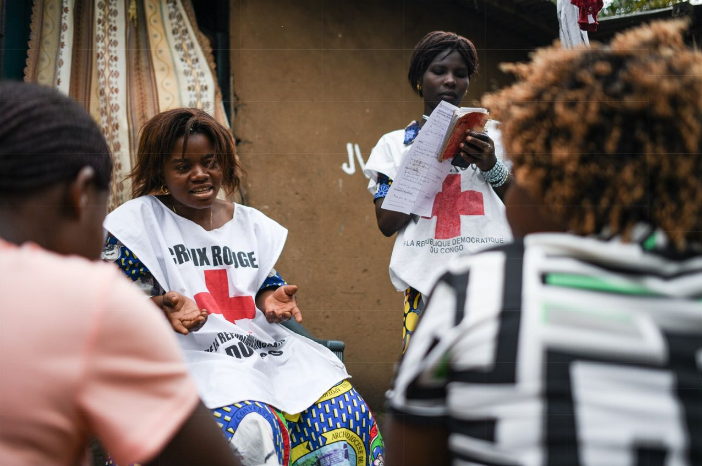
In contrast to widespread mistrust of the national government, the DRC RC had gained the people's confidence by promoting health and assisting with health emergencies and epidemics for many years. As part of the Ebola response, over 800 local Red Cross volunteers in Ebola-affected communities across 29 health zones undertook risk communication and community engagement (RCCE) activities (e.g., community meetings, "phone-in" radio shows, mobile cinema presentations) and made home visits in selected communities. (In addition to consulting community and neighbourhood leaders before approaching homes or initiating public awareness activities, Red Cross team leads were trained to maintain an awareness of the local situation, which could leave them vulnerable to violence.) During these activities, volunteers recorded unstructured, free-text comments from community members about Ebola, such as questions, beliefs, observations, rumours, or suggestions for improving the government-led response to the epidemic. In addition, volunteers organised public presentations followed by informal discussions, and they recorded feedback from these events.
Comments were coded and analysed using a text-coding system developed in August 2018 by the DRC RC, IFRC, and CDC. Coded comments were then aggregated and qualitatively grouped into major themes, and time trends were examined. The coded community feedback was shared with all response partners through three main routes: weekly PowerPoint presentations for the Ebola response leadership at multiple levels (more than 80 such presentations were created by CDC, validated by RC and IFRC, and shared by IFRC during the response); regular dissemination through RC networks and to partners through an interactive dashboard created and regularly updated by IFRC; and lastly through the dissemination of more than 20 "deep dive analyses" of key topics requested by the response. "Deep dive" reports were drafted by CDC and validated by RC/IFRC and distributed through RC/IFRC networks.
During the review period (August 2018 through February 2020), there were 292,232 comments collected from communities experiencing Ebola cases within the previous 30 days. Since some comments were coded with more than 1 text code (e.g., if a comment addressed 2 issues), the total set of coded comments was larger (n=315,820).
Overall, the community feedback pointed to a need for more widespread and frequently updated RCCE about cases, deaths, and survivors, as well as EVD symptoms. Communities reported a lack of information about the outbreak and the response, as well as concerns about the Ebola vaccination programme (e.g., about vaccine safety) and healthcare quality. Some doubted that Ebola was real; others perceived personal profit and political motives behind the Ebola response.
At multiple levels, this community feedback led to relatively rapid changes in practice. Red Cross volunteers began using an "answers to frequently asked questions" document, shared through the DRC RC WhatsApp chat, as a field reference. At the health zone level, Ebola response leaders improved public communications about the state of the epidemic and included in the updates a section on community feedback and answers to common questions. This information was shared both in print and on the radio. The leaders also made a range of modifications to Ebola response strategies to address community concerns, such as involving Ebola survivors and traditional healthcare providers in response activities. Two procedural changes that were followed by drops in negative community responses were: using transparent body bags, which allayed fears that bodies or organs were being stolen, and widening the eligibility criteria for Ebola vaccination, which addressed concerns that selectively vaccinating individuals within Ebola-affected communities was unfair.
Reflecting on the experience, the collaborators note that the Red Cross community feedback collection was unique in that it empowered local volunteers to use the information immediately to address community questions and concerns, it was collected continuously throughout the outbreak, and it provided an opportunity for community members to talk about whatever concerned them, in their own words. They suggest that the system creates a platform for local voices to be heard throughout an emergency response and provides a mechanism for assessing the effects of programme adjustments on community sentiments.
As a result of this work, IFRC has published a Feedback Starter Kit to guide volunteer groups in developing the capacity for social science inquiry and community engagement in emergency response. IFRC and CDC also adapted the Ebola text-coding scheme to capture COVID-19-related feedback, and this framework is being used in several countries.
In conclusion: "Throughout the outbreak, the utility of the Red Cross community feedback and all forms of social science inquiry were increasingly recognized as important to ending the epidemic....Community feedback can provide a tool for those willing to listen and act based on what they hear. This approach could not only result in more effective epidemic responses but also develop local community ownership of public health action and greater resilience in the face of any health threat."
Global Health: Science and Practice June 2021, 9(2):332-43; https://doi.org/10.9745/GHSP-D-21-00144; and email from Giulia Earle-Richardson to The Communication Initiative on August 13 2021. Image credit: © 2021 Corrie Butler/IFRC
- Log in to post comments