










































Development of a Theory-Based HPV Vaccine Promotion Comic Book for East African Adolescents in the US
University of Washington School of Public Health (Celentano); University of Washington (Winer, Ibrahim, Mohamed, Lin, Amsalu, Ko); Sungkyunkwan University (Jang); Somali Health Board (Ali); Fred Hutchinson Cancer Research Center (Taylor, Ko)
"Comic books can be effective on addressing a sensitive topic with a light-hearted approach (compared to traditional print materials)..."
Given their potential to educate and entertain at the same time, graphic novels or comic books have emerged a promising health communication tool to promote behaviour change. For example, parents can use these tools in having potentially sensitive conversations with their children about human papillomavirus (HPV) vaccines, as matters concerning sexual health may be stigmatised in some communities. This paper describes the development a theory-based comic book as part of a multilevel communication intervention for adolescents, mothers, and healthcare providers to promote HPV vaccination among East African adolescents in the United States (US).
Designed to appeal to and be appropriate for 14- to 17-year-olds, the comic book was developed through a multi-step process that began with a review of the literature on perceptions of HPV vaccine and uptake among East African mothers and their adolescent children. The researchers then conducted focus groups with Somali, Ethiopian, and Eritrean mothers (n=30) to understand their socio-cultural beliefs and information needs with regard to the HPV vaccine, and to present to them a mock-up of the comic book for their feedback. Next, from October 2017 to September 2018, mothers and their adolescent children were recruited to participate in ethnolinguistic-centric educational dinners, held in Somali or Amharic, on HPV vaccination. Dinners included both an interactive educational forum intervention for mothers (to promote HPV vaccination in their 11- to 17-year-old children) and the comic book intervention for 14- to 17-year-old adolescent children. This process revealed, for example, that:
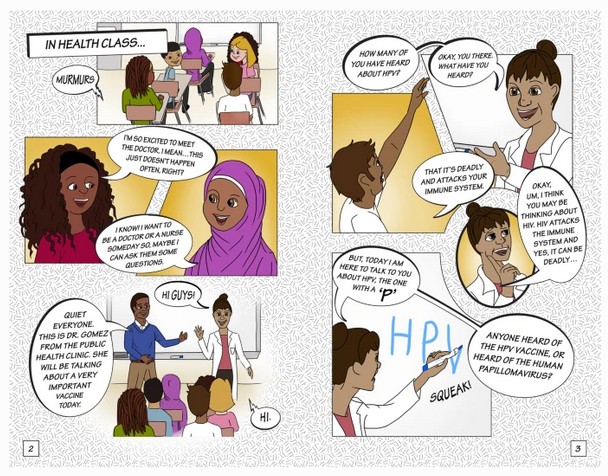
- The mothers stressed that the comic book should include diverse characters, including girls and boys from different races and ethnicities (with characters tailored to Somali, Ethiopian, and Eritrean communities), feature the main character to be from the community, and show families. The adolescents corroborated mothers' suggestions about ethnic representation and the rare experience of receiving a comic book with characters that resembled them.
- The mothers responded positively to the deep connection between the girl and her mother portrayed in the comic and their affective interaction in the storyline. Ethiopian mothers also identified with the humorous twist about the pain message: A friend of the main character compares the pain of getting the HPV vaccine to the "pain" of studying for their next math test. ("Our findings show that pain is a notable children’s concern that needs to be addressed in health education. Pain has been identified as a major barrier for children and adolescent vaccines...")
- Some mothers mentioned that their children had more access to information fro school, peers, healthcare providers, and community centres, as they are more assimilated to western culture. An Eritrean mother explained that these differences in acculturation can create parent-child communication challenges and discussed the importance of having peers educate one another. Mothers agreed that if their children get information from multiple sources, it helps validate what they have heard and enhances message persuasion. They recommended that this sphere of social influence was portrayed in the comic book.
Messages were revised to include the input from the mothers in terms of their preferences for characters and socio-cultural beliefs. For example, the mock-up did not include information on pork gelatin (identified as a barrier for vaccine uptake during the Somali focus group); thus, this detail was added into the final comic book. Another change involved the subjective norm message, which was originally delivered by the main character's mother as "You even told me that many of your friends have had the HPV vaccine shots." After the focus group, the message was revised to be delivered by the main character's peers as, "Oh yeah! I totally got vaccinated in the beginning of the school year. I know Ayan and Fatima also got vaccinated."
To address information needs as expressed by focus group participants, the researchers embedded the messages grounded in behaviour change theories (the Health Belief Model (HBM) and Theory of Reasoned Action, or TRA) - e.g., messages around perceived susceptibility, severity, benefits, and barriers - into the storyline to educate and promote behaviour change. Messages around subjective norms were integrated into the main character's interaction with her social environment. The final content was reviewed by the community partners before moving to production - the process of which is detailed in the paper.
The researchers then assessed the acceptability of the comic book and specifics on comic book structure, character appeal, and message relevance among Somali, Ethiopian, and Eritrean adolescents (n=134). Overall, the comic book appealed positively to most adolescents who commented on this category (82.9%), with a few reporting neutral (7.2%) or negative (9.9%) responses. Comments about the characters were mostly positive; respondents noted the ethnic representation (47.1%) and diversity of the characters (13.7%). Comments around the story and content were all positive, with most of these responses noting the educational value of the story (97.9%), followed by humour appeal (35.4%) and the flow of information among peers (32.3%).
In conclusion: "A rigorous multi-step process that integrates theory and focus group data can help create culturally appropriate health messages that can educate and appeal to the community."
BMC Public Health (2021) 21:1137 https://doi.org/10.1186/s12889-021-11005-2. Image credit: Isabelle Celentano
- Log in to post comments