










































Community Engagement in WASH Emergencies: Understanding Barriers and Enablers Based on Action Research from Bangladesh and the Democratic Republic of Congo (DRC)
Oxfam International
"Engaging communities in humanitarian programming is key to ensuring their participation in decision-making that affects them as outlined by commitment 4 of the Core Humanitarian Standards."
Access to water in sufficient quality and quantity, safe excreta disposal, and positive hygiene practices such as hand washing are considered critical factors for risk reduction and disease prevention. However, the simple provision of hardware facilities does not necessarily ensure that crisis-affected populations will use them effectively. The non-governmental organisation (NGO) Oxfam's WASH (water, sanitation, and hygiene) team is undertaking a paradigm shift toward greater community engagement (CE) in WASH, with a strong focus on measuring community participation. This article presents key findings from Oxfam's responses in Bangladesh and the Democratic Republic of Congo (DRC), describing the process of building trust and identifying barriers and enablers to meaningful CE in emergencies.
Research from the Ebola crisis in West Africa revealed these barriers to the Oxfam WASH team's public health promotion (PHP) work:
- Public health programming often adopts an instructive approach rather than building on the local expertise of affected communities;
- Teams use a variety of methods and communication channels to facilitate behaviour change among diverse communities, but they do not necessarily measure whether this results in meaningful participation;
- Despite global commitments to work in partnership with crisis-affected people and to strengthen accountability mechanisms, there is a perception that community participation is non-essential (a mere add-on); and
- Community interaction does not necessarily factor in existing power dynamics and, as such, there is a tendency to focus on local elites rather than seeking to establish continuous interactions with the vulnerable or less accessible population groups.
Understanding these barriers led Oxfam to revise its current approach to community participation and develop new tools to ensure that CE is at the centre of the Oxfam WASH programme. These tools include an overview of the lessons learnt, a model to facilitate understanding and implementation of CE methods (see Figure 1), and a guidance note outlining the process, including indicators to measure community participation and satisfaction. (For instance, critical parameters for a community's satisfaction for latrine development might include: languages and communication channels used and the extent to which the information reaches all sections of the community using context-specific channels; how specific gendered needs were taken into account in the design and location of the facilities (access, privacy, safety, menstrual hygiene management); and the use of their feedback to make relevant changes in the programme.)
The methodologies used will be organic (contingent on a team's dynamics, capacity, and programmatic priorities) and dependent on context. But, broadly, the strategy links communities to other emergency response stakeholders through coordination and advocacy mechanisms. It seeks to maximise the influence of affected communities over positive outcomes in emergency WASH responses and is a continuous process reflecting the relationship between affected communities and humanitarian response actors.
The pilot projects, conducted in Bangladesh (Rohingya refugee crisis, Cox's Bazar) and the DRC (Ebola outbreak, North Kivu), specifically sought to tackle the barriers outlined above; the ways in which the individual barriers were addressed are summarised in the article.
Next, two detailed case studies are offered of the projects.
In brief, the case study of the water network in Cox's Bazar provides background, details the CE approach used, and describes initial findings and outcomes. To highlight one element of the case study: In ensuring consultation and opportunities for communities to influence the decision-making process on the design, the Oxfam team learned that:
- Most water users prefer small group meetings, limited to the representatives of different water user groups, based on their suggestions. The representatives would have the assigned responsibility of ensuring that the outcomes of these meetings be shared among the user group members.
- The use of pictures/posters ranked as the second-highest preferred communication method. Different groups suggested the printing of "dos and don'ts" in pictures on the tap stands, which they would use on a daily basis. Illiterate women expressed the need for coloured images to facilitate understanding.
- The use of megaphones with pre-recorded messages was another critical communication channel identified, particularly among adolescent girls and elderly women.
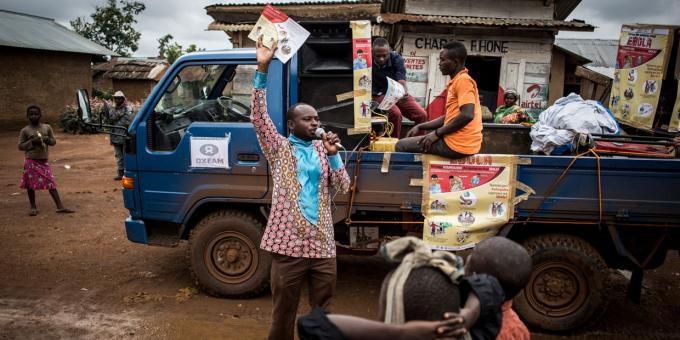
In the case of Oxfam's WASH work in the DRC, the West African Ebola outbreak (2014-2016) had highlighted the need for CE to build trust and confidence in the response system. Thus, in the DRC, a community-based alert system (CBAS) supported by the United Nations Children's Fund (UNICEF) actively sought to strengthen the community's capacity to prevent and reduce Ebola transmission risks, thereby promoting the role of local leaders (chef de quartier, cellule level, street leaders) and networks of community dialoguers. The CE model prioritises an action-oriented approach over conventional message dissemination methods by focusing on the analysis of community-perceived barriers to contain/reduce the epidemic spread, and by promoting corresponding community solutions.
For instance, there was very low acceptance and partial rejection of the vaccination teams due to both a widespread perception of the vaccination being "only for elites" and the perceived discriminatory and disrespectful behaviour of certain vaccination teams. Oxfam shared this feedback with the focal point of UNICEF Communication for Development (C4D). Direct meetings with a representative of the vaccination team were then organised, providing an opportunity to listen to the various concerns and explain the principles and eligibility criteria of the vaccination. These efforts were additionally supported by social science researchers from the World Health Organization (WHO) and UNICEF, advocating for an orientation of the vaccination teams to improve their sensitivity to socio-cultural perceptions and behaviours.
To provide more detail on how the CBAS worked: Each group (leaders and dialoguers) received preliminary training on preventive and treatment methods of Ebola, as well as the basic principles of community dialogue. In addition, community leaders were equipped with phone credit to provide daily updates on alerts (probable Ebola cases). After a few weeks, community dialoguers were also equipped with credit, as they were considered trusted information sources within their community. The Oxfam team held weekly meetings with each group to evaluate the effectiveness of the system, moving toward a more strategic approach as insecurity in the area increased.
During armed attacks in Beni city, Oxfam put people in touch with critical response services provided by other agencies. Reportedly, the continuous feedback loop to communities was crucial to ensure they remained informed, whilst simultaneously fostering trust in Oxfam and acceptance of its response work. In October 2018, a pilot project was introduced to enable teams to better and more systematically capture qualitative information around people's perceptions, questions, concerns, and rumours in Oxfam's working area in Beni, and to use the information in real-time. Figure 13 in the paper outlines the process of introducing and using mobile technology for real-time analysis enhancing programmatic adjustments.
A summary of lessons the Oxfam WASH team learned in its CE work both Bangladesh and the DRC:
- As early as possible during an emergency response, listening mechanisms should be established in order to understand how the crisis is affecting people's lives and determine what the priority needs may be.
- CE takes time and resources, and it requires extensive collaboration and coordination.
- Encouraging and using feedback from diverse population groups, including the most vulnerable and marginalised, on the quality and effectiveness of the response is a central component to CE.
In conclusion, the action research described in this article "was vital to create space for CE in Oxfam's response work in the DRC and Bangladesh, to adjust the strategic focus, and to make programmatic changes based on the community's feedback." The programmatic changes in both countries are outlined. For example, in Bangladesh, documentation of lessons learned from the CE aspects of the water network design will inform the application of CE in other emergency settings (e.g., in future global work with the United Nations High Commissioner for Refugees, or UNHCR) - ultimately leading to WASH responses that are more community-centred than they were in the past. And in the DRC, Oxfam believes that there is new support for their view on CE by WHO - for example, in terms of developing a response-wide CE strategy that is owned by all and mapping key social influencers, barriers, and solutions to address the root causes of community distrust in the Ebola response system at the local level (Katwa/Butembo).
The pilot projects and respective results will be used to inform the design of future strategies at both the country and regional levels. The hope is that "other humanitarian agencies will be influenced to do likewise, thus advancing behavior changes throughout the sector and ultimately contributing to key WASH outcomes by reducing public health risks in emergencies....How the WASH sector takes these recommendations forward will likely depend on various factors, including individual organizational strategies and the capacity of each to strengthen community-centered ways of working....A global roster of social-science experts would be invaluable to this and should be made available to relevant research institutions, as well as local, national, and international NGOs."
Water 2019, 11(4), 862; https://doi.org/10.3390/w11040862. Image caption/credit: Medical workers administer the Ebola vaccine in Mangina, DRC. John Wessels/Oxfam
- Log in to post comments