










































How to Bring Family Engagement and Early Learning into the Digital Age
New America (Guernsey); Joan Ganz Cooney Center at Sesame Workshop (Levine)
"By paying close attention to the ways in which technologies and media may be deployed to promote new connections that advance critical skills and learning pathways - and by ensuring that educators, mentors, tech developers, and parents are prepared to help youngsters navigate a rapidly changing world - ...children can grow into adults who will keep our communities vibrant and flourishing."
From the United States (US)' New America's Education Policy Program and the Joan Ganz Cooney Center at Sesame Workshop, this report guides city and community leaders in taking purposeful steps toward modernising their family engagement and early learning plans. Operating from the conviction that every US community has the potential to transform itself into this kind of ecosystem that supports families and promotes digital inclusion, the report aims to help local leaders and other policymakers examine what is needed and develop integrated approaches to the use of libraries, schools, and multimedia spaces, as well as through home-based internet connectivity services.
Joan Ganz Cooney Center research reveals that:
- At least 34% of children ages 2 to 10 use educational media every day.
- Children and parents frequently learn with, and about, technology together: Among families in which the parent and child both use the Internet, 77% of parents say they have helped their children with using digital technology, and 53% say their children have helped them.
- 33% of low- to moderate-income families do not have high-speed home internet access. Mobile-only access is a form of under-connectedness.
- More than half of parents in a national survey (2014) said they needed more guidance locating quality educational media to support their children's learning.
As reported here, a variety of initiatives are using digital tools such as on-demand video and text messaging to connect with vulnerable families and improve educational outcomes. "But so far, these efforts are sporadic and fragile. Very few are fully sustainable or ready to scale up. Community leaders need a plan." To that end, the report describes four actions to help community leaders build more advanced systems for family engagement and early learning. Within each of the four action steps, information is provided for communities at the very beginning ("Getting a Good Start"), for those who are already testing new approaches ("Making Progress"), and for those who have achieved enough to promote and build on their successes ("Sharing with Others and Scaling Up"). Concrete examples of communities in action are also included throughout in text boxes. The action steps are:
- Take stock of family engagement offerings and online connectivity with an eye toward equity and diversity. This involves collecting and examining data on whether community systems and programmes are working to promote early learning and effective parenting, while also examining the online networks and resources available to those families. For instance, one of the initial steps might entail analysing local information to pinpoint specific neighbourhoods and subgroups that need more attention, such as families who speak a language other than English at home. Having laid out a collective vision for building a Digital-Age early learning ecosystem in the community, make this work visible - for instance, in the local media.
- Develop professional learning programmes that build corps of media mentors. Models are emerging from professional organisations such as the Association of Library Service to Children (part of the American Library Association), which aims to train and support a new cadre of media mentors. Early childhood leaders, such as those affiliated with the National Association for the Education of Young Children, are also spreading the word through books, forums, and professional development institutes. This might involve, for instance, helping early learning centres, libraries, and schools advocate for more funding for staff to participate in media mentorship programmes, especially for those who work in underserved neighbourhoods. Another one of the suggestions: Share materials that prove useful for professional development around media literacy, aiming for the development of open educational resources (OER) and sharing them with the larger educational community by partnering with the national Learning Registry. Local public media stations can also be used as distributors of information and activators of community conversations about skill-building.
- Invest in physical infrastructure that promotes connectivity and meaningful participation. "Community leaders should create platforms and commissions that allow for more intersections between the early learning and education worlds and the worlds of information technology and physical infrastructure planning. The buildout of high-speed networks and wireless access points should be integrally connected to the needs of families and learning environments." One starting idea is for local leaders to showcase how a lack of connectivity may be affecting low-income households or particular neighbourhoods and public housing projects. Among the recommendations in rural areas or in smaller communities is to link up with neighbouring towns to create regional co-ops and other partnerships that can help to share costs.
- Create a continuous cycle of improvement using research and evaluation. Some suggestions: "Avoid a focus on technology itself as the end goal. Goals should be couched in terms of building relationships with and within families and in early learning goals supported by the science on how children learn....Incorporate families' voices and preferences in the tweaking and improvement of programs so parents and caregivers can help to sustain them and build more public will for expansion."
Several pages at the conclusion of the report feature titles and links to resources that are designed to support community leaders in modernising their family engagement and early learning plans. "Over the coming years, New America and the Joan Ganz Cooney Center will continue to support communities by creating additional toolkits, fostering networks, and providing policy and research guidance."
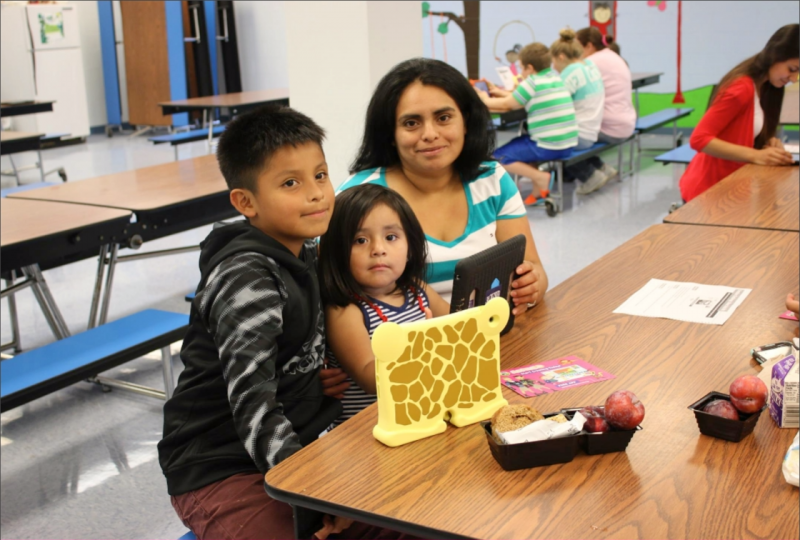
"Family Engagement and Early Learning in a Digital Age", by Lisa Guernsey, April 25 2017. Image credit: Aaron Morris
- Log in to post comments