










































Bangladesh Knowledge Management Initiative (BKMI)
"Making SBCC materials, resources and training available in a digital format is a cost-effective and sustainable way to reach more people with consistent, reliable information." - Rebecca Arnold, Project Director, BKMI
Launched in 2013, the 3-year Bangladesh Knowledge Management Initiative (BKMI) was an effort to strengthen the capacity of the Government of Bangladesh (GoB), United States Agency for International Development (USAID) implementing partners, and other stakeholders to develop strong, consistent, and effective social and behaviour change communication (SBCC) campaigns and interventions to improve the health and well-being of the people of Bangladesh. In addition, BKMI facilitated coordination around SBCC within the Ministry of Health and Family Welfare (MoHFW) and with other stakeholders and supported the multi-sectoral BCC Working Group as a forum for coordination, networking, and learning.
BKMI designed a capacity-building approach at 3 levels: (i) improving the knowledge and skills of individuals who work in the 3 SBCC units of the MoHFW; (ii) developing tools and establishing processes within those units to strengthen organisational capacity; and (iii) working to optimise coordination of SBCC activities and integration of health, nutrition, and family planning (FP) topics at the system level.
One capacity strengthening strategy was to introduce appropriate information and communication technology (ICT) tools for SBCC and knowledge management (KM). Working closely with the MoHFW, BKMI developed an easy-to-use eToolkit, or digital library, and 8 video-based eLearning courses for field workers. These digital resources cover FP, maternal, newborn, and child health (MNCH), and nutrition topics, along with interpersonal communication and counseling (IPCC), and health, population, and nutrition (HPN) integrated messaging. Specifically, BKMI has developed digital archives for Bureau of Health Education (BHE), Information, Education, Motivation (IEM), and Institute of Public Health Nutrition (IPHN) units; eLearning courses for Program Managers (on these topics: Monitoring and Evaluation for SBCC, and Message and Materials Development) and Field Workers (on these topics: Family Planning 1 & 2; Maternal, Neonatal and Child Health 1 & 2; Breastfeeding; Complementary Feeding; Integrated Messaging; and Interpersonal Communication and Counseling); an eToolkit for Program Managers; an eToolkit for Field Workers (available online, offline, and as an Android app - see Related Summaries, below, for a case study on this eToolkit); and a website for BHE.
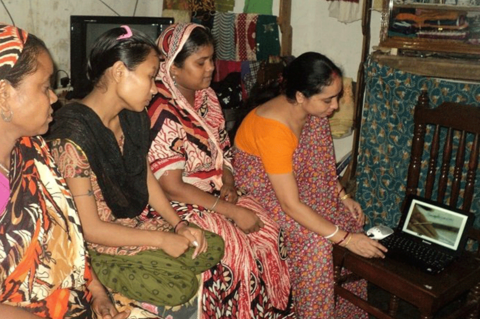
In 2013 during an earlier phase of the project, BKMI deployed the eToolkit and eLearning courses as a three-and-a-half month eHealth pilot involving 300 netbook computers with the eToolkit and video eLearning courses being distributed to field workers in 12 selected upazilas of two of the lowest performing districts in Bangladesh: Sylhet and Chittagong. A lack of accurate and up-to-date information and trainings for government field workers were identified as contributors to Bangladesh's poor health indicators. Following training by BKMI, the field workers used the digital resources on the netbooks to facilitate their usual counseling activities with mothers in households and clinics. The results of the eHealth pilot are summarised in the BKMI eHealth Pilot Results Summary. Among the results: increased field worker knowledge, the field workers' improved ability to integrate key messages during counseling, and an overall increase in demand for HPN information in communities. In the short film below, Rafiq and Kawsar, two field workers who participated in the pilot, discuss how they improved their knowledge and skills around FP, MNCH, and nutrition and began to change health behaviours in their communities.
Other activities included:
- Providing technical assistance on the design, implementation, management, and evaluation of strategic, evidence-based SBCC interventions by working directly with: BHE, Directorate General of Health Services (DGHS); IEM, Directorate General of Family Planning; and IPHN, DGHS.
- Coordinating the BCC Working Group, a forum for discussing and sharing best practices for SBCC on HPN in Bangladesh. This working group encouraged coordination, networking, and capacity development, and facilitated cross-promotion of messages.
- Coordinating the development of the Comprehensive National SBCC Strategy by MoHFW, non-governmental organisation (NGO), and development partner stakeholders. The Strategy, now approved by the MoHFW, will provide a high-level, theory-based, and evidence-based vision for SBCC for the MoHFW.
- Strengthening the Information, Education, and Communication (IEC) Technical Committee, the government body that approves all SBCC materials, by standardising review criteria and providing training.
- Disseminating 600 copies of a compiled set of 4 DVDs of SBCC videos.
- Updating 4 Nijeke Jano (Know Yourself) adolescent sexual and reproductive health (ASRH) booklets.
- Delivering workshops on: Campaign Design; Leadership in Strategic Communication; Strategic Communication for Public Health; Knowledge Management; and Using ICT for SBCC.
- Completing an SBCC Mapping and Situation Analysis for USAID Bangladesh.
- Field testing a monitoring checklist for SBCC activities at the grassroots level.
- Sharing Best Practices for SBCC in Bangladesh via a Share Fair event called Safollo Gatha (Success Stories). Presented each year since 2015, the event communicates best practices for SBCC in a festive and entertaining format. Best practices featured during the events were selected based on their innovation, adaptability, potential for scale-up, and effectiveness.
Organisers found an opportunity to elevate the value of SBCC by linking it with efforts in Bangladesh to improve household-level data collection. Field workers' registers are being digitised, and MoHFW is beginning to invest in mobile technology for field workers, so that data are available for planning and for measuring progress toward the Sustainable Development Goals (SDGs). Linking the digital registers and the BKMI's eToolkit for Field Workers, which is filled with digitised print and audio-visual counseling materials, is a natural fit, as they are both for the same audience: field workers who interact with community members.
Health, Reproductive and Sexual Health, Nutrition, Population
In its first iteration, the USAID-funded BKMI was managed under the Knowledge for Health (K4Health) project, implemented by Johns Hopkins Center for Communication Programs (CCP), and was then managed under the Health Communication Capacity Collaborative (HC3) as BKMI II. The project worked in close coordination with the Bangladesh Center for Communication Programs (BCCP).
"Three Years of Multi-Channel SBCC Capacity Strengthening in Bangladesh", by Rebecca Arnold, October 24 2016; "Bangladesh eHealth Pilot Hailed as Great Success", July 7 2014; HC3 website; BCCP website - all accessed on November 17 2016; and email from Rebecca Arnold to The Communication Initiative on February 8 2017.
- Log in to post comments