










































Communicating Effectively About Vaccines: New Communication Resources for Health Officials
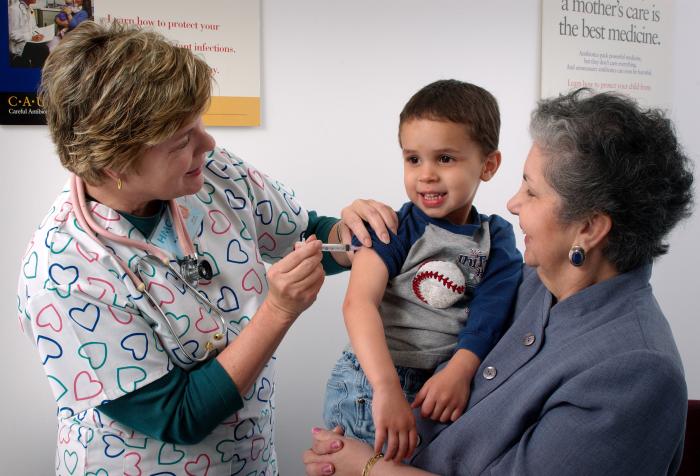
In August 2009, the Association of State and Territorial Health Officials (ASTHO) commissioned a survey [PDF] of 1,278 United States (US) parents and guardians to gather information about effective messages and materials for addressing parental concerns, support more informed decisions on the part of parents and guardians, and decipher how best to clearly and accurately promote the benefits of vaccines in ways that resonate with family decision makers. The insights gleaned from this study were then used to develop the messages and information found in this toolkit.
Beyond ideas for understanding the "target audience", the focus of the toolkit is the key messages (see page 7) and the creative advertising concepts (see pages 10 and 11) - e.g., in the form of print and web ads, In addition, there is information on the characteristics of a hesitant parent, a regional breakdown of attitudes, sources of information most used by parents, and strategies on how to best use the information.
The results of the survey suggest that paediatricians, public health officials, and the Centers for Disease Control and Prevention (CDC) are seen as reliable sources of information on vaccine issues. With a better understanding of which messages resonate with the public about the benefits of vaccines, public health officials can tailor their communications in a way to address the concerns of parents along the spectrum. The most frequently refused vaccines are Human Papillomavirus (HPV) and flu (8%), followed by varicella (5%). However, parents who refused HPV or flu refused the fewest other vaccines. Parents who refused Haemophilus influenzae b (Hib) or polio vaccines refused the highest number of other vaccines. The study found that positive messages were generally rated as more convincing and believable than negative messages. The positive message that resonated most was, "Vaccination is one of the most important ways I can protect my child from life-threatening illness and it's the best-known protection against a number of infectious diseases."
For this resource, ASTHO partnered with Porter Novelli, a global public relations agency, to develop and test messages, based on that research, to reach parents about the importance and safety of vaccines. Four concepts were developed and tested with moms in Seattle and Washington D.C., US. These sample concepts and notes about the moms' reactions to each are included. The favourite ad concepts varied by region. The messages are included in this packet along with a few basic communications tools to help state and territorial health officials create new and effective vaccine campaigns.
29
ASTHO website, July 30 2013. Image credit: Parents For Vaccines
- Log in to post comments