










































Regional Network on HIV/AIDS, Livelihoods, and Food Security (RENEWAL)
"Policy influence - as a means of transforming new knowledge into enduring change - can be achieved through continued engagement of policymakers from the outset and throughout the research process. RENEWAL has termed this real-time involvement 'inreach.'"
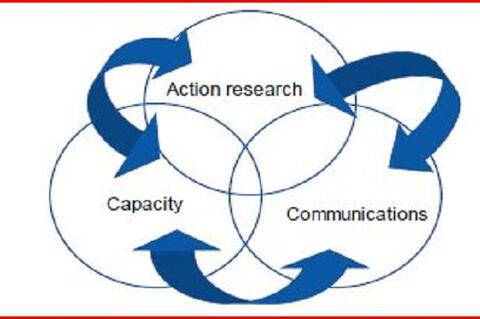
Launched in 2001 by the International Food Policy Research Institute (IFPRI), RENEWAL was a regional network-of-networks that was active in Kenya, Malawi, South Africa, Uganda, and Zambia until 2010. RENEWAL comprised national networks of food- and nutrition-relevant organisations (public, private, and non-governmental) together with partners in AIDS and public health. RENEWAL sought to enhance understanding of the worsening interactions between HIV/AIDS and food and nutrition security and to facilitate a comprehensive response to these interactions. The core pillars were: locally prioritised action research, capacity strengthening, and policy communications. The objectives were to:
- reduce critical gaps in understanding how livelihoods, particularly those deriving from agriculture, contribute to the further spread of HIV (susceptibility) and are affected by HIV and AIDS (vulnerability);
- generate new policy-relevant knowledge on how households and communities may strengthen both their resistance to HIV transmission and their resilience to the impacts of AIDS; and
- enable relevant institutions (in particular, governments) to generate and to act upon realistic priorities for responding to the interactions of AIDS epidemics with food and nutrition insecurity.
RENEWAL operated on the idea that the process of developing networks is both a means and an end. Networking was seen as necessary to create channels for identifying critical socioeconomic challenges, for determining appropriate investigation, and for sustaining communication and information flows during research and discussions on potential and actual utilisation of research. The set of overlapping networks was the basis on which scientists and policymakers mutually engaged and influenced each other and hence, an underlying source of evidence-based interventions. In addition to the core RENEWAL team, there were many other research partners linked to ongoing studies. Various international research collaborators were also involved in RENEWAL collaborations.
RENEWAL pivoted on the 3 interacting processes of locally prioritised action research, capacity strengthening, and policy communications - for 2 primary reasons: enhancing impact and underpinning sustainability through strengthened capacity.
- Action research aimed to inform policy needs by working with network partners, relevant policymakers, practitioners, and civil society organisations to generate locally relevant priorities for action and for research. This component focused on 3 key themes: (i) AIDS, agriculture, and livelihood security; (ii) AIDS, community resilience, and social protection; and (iii) AIDS and nutrition security. RENEWAL engaged directly with the international AIDS community to demonstrate the relevance of mainstreaming food and nutrition considerations within a truly broad-based response to the epidemic.
- Capacity strengthening was multidimensional, stressing the importance of empowering individuals and institutions through thematic and technical knowledge enhancement and experience. This referred to the capacity to do high-quality research and to make effective use of research through targeted advocacy and communications. RENEWAL activities in this category focused, for example, on addressing the specific needs of the National Coordinators and National Advisory Panels in RENEWAL's hub countries. Specific activities included trainings on research methods, presentation skills, scientific writing, policy brief development, and stakeholder and network analysis for policy impact. Online courses on proposal writing and scientific writing for publications were offered.
- Policy communications, which forged links between researchers and practitioners - with the thought that this approach is central to successful outreach. "As such, policymakers, civil society, and community-based groups are not simply targets of post-research results dissemination; they are at the table from the beginning and in constant communication, through the national networks, with the ongoing research and emerging results. This is partly achieved through National Advisory Panels and through strategic engagement with key stakeholders throughout the life-cycle of research projects."
The RENEWAL strategy was to adopt an "in-reach" as opposed to an "outreach" approach when starting projects. "Outreach" emphasised difference and boundaries between different agencies, whereas "in-reach" acknowledged common concerns of different agencies and the scope for reaching in to the source of those concerns. Establishing and engaging with a National Advisory Panel (NAP) was a means to ensure ongoing consultation with stakeholders, as well as to identify research priorities and changing political interests and perspectives on them. Means to strengthen consideration of the complexity of the HIV-hunger nexus included regular interaction of RENEWAL's coordinators with each other and, in each country, with all members of research teams, as well as between senior team members from different institutions with each other in the case of cross-organisational studies and between the principals of RENEWAL projects in different countries. These interactions were designed to ensure cross-site comparability in the design of projects and policy relevance, and they were a conduit for ongoing advocacy. In other words, "research communication" was not simply dissemination of research results but incorporated activities ranging from capacity building in the form of mentoring on writing for different media and training to write "issues briefs", to using different media for different purposes as a project progressed, and ultimately, to packaging and disseminating the form of the research as well as the results in imaginative ways.
These activities were supported at the regional level through engagement with regional institutions. For example, RENEWAL helped draft the HIV/AIDS Framework for the Southern African Development Community (SADC) HIV and AIDS Unit. Similarly, RENEWAL provided support to SADC and the East Africa Community through Joint United Nations Programme on HIV/AIDS (UNAIDS)-funded research into the impact of rising food prices on people living with HIV and those affected by AIDS. This research was co-commissioned by the Networks of African People Living with HIV in both the Southern African Region (NAP+ SAR) and East Africa Region (NAP+ EAR).
At the global level, RENEWAL participated actively in a number of high-level meetings and conferences, including the International AIDS Conferences in Mexico City, Mexico, and Toronto, Canada, the African Union Regional Experts meeting on Social Protection, and the UNAIDS Programme Coordinating Board.
HIV/AIDS, Food Security.
"As the multifaceted impact of the AIDS epidemic continues to intensify across southern and eastern Africa, dangerous new interactions are developing that threaten the trajectory of national social and economic development.....Not only does HIV coexist with widespread food insecurity and economic inequality in time and space, it interacts with these conditions. HIV incidence rates are fuelled by food insecurity while subsequent AIDS-related morbidity and mortality, in turn, further exacerbate food insecurity. This emphasizes the multipronged rationale for linking food and nutrition security with AIDS programming. Taking a livelihoods approach, RENEWAL situates the determinants and impacts of the HIV epidemic and the responses to the disease within the frameworks of people's lives."
A December 2011 evaluation report [PDF] concluded that "RENEWAL has had a significant impact: a large number of publications [over 150] have been produced; many food, nutrition, and agricultural organizations have become aware of the importance of HIV/AIDS for their core business and are making explicit attempts to factor these understandings into their policy and programming processes; and AIDS policymakers and programmers are factoring food and nutrition considerations into their processes. The RENEWAL network-of-networks approach is considered by many to be a leading model for responding to the interactions between AIDS and food security. The conceptual and practical utility of the HIV/AIDS lens is well understood and increasingly used, in policy, planning, and program design."
RENEWAL website, October 4 2012; "Playing the Role of a 'Boundary Organisation': Getting Smarter with Networking", by Scott Drimie and Tim Quinlan, Health Research Policy and Systems (HARPS) 2011, 9 (Suppl 1): S2; email from Stuart Gillespie to The Communication Initiative on January 13 2016; and "Ex-post Impact Assessment Review of the Regional Network on AIDS, Livelihoods, and Food Security (RENEWAL)" [PDF], by Timothy R. Frankenberger and Suzanne Nelson, December 2011 (accessed January 15 2016).
- Log in to post comments