










































Policies and Social Norms: Their Relationship to Women's Economic Empowerment in Nigeria
"Understanding the role of norms in women's strategic decisions is critical to developing effective policies and interventions to improve women's overall socio-economic development."
The influence of social and gender norms on women's socio-economic development is increasingly recognised. This report from the Nigeria Social Norms Learning Collaborative (NLC) provides a review of policies that facilitate or hinder women's economic empowerment (WEE) at the national and geo-political zones - presenting one state per zone as an example (Abia, Borno, Edo, Kaduna, Lagos, and Niger). It also assesses the relationship between social norms and WEE policies and explores how that relationship informs government-led programming to address policy gaps, shift social norms, and scale up programmes to enhance WEE across Nigeria.
This policy review consisted of a desk review, 36 in-depth interviews (IDIs), and two focus group discussions (FGDs) with key stakeholders across the selected states and at the national level. All IDIs and FGDs were conducted virtually, in English or Hausa, respecting COVID-19 precautions. Data were analysed using the building blocks of WEE (see Section 2 of the report: Key Concepts & Frameworks) and the norms and policies related to each across states.
For the purposes of this publication, women's empowerment entails expanding a woman's choices by making available opportunities that otherwise would not have been possible and strengthening her voice so that she can speak up and be heard in discussions and decisions that shape her current or future situation, both within and outside her home. This vision can only be achieved by transforming unequal power relationships that disadvantage women in terms of authority, social privilege, and control of resources. These power relationships are often firmly held in place by social norms.
The type of social norms most relevant to WEE are gender norms, which define what is expected of a woman and a man in a given group. Social norms can:
- influence how women view themselves, perceive their abilities, and shape their aspirations;
- lead to discriminatory treatment;
- limit women's access to education, skills development and technology, assets, information and social networks, and resources such as credit and capital;
- limit women's mobility and financial independence;
- increase vulnerability to gender-based violence (GBV); and
- limit women's employment and entrepreneurship opportunities, often confining them to the informal sector and to activities with relatively low economic returns.
The analysis revealed 4 building blocks of WEE:
- knowledge and skills;
- financial services and markets;
- legal and social protections; and
- access to health services.
An additional domain - gender equality - emerged from this analysis as a precursor to WEE, which is labeled as a "condition", as it cuts across the 4 building blocks. The intermediate outcomes that emerge from building blocks and ultimately contribute to WEE include women's enhanced capacity and agency and their successful financial inclusion and entrepreneurship or employment.
Social norms have the potential to affect all stages of policy cycle. Two of the most critical points are:
- development, adoption, and publicisation of laws, which can help change patterns of behaviour, establishing new "descriptive norms", attitudes, and beliefs; and
- implementation of policies and related programmes, which may aim to shift discriminatory norms directly (by promoting discussion of the negative impacts of such norms) or indirectly (by increasing women's access to resources and opportunities, which can lead to new norms emerging).
Section 3 of the report discusses the relationship between social norms and WEE in Nigeria broken down by building block/condition. A table in this section identifies the following common gender norms related to WEE in Nigeria: Families consider sons more deserving of care and investment; husband controls wife and provides permission for her to access health care, engage in income-generating activities, access financial services, and move outside the home; men should be the key decision-makers in their families and communities; women are not expected to control their own assets or property; women are expected to take care of most domestic and nurturing chores within the household; and in some circumstances it is appropriate for men to use violence to discipline their wives.
The report then examines the intersection between social norms and policy. (See Appendix Table C for selected laws, policies, and programmes, the social norms they address, and how they are being implemented.) In general, the policy mapping and interviews show that at national level and across the focal states, various policies and programmes have been developed that aim to promote both broad gender equality and specific building blocks of WEE. Overall, where laws have been adopted or the federal government acceded to international conventions, development of policies and programmes has generally followed, and social norms were not viewed as a major impediment. However, limited implementation was the single most common issue raised in the interviews. Some civil society respondents related this problem specifically to the need to bring local stakeholders on board with norm change processes.
The main body of the report concludes with recommendations for addressing social norms that constrain WEE, such as:
- Understand and address the diverse norms at play in different contexts - e.g., needs assessments must take into account the diversity of women's situations, social identities, and livelihoods.
- Engage key stakeholders, including community and family members, in mobilisation for WEE - e.g., addressing norm-based barriers requires understanding the ideas, interests, and incentives of different groups, to best engage and sensitise them and catalyse norm shifts.
- Make greater use of norms-based insights to increase the impacts of WEE programmes - e.g., publicise existing initiatives, with positive stories about their impacts more widely, including through broadcast and social media, to help shift norm-based barriers to uptake.
- Provide an enabling environment for the effective implementation of WEE policies and programmes - e.g., both governmental and civil society organisations (CSOs) should engage in sustained awareness raising on WEE policies, making greater use of local languages to reach marginalised women.
- Create specific policies - e.g., adopt the Kano State Family Code to strengthen the family system and empower women by the proper implantation of Shari'ah principles, with reference to issues of unpaid care, decision-making, divorce, inheritance, GBV, and child welfare.
In conclusion: "Adapting and enacting policies at the national level has set the pace for the promotion of WEE in Nigeria. Yet there are still challenges ahead, in part due to deeply entrenched social norms which perpetuate gender bias and limit women's access to economic opportunities....This analysis of the building blocks of WEE reveals the influential roles of social and gender norms across all states, while reminding us of contextual differences."
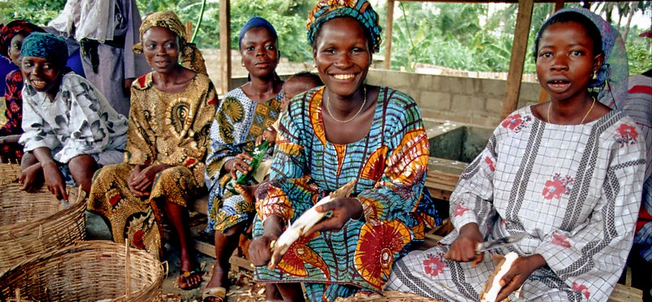
ALiGN platform, April 22 2022. Image caption/credit: Cassava processing, a source of employment to Nigerian women (file name 69), © International Institute of Tropical Agriculture 2006 via Flickr (CC BY-NC 2.0)
- Log in to post comments