










































The Wheel of Development: The MDGs as a Communication and Development Tool
Advisory Council on International Affairs, Ministry of Foreign Affairs
"The effectiveness of the MDGs as a communication tool should not be underestimated by those who primarily focus on it as a development tool. The indicators of the MDGs still have value and could be used in a different way (to measure progress and inequality, for example)."
This article examines the merits of the Millennium Development Goals (MDGs) as a communication tool as compared to its merits as a development tool.
In the opening section, Van Norren explores some criticism of the very concept of the MDGs in general, listing 4 schools of thought. As an example of one concern: narrowly defined indicators can, for example, encourage governments to send people to school without making sure there are good teachers or teaching materials, purely to achieve the MDG concerned.
She next introduces her core argument: "The MDGs should be kept as a communication tool, but their content modified as a development tool." The rationale is that the MDGs have represented a way to try to keep all, including emerging, economies focused on a common development agenda. "It is also a hard-won focus of the development debate that is multidimensional, even if that focus is sometimes haphazardly implemented..." Also, Van Norren points out that developing countries (and their regional institutions) have invested in national MDG reporting systems, including indicators that can be used to build upon.
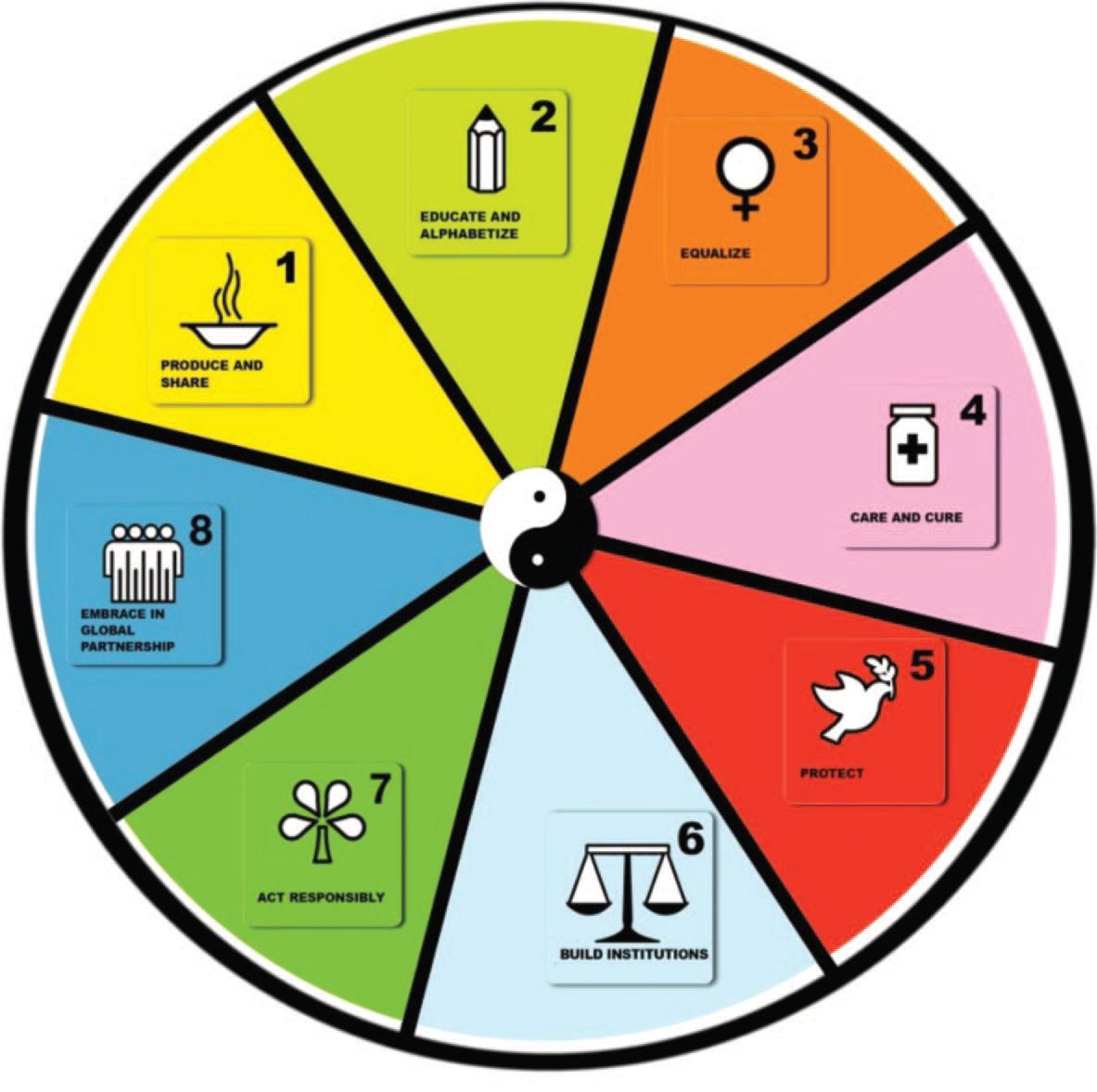
Van Norren argues that "differences about how to achieve development will always exist, which is a healthy debate that cannot be captured in a simple MDG model." She notes that the MDGs are numbered 1-8, but that "[n]umbering always involves a hierarchy, even when this is unintended." She stresses the importance of showing the interrelation of all issues involved and the way several components of development contribute to each other. She does this by representing the MDGs in the form of various visual diagrams. In one of them: "The actions are formulated in verbs, close to the current wording and symbolism, but with the addition of two new clusters: produce and share, educate and alphabetise, equalise, care and cure, protect, build institutions, act responsibly, embrace in global partnership." This model is motivated by the author's conviction that "The MDGs are especially strong in communicating a complex development issue to a broad audience, but their visualisation so far does not show their interrelation."
The article concludes with the claim that "a picture is worth a thousand words. This is a symbol to mobilise and communicate an analytic view of what development entails." Van Norren's visual model tries to make the complex interplay of issues easier to grasp for a large audience, post-2015. The idea is to demonstrate the integration of development dimensions and the necessity of a holistic approach.
Editor's notes:
- This article does not represent the views of the Advisory Council on International Affairs or the Foreign Ministry.
- The yin yang symbol is used to represent a balance of male and female values in development.
- Van Norren also proposes a wheel of governance.
Post2015.org, June 20 2012. Third World Quarterly, 33:5, 825-836; and email from Dorine E. Van Norren to The Communication Initiative on June 22 2012.
- Log in to post comments