










































Visualising Primary Health Care: World Health Organization Representations of Community Health Workers, 1970-89
University of York
"Considering the politics of visuality, and not simply visual representations as abstracted from the context of their production and dissemination, allows one to investigate the reception of messages, which are never absorbed uncritically in line with the creator's intentions."
This article examines a period of picturing and public information work on the part of the World Health Organization (WHO) regarding community health workers (CHWs). It explores the ways in which the WHO sought to advance the primary health care (PHC) agenda around the 1978 Alma-Ata conference, in particular by focusing on CHW programmes. Photography was believed to be a tool to change widely held assumptions and to inspire community action, and was thus used by the WHO to help overcome challenges relating to the implementation of community-centred approaches and PHC more generally.
CHW is the name commonly given to close-to-community workers with no specialised medical training who traditionally operate as links between doctors, nurses, and remote or hard-to-reach groups. They can specialise in one task or carry out a diversity of functions, which commonly involve identifying the health needs of local populations, particularly of neglected groups like women, the elderly, and the disabled; gathering epidemiological information; scheduling consultations; accompanying patients in long-term medication protocols; supporting vaccination programmes and vector-control interventions; and promoting health education and disease prevention campaigns.
The article tracks attempts to define CHWs and examines the techniques employed by the WHO during the 1970s and early 1980s to promote the concept to different audiences around the world. For decades prior to Alma-Ata, there was a conviction that the use of (Western) technologies was the optimal strategy for solving the world's health problems. As WHO shifted gears in the run-up to Alma-Ata, it attempted to develop attractive means for communicating the approach to different audiences at a time when many, including some WHO staff, were unsure about it.
The Alma-Ata Declaration emphasised that the people should have the right and duty to participate individually and collectively in the planning and implementation of their health care, and that PHC was the key. The accompanying Alma-Ata conference was envisioned as a high-profile opportunity to advance the PHC vision. For the WHO, it was an opportunity to advocate the idea of community participation by showing it in action and portraying it as attractive and achievable. A public information component was therefore sanctioned as part of the conference preparations. Success stories and model examples were selected to help promote the concept of PHC to member countries where programmes were non-existent, and address its perceived status as short-term or second-rate.
Specifically, at the Palace of Lenin, the Alma-Ata conference venue, provisions were made for journalistic coverage through a radio studio and dedicated telephone and telex services. Information kits were distributed and short radio interviews with people involved in PHC delivery prepared. The Palace's foyer was requisitioned for a WHO/United Nations Children's Fund (UNICEF) photographic exhibition, with PHC-related photo-stories made available to delegates. The Palace's theatre was reserved for film screenings of 15 films showing a variety of PHC activities from around the world.
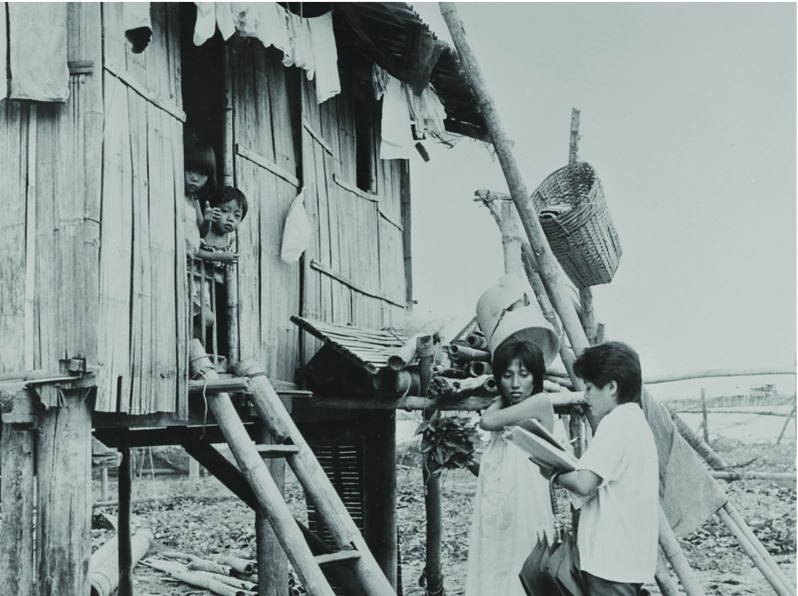
CHWs were selected as key protagonists in the WHO's new visual strategy, and they were presented as inextricably linked with the push towards PHC - for example, in WHO's magazine Global Health. Photo stories that featured them were characterised by tales of courage and determination. This was reinforced by the position of CHWs in relation to the patient suggesting a power dynamic, and their professional accoutrements marking their skill as well as the medical tradition into which they were supposed to fit. The photographs also represented a conscious effort to secure the trust of local populations, thereby confronting the assumption that CHWs provided temporary or second-rate solutions. Photographers used light, shadow, and perspective to further emphasise this reading and to develop a vision that matched the aspirations of the Declaration.
That said, the community-centred model challenged predominant views of clinical relations based upon hierarchy and distance between the patient and the health professional qualified to dispense care. When representing CHWs in photo stories, the WHO placed great importance on physical contact and touch, emphasising the healing hands of CHWs. This same theme could be seen in photographs that featured larger community spaces; in many instances, CHWs and community members were presented as being on the same level, or in a circle, discussing together. Again, this spoke to the theme of proximity and non-hierarchical relationships, showing that CHWs performed functions that allowed them to approach problems through dialogue and cooperation with the community.
Aside from the focus on CHWs and the people they served, the WHO also showcased the more general benefits of community collaboration. An aspiration vocalised at Alma-Ata was that action in the form of CHW programmes would inspire further community collaboration and translate into broader community development. The "community" was therefore also made a prominent actor in the photographs.
Other representations reported on ambitious development activities that represented measurable successes in terms of children immunised against whooping cough, measles, diphtheria, poliomyelitis, and tuberculosis, as well as provision of clean drinking water.
When not pictured in the home environment, CHWs were commonly photographed on the move, which emphasised the CHW's perceived ability and commitment to better deliver health to underserved areas. World Health editors selected photographs of community workers walking or riding horses, bicycles, and motorcycles.
In sum, the WHO's representations of CHW programmes relied upon themes of professionalism, proximity, community development, and mobility. The agency sought to make CHWs visible as reliable and trustworthy, close-to-community elements that could bring health care to the most remote households. CHWs were also community members that assumed a prominent role in mobilisation, seeking to inspire others to contribute to development.
As the article explores, WHO efforts at enhancing the visibility of CHWs faced significant challenges. The efforts to publicise CHWs and the PHC approach took place in an environment of mounting pessimism and criticism of Alma-Ata's goals, which were said to be unrealistic and idealistic. Despite the WHO's media effort, there continued to be fundamental misunderstandings about the very idea of PHC. Furthermore, and contrary to what was envisioned, workers drawn from the communities were not universally accepted. In particular, they had to face the fact that community development initiatives often led to the entrenchment of existing power structures and inequalities instead of contributing to increased participation and democratisation.
By the end of the 1980s, the WHO was still uncertain about how best to present the PHC concept and was facing difficulties in putting the message across effectively. These problems persisted into the 1990s, when community participation was once again the central theme of the 1994 World Health Assembly. The media teams sought to create a composite video and complementary photograph exhibition for presentation during the Assembly, but questions continued to arise around audience (policymakers, social groups, or local leaders), purpose (to expand community action for health, or show small successes to inspire action), and even content (as the years passed, it proved difficult to procure relevant and interesting imagery in support of the WHO's messages).
Reflecting on this history and analysis, the paper concludes that, "despite the great hopes surrounding the Alma-Ata vision of 'Health for All', there was a mismatch between visual representations and the stark realities on the ground - and here the representations put forward by the WHO may have been partly to blame. In order to 'sell' PHC, the WHO portrayed CHWs in a favourable light - yet it was perhaps too favourable, and difficulties not always sufficiently elaborated upon."
Continuing, the authors suggest: "One reason that explains the lack of success of WHO representations, and the ways in which they unwittingly contributed to the neglect of PHC and CHW programmes, is the fact that they were overwhelmingly top-down, without appropriate consultation and ownership by CHWs themselves. Representations that are more cognisant of these challenges may succeed where previous ones faltered....Nonetheless, visual representations still have an important role to play in creating the conditions for more equitable and universal access to health care. Moreover, these representations can also be, in and of themselves, exercises in the democratisation of health, by giving voice to people and perspectives that have been silenced or ignored for far too long."
Medical History (2018), vol. 62(4), pp. 401-24. Image caption/credit: "A community health worker on her house rounds" (1980). © WHO/Ghulam Zafar
- Log in to post comments