










































Using Theatre for Human Rights Education and Action
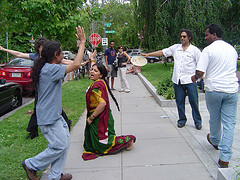
This "Tactical Dialogue" is part of a monthly online dialogue series moderated by the New Tactics in Human Rights Project. It explores the topic of how theatre is being used to promote, educate, motivate, and move people to action regarding human rights, development, and issues of change. It is intended as an opportunity to ask questions, share experiences, and build connections with practitioners using theatre by sharing stories of how theatre is used as a powerful tool in human rights work. New Tactics also uses the dialogue to share theatre exercises and tools that have been useful for groups and communities looking to solve their problems.
The dialogue summary explains “why focus on theatre”: "The power of theater as a way for people and communities to share their experiences, generate conversation, and enable new insights to emerge. The power of theatre to break down isolation and building hope. By working through theatre, both performers and spectators can engage difficult questions in a safe space. Theatre is also an ideal instrument to give witness to human rights violations. It is also an excellent tool for education and awareness raising. Lastly, these insights can be used to advocate for policy and legislative changes."
The summary gathers themes from the online conversation of approximately 2 months' duration with international contributions from people with a range of experience, including: Forum theatre and Legislative theatre, pioneered by Augusto Boal; puppetry; and theatre for torture and war trauma survivors. Among the themes are the following:
- Theatre's limitations, including achieving change in real life, creating long-term change, and its limits in fighting oppression
- Difficulties in measuring and quantifying impact, particularly in volatile conditions
- Impact measurement: a database for gathering information on impact, ways of keeping in touch with past participants, and other ways to measure impact over time
- The role of the facilitator: creating the opportunity, without dictating the process, and listening and supporting the community to find a way to tell their story. Self-awareness and awareness of what is culturally appropriate were recognised as important for facilitators: "...outside facilitators coming into a community might have ideas about what's going on, what's "edgy" or "important" about the place we are working in, but like the forum theatre for the homeless, we can't create a show based on what interests us, it has to interest the community."
- Self-care as an activist facilitator: awareness, balance, and connection - in particular,
connecting to personal support outside of human rights networks - Process versus outcome, and the different approaches that favour one or the other, discussed in the context of letting the participant community be the experts, beginning with having them choose the theme, promote the workshop, and develop their voice, including taking the theme in a different direction than originally proposed
The discussion covered use of different media including: technology to spread information about art and the use of culture; DVD recordings to extend the reach of the project; puppets to present painful stories or themes; entertainment and humour on political issues; traditional artistic practices for social commentary; and using images instead of language - e.g. participants might gather images of street life, using photos, arrange them to express their reality as drug users, and project them for an audience.
Engagement with social activists was discussed: Though theatre was expressed as an ideal way in assisting activists in exploring, debriefing, sharing, celebrating, and generally processing "the work", one participant expressed the difficulty in getting activists involved due to lack of time and resources.
The following list of shared theatre exercises and tools came from the discussion:
- Analytical framework for assessment of theatre.
- A matrix for measuring impact.
- The Change Cycle™ Model.
- Theater of the Oppressed - Complete the Image.
- Making images.
- Organise a puppet parade.
- Elicit images on a theme.
- Assorted resources.
- Enabling children through the theatre.
The complete threaded discussion is available on the New Tactics website.
New Tactics website, July 15 2010.
Comments

VERY SATISFY BUT
YES I FIND VERY INTERESTED YOUR PAGE BUT WHAT WE WANT IS TO IN PARTNERSHIP RIGHT NOW CAUSE AFRICA WILL NOT WAIT TO BE DEVELOPED ONLY THROUGH IS INTELEVTUALS SO PLEASE WE NEED A TELEVISION AND RADIO STATIONS TEACHING PEOPLE TKS
- Log in to post comments