










































Under the Mango Tree Radio Project
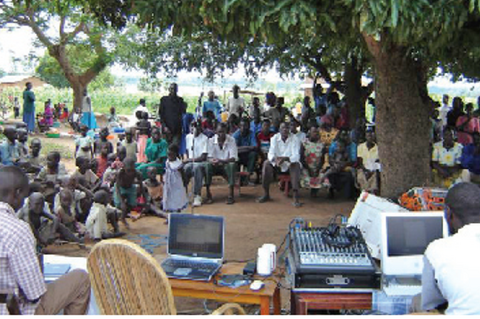
According to AFFORD, Under the Mango Tree combines two proven communication strategies: community mobilisation and interactive radio programming. The project capitalises on two realities in Uganda: people listen to each other, and people listen to the radio. By recording community dialogue for regional broadcast, the programme recreates the intimacy of a small-group setting for a mass media audience.
To produce the show, community members gather in an outdoor public site. With the help of a moderator and health professional, the community discusses issues around one of AFFORD's supported topics. The live sessions are recorded and edited into 30-minute radio segments. Each episode is translated and broadcast in five languages. Listeners provide feedback by calling a toll-free hotline with questions and comments about the show, and frequently asked questions are selected and answered in 45-second radio spots. Twenty-six episodes of the show were produced in five languages and broadcast on 11 stations nationwide.
The programme was produced using the following strategies.
Designing the show: AFFORD's communication team uses health data to transform health programme strategies into design documents for radio. The Ministry of Health and USAID then review and approve these documents. Moderators receive training on how to use the design plan. Together with a team from Good Life (an AFFORD-led campaign to market the practices, products, and services that provide wellness for Ugandans), a suitable plan is mapped out for recording in a community.
Mobilising communities: A team of community mobilisers visits approximately one week ahead of the recording crew. They obtain the approval of local officials, enlist Popular Opinion Leaders' assistance in door-to-door outreach, map recording areas, and set up for the show. AFFORD then trains local health professionals to moderate the discussions.
Recording dialogue: The mobilisation team gathers local health professionals and community members "under the mango tree", where they address a given health topic. A local media production company records the dialogue. Regional celebrities pair up with local health providers to create an exciting and informative atmosphere.
Creating attention-getting programmes: The recorded dialogue is mixed with information and entertainment. The final result is a 30-minute programme designed to be exciting, relevant, and fun. An advertising agency develops media placement plans to ensure that the programme is aired on local radio in every region of the country.
Engaging listeners: After an internal evaluation, AFFORD took steps to increase listener participation. AFFORD established a toll-free hotline for listeners to ask questions about programme content. These questions are answered directly through 45-second radio spots broadcast over eleven radio stations.
Monitoring: AFFORD pre-tests each radio programme with focus groups in all five regions. Detailed information on radio message exposure will be collected as part of a national household survey conducted by the Uganda Health Marketing Group's Research and Evaluation unit.
AFFORD states that numerous behavioural studies have shown that peers have a significant impact on what people think and do. By creating a radio programme from real-life discussions, AFFORD hopes to make it easy for listeners to relate what they hear to their own lives. By training local health providers to guide the discussions, the programme is able to provide correct information through a trusted source, one that community members can consult again in the future.
HIV/AIDS, Malaria, Reproductive Health, Child Health
In Uganda, FM radio is the most widely accessed media; the 2002 National Population Census found that 80% of the population has regular access to a radio, while only 2% have access to a newspaper. In addition, radio's flexible programming makes it easy to incorporate popular music into the programme. Regional celebrities moderate the show, using their social influence to attract larger audiences and affect health behaviours.
According to AFFORD, more than 1,000 Ugandans were involved in the live discussions, which reached 5.7 million listeners. Several key lessons have been learned from the programme so far. Firstly, mobilisation for radio programmes is most effective in communities with a Popular Opinion Leader network, another programme which works to identify community leaders. Also, the community discussion format brings out numerous myths and misunderstandings, and addressing these misconceptions should be a focus of future Under the Mango Tree programmes. Lastly, partnering with local health care providers to moderate community recordings is effective, but requires substantial training inputs.
Under the Mango Tree: Radio for Everyday Health [PDF] and JHU-CCP website on October 5 2011.
- Log in to post comments