










































Toward Shared Meaning: A Challenge Paper on Social and Behavior Change and Social Norms
"How do we best apply social norms approaches and measurement to SBC [social and behaviour change] programming to facilitate and achieve sustained SBC?"
In 2020, the United States Agency for International Development (USAID)-funded Passages Project called for a "challenge dialogue" to grapple with a perceived lack of community consensus regarding what is needed to ensure that social norms are adequately addressed in social and behaviour change (SBC) programming and research. In late 2020 and early 2021, Passages invited a broad array of people who work in SBC and in social norms to join in the dialogue. Over 100 diverse players came together with the goal of facilitating consistent use of social norms measurement and programming approaches in SBC programmes. This paper serves as the culmination of that endeavour, documenting progress made to date.
As the paper outlines, social norms may be addressed by any type of SBC interventions, including those programmes which: have behaviour change or social change or any combination as an end goal; address a single behaviour or multiple behaviours; and operate at any level in the socioecological model, from national to community based. Many types of SBC techniques may be used to address social norms, including modeling a new behaviour, correcting over-estimations of practice, promoting community dialogue, creating safe spaces for norms to be questioned, addressing power dynamics, and others.
The Passages Project (see Related Summaries, below) represents USAID's effort to explore what happens when programmes address a broad range of social norms, especially in large-scale interventions. Six years into the 7-year Passages Project, which addresses family planning, reproductive health, and gender-based violence, the challenge dialogue represented a chance to deepen knowledge about what social norms are, how they operate, and how practitioners can develop, elevate, and support norms that allow for healthy outcomes.
The first debate saw the group shifting from a narrow look at programmes that aim for behaviour change, expanding to include programmes with social change goals. The distinction between behaviour change and social change - and their measurement - can be framed as follows:
- When the aim of a programme is behaviour change, success is measured by change in the proportion of people who practice a clearly-defined behaviour that has been identified as improving health or well-being. There is a dearth of literature on how to use social norms in behavioural interventions, and simple, individually tailored messages containing normative information remain the dominant approach.
- Many avenues can lead to social change, including technological innovations, changes in the ecosystem, and social and political movements. In each of these avenues, social norms are involved. Social change refers to alterations in social roles, relationships, and influence in the social environment, whereas social norms provide rules that define acceptable, appropriate, and obligatory actions within a given group or community. Often, entrenched norms are an obstacle to social change.
One challenge dialogue participant, noting that Passages has focused on community-based norms-shifting interventions, asked that the conversation consider a broad range of SBC programmes. Another opined that behavioural sciences have dominated in social norms work, leaving many unfamiliar with the sociology and anthropology literature. One person observed that even in programmes that intend to address social norms, norms may not be systematically targeted and are rarely measured well. Participants "universally embraced" the invitation to be part of a dialogue that would pull together players with diverse experiences to coordinate efforts.
Along these lines, as the discussions progressed, organisers came to understand that the expectation of reaching an agreement on shared language and frameworks was not only unrealistic but unnecessary. The academic traditions from which participants come - e.g., behavioural economics, communication for behaviour change, social psychology, psychology, sociology, and anthropology - have distinct terminology and worldviews regarding social norms, and that diversity enriches the field. In lieu of reaching consensus, the group suggested that SBC implementers and researchers explicitly identify the source of the theoretical frameworks they are applying, which allows for collaboration, understanding, and evidence generation across differences.
Despite differences, there were many points of agreement. For example, all spoke of social norms work as complex and requiring locally-grounded models in order to accurately reflect drivers of behaviour. People agreed that being attentive to ways social norms may influence programme implementation and outcomes can transform SBC work. There was a broad recognition that social norms ought to be addressed at many levels of the socio-ecological model, and that community dialogue is not the only way to engage with social norms: Advocacy for policy change, mass media, interpersonal communication, use of technology, and changes in the physical environment may all offer opportunities to deal with norms.
Participants in the challenge dialogue whose focus is on measurement pointed out that an absence of quantitative evidence does not necessarily mean that change is not happening and that randomised control trials and outcome evaluations with an eye to proving attribution may not provide a complete story. They raised questions about how collective norms can be measured. They inquired, too, on the best ways: to validate what is being measured with those affected, recognising that some changes may not be visible to observers outside the community/population; to monitor unintended consequences of norms-shifting interventions; and to measure norms in real time to see if shifts are happening. They suggested seeking some new indicators for social constructs that include social norms, asking: How is it possible to achieve consensus on measurement approaches and indicators?
The report includes an annex of case studies of SBC programmes that address social norms:
- Case Study A: The Young Men Initiative (YMI)
- Case Study B: USAID Tulonge Afya
- Case Study C: The Uplifting Women's Participation in Water-Related Decision-Making (UPWARD)
- Case Study D: The Community Care Programme in Somalia
- Case Study E: Girls' Holistic Development: Grandmother Project - Change through Culture
The paper lays out specific recommendations, including, for example:
- Invite SBC implementers to use the many existing resources (e.g., see list on page 18) that outline methods for identifying the relevant social norms, designing and implementing programmes that acknowledge and address those norms, and monitoring and evaluating these efforts.
- Expand on the guidance that aids practitioners on how to determine if, when, and how to address norms as part of a more comprehensive SBC approach.
- Create realistic expectations for social norms programming, including reasonable timeframes.
- Explicitly identify the source of the theoretical frameworks that programmers and researchers are applying.
- Build on programmes developed by and in conjunction with leaders in the global South, and ground work in shared values.
- Encourage inclusion of clear, measurable objectives for social norms change in SBC.
- Broaden the acceptance of qualitative methods when exploring complex situations and problems, and identify new indicators that provide crucial information.
- Develop a common research agenda among partners and stakeholders to synthesise key questions and build the evidence base for how to design norms-focused SBC.
- Explore ways to programme for scale and to learn how scale itself may affect change.
- Keep the door open for ongoing dialogue across fields about how to apply social norms approaches for SBC.
The Social Norms Learning Collaborative, an initiative for identifying, sharing, and discussing norms-shifting interventions focused on improving health and well-being, calls for expanding this existing community of practice as it carries forward some of these recommendations.
In conclusion, the challenge dialogue highlighted "the value of bringing in many voices and ensuring that community members and local academics are at the table - early, often, and substantially - for the design, implementation, and evaluation of SBC programs. While useful for any SBC work, this was especially important for programs seeking to understand and work with social norms."
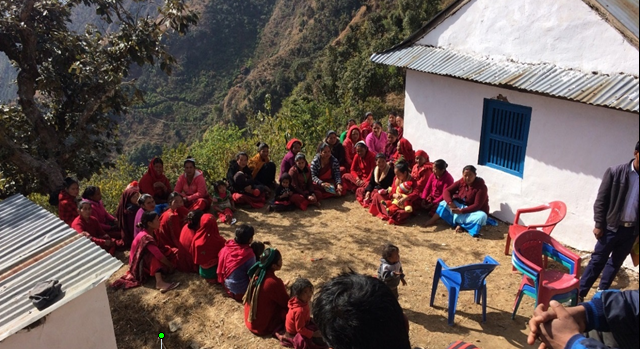
Institute for Reproductive Health (IRH) website, March 30 2022. Image caption/credit: Community facilitation team members and UPWARD programme staff. Credit: IRH 2019
- Log in to post comments