










































Sujaag: Collective Action for HIV De-stigmatisation
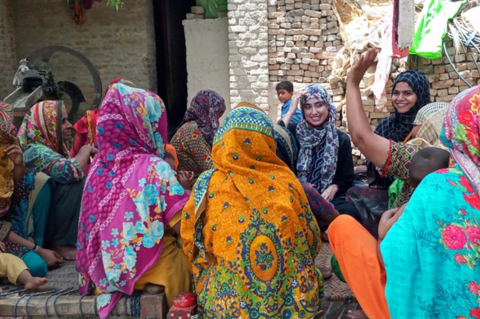
"I used to face hatred because my child was diagnosed with HIV, but now things have changed; people in the village have learned that HIV doesn't spread when kids play together." – Mother, Village Thango Khan Bozdar
Sujaag (meaning "to awaken" in Sindhi language) was a hybrid community engagement and mass media communication project designed to address HIV-based stigma and create acceptance for people with lived experiences of HIV in Larkana District, Sindh, Pakistan. It was implemented between December 2020 and March 2021 as a response to an HIV outbreak in Ratodero Tehsil (an administrative sub-division) in 2019 that mostly affected children. Through this project, IRD Pakistan envisioned development of a compassionate environment for people living with HIV (PLHIV), especially parents of children living with HIV (CLHIV), that is free from stigma and discrimination.
The project's two-pronged approach included: (i) community engagement, via development of community support groups (CSGs), Theatre of the Oppressed performances, and health education sessions, and (ii) targeted social and behaviour change communication (SBCC) campaigns comprised of branded local transport, contextualised television advertisements, and interactive social media tools. The project's slogan, "Rishta Na, Soch Badlio" - meaning "change your mindset, not your relationships with your loved ones" - focused on empathy towards and inclusion of people living with HIV.
Participatory formative research guided the foundations of the project. Specifically, to co-create contextual solutions, Sujaag took an inclusive approach. First, 10 community health workers (CHWs) were trained to engage with local religious leaders, advocacy champions, and HIV networks to identify local PLHIV. The CHWs then formed 23 CSGs that were made up of PLHIV, caregivers, and the general population. Each of the 12 female groups and 11 male groups comprised 8-12 participants, for a total of 280 persons (58% women, 42% men), all of whom were from Sujaag's intervention communities. The groups met on a weekly basis. CHWs employed an adaption of The Constellation's SALT-CLCP (Stimulate Appreciate Learn and Transfer - Community Life Competence Process) (see Related Summaries, below), which took CSGs through a rigorous learning (participatory action research - PAR) cycle to identify shared goals and develop action plans embedded in collective resources.
Each group meeting was facilitated by at least one trained health worker to unpack HIV stigma in the community's context, reflect upon the social determinants of HIV, appreciate the role of social inclusion, define individual and collective aspirations, gain a deeper understanding of stigma from the community's perspective, and develop clear plans and methodology for community action and advocacy around HIV.
Then, through collaborative efforts, CSGs implemented community mobilisation using social and behaviour change techniques such as theatre plays and awareness sessions. They also took active measures on the ground to improve lives of CLHIV, their caregivers, and the general community, including: advocacy (drafting letters for health and educational services), environmental upgrades (clean-up drives), positive health seeking (HIV screening mobilisation; preventive practices), and formation of village committees (on nutrition, health, and education). Through meaningful communication and community engagement practices, the project hopes these CSGs, which numbered 23 across Ratodero, will be sustainable.
In all the phases of the Sujaag project - intervention design, implementation, and evaluation - the socioecological model (SEM) was used as a continuous, reflective, and mindful process. It empowered the implementation researchers to understand the complex interplay between individual, interpersonal, community, and policy factors that put people at risk of being stigmatised or protect them from experiencing or perpetrating stigma-induced behaviours. This process also helped the programme team recognise how factors at one SEM level influenced and overlapped with factors at another.
HIV/AIDS, Sustainable Communities, and Participatory Collaborations
Context:
Although the HIV prevalence rate among adults is less than one percent in Pakistan, in April 2019, Pakistan faced its ninth concentrated HIV epidemic. This outbreak largely affected children in Ratodero Tehsil, and brought to light multifarious types of marginalisation of people with lived experiences. Families affected by this outbreak struggled with a plethora of social problems, including lack of access to information, discrimination, mistreatment, and isolation. Reportedly, CLHIV were being stopped from attending school or playing with their peers, and women were subjected to violence and cruelty at the hands of family members and neighbours. These discriminatory practices are particularly damaging in cultures like Pakistan, where the goals of the group as a whole - over the needs and desires of each individual - are emphasised, and social relations ensure protection and inclusion. The outbreak highlighted the need for a contextualised approach inclusive of the lived experiences of PLHIV, especially parents of CLHIV.
Historically, HIV campaigns in Pakistan have focused on fear-based messaging around prevention and medical information, which may have further propagated stigma and discrimination, deteriorating health outcomes of those affected. In contrast, the local support systems created through Sujaag highlight that inclusion of lived realities humanises HIV discourse and can alleviate the impact of stigma for those with lived experiences of HIV. Moreover, collective efforts that leverage social capital can promote sustainable social transformation.
Evaluation findings:
Sujaag engaged over 3,500 people via numerous community dialogue sessions, including 110 health awareness sessions and 37 interactive community theatre plays. Sujaag's digital channels further reached over 240,000 people. Survey data indicate that 45.8% of the respondents were exposed to at least one feature of the programme. The survey further highlighted that those exposed to the programme had an aggregate score of 72%, showing moderate to high HIV knowledge and perceptions, compared to 63% amongst those not exposed.
Findings from focus group discussions carried out in Sujaag's formative and evaluative phases revealed that stigmatising attitudes were less striking after than before the intervention. Changes were observed at each of the levels of the SEM. Here are a few examples, as reported by focus group participants in the evaluative phase:
- Individual level: Conversations that took place in CSGs helped reduce internalised stigma. Respondents emphasised that shifts in intrapersonal realities were possible because of access to new information in a safe space where people could engage in critical dialogue and ask questions.
- Interpersonal level: The CSGs fostered inclusivity and helped collectively tackle stigma and other social issues in their area. Health workers facilitated CSG members to co-identify resources and social support mechanisms that enable communal functioning.
- Community and social level: Not only has there been a re-establishment of severed social relationships, but by leveraging shared resources, community members were able to build support networks for people with lived experiences in the form of community-led ration distribution and financial aid.
- Macro level: Some CSG members were able to take actions to improve infrastructure for health, education, and utilities through advocacy efforts with local government representatives and community leaders during the implementation period. These actions included: demands for increased screening for HIV; advocacy efforts with union councils (the smallest unit of local governance in Pakistan) for quality and integrated health services for persons affected by HIV; health providers' training on counseling; and sensitisation trainings among young people. Participants also reported that active measures to prevent the spread of HIV have been adopted in response to Sujaag media messaging, such as safe practices and screening to know one's HIV status, as well as medical adherence amongst PLHIV.
In short, organisers say that participants' reports in the evaluation phase reflected more positive views and directly related these to the project's activities, which focused on multiple levels in the social ecology of these communities.
"Addressing Stigma among Persons Living with HIV through the Sujaag Project in Pakistan: A Socioecological Analysis", by Kainat Khurshid, Tapati Dutta, Kausar S. Khan, Syed Aun Haider, Usman Ali Ahmed, Hashmat Jatoi, Mohammad Tahir, Raja Sarfraz, Aneeta Pasha, Myra Khan, and Mehek Ali, Journal of Social Issues, August 30 2022, DOI: 10.1111/josi.12547 - sent from Tapati Dutta to The Communication Initiative on August 31 2022; IRD website and The Consellation website - both accessed on September 1 2022; and email from Mehek Ali to The Communication Initiative on September 6 2022. Image credit: IRD
- Log in to post comments