










































Solidarity for African Women's Rights (SOAWR)

SOAWR activities seek to:
- influence public opinion and build constituencies in favour of the ratification, domestication, and implementation of the Protocol, nationally, and regionally;
- expand SOAWR’s relationship with the AU Commission, the Pan-African Parliament, and other bodies to ensure commitment to the provisions of the Protocol;
- raise awareness among African states of the importance of the Protocol in addressing conditions facing women and girls;
- actively engage with the mass media and make use of the internet to popularise the Protocol; and
- strengthen the leadership capabilities of women’s organisations.
The key communication activities have included:
- the production of advocacy material in various media including special issues of Pambazuka News (available from the Pambabzuka website);
- the publication of Not Yet a Force for Freedom; Breathing Life into the African Union Protocol on Women’s Rights in Africa; and Grace, Tenacity and Eloquence: The Struggle for Women’s Rights in Africa;
- participation in African Union summits, engaging with ambassadors and ministers, holding press conferences and discussions with national civil society organisations;
- the "colour card campaign" – SOAWR issued coloured cards to member states during African Union summits: green for countries that had ratified the Protocol; yellow for those that had signed but not ratified it; and red for those that had not signed it;
- writing to African presidents on several occasions about their commitment to ratify, domesticate, and implement the Protocol as declared in their Solemn Declaration on Gender Equality in Africa adopted in July 2004;
- the establishment of working relations with the relevant AU departments to track the progress of ratification by member states;
- bringing together AU decision makers, government representatives, and women’s leaders in parallel with African Union conferences and regional economic unions to ensure the visibility of women’s rights; and
- a mobile phone campaign "Text now 4 women’s rights" to popularise the Protocol, enabling thousands of African cell phone users to join the campaign and be updated on the progress of ratification; and
- organisation of press conferences, television and radio interviews, and issuing of press releases.
The advocacy campaign has taken different shapes in different countries, but on the whole reflects the use of face-to-face strategies and mass media to support the ratification of the Protocol.
- In the Democratic Republic of Congo (DRC), the Executive Director of the Centre d’Etudes et de Recherche en Droits de l’Homme et Democratie (CERDH) wrote to the President and the National Assembly urging them to ratify the Protocol.
- In Malawi, the Women Lawyers Association conducted awareness-creation activities around the Protocol.
- In Djibouti, Zeinab Kamil Ali, a member of Djibouti’s National Committee on Human Rights wrote an article in support of the ratification of the Protocol for the local newspaper, the Nation.
- In the Gambia, the African Center for Democracy and Human Rights Studies (ACDHRS) lobbied government officials and parliamentarians.
- In Guinea, Conakry Cellule de Coordination sue les Pratiques Traditionelle Affectant la Santedes Femmes et des Enfants (CPTAFE) paid courtesy calls to various political, administrative and judicial authorities in the country. They organised an awareness and sensitisation workshop for members of the National Assembly, in which members of CPTAFE called for the ratification of the Protocol.
- In Kenya, the Coalition on Violence Against Women (COVAW), in collaboration with its partners, lobbied the Vice President and Minister for Home Affairs, the Minister for Gender, Sports and Culture, the Minister for Justice, and Constitutional Affairs, and the Minister for Foreign Affairs to ratify the Protocol.
- In Mali, following the lobbying activities carried out by civil society organisations to get ratification before the Heads of States Summit, the Minister for Promotion of Women presented a bill calling for ratification of the Protocol.
- In Mozambique, the Foreign Ministry made a commitment to the Foundation for Community Development (FDC) that the Protocol would be tabled for ratification in Parliament.
- In Namibia, the Protocol was debated in parliament and did not receive any resistance.
- In South Africa, Elize Delport developed a training course through the Centre for Human Rights at the University of Pretoria called “Gender Equality in Africa” that focused on the Protocol.
- In Uganda, Akina Mama Wa Afrika (AMWA) commenced with work to popularise the Protocol amongst women non-government organisations (NGOs) with a view to building a common position and lobbying strategy to engage with government officials and members of parliament.
SOAWR members FAHAMU Networks for Social Justice, Inter African Network for Women, Media, Gender Equity and Development (FAMEDEV), and The African Women's Development and Communication Network (FEMNET) collaborated to carry out the Media for Women's Rights Project, which was designed to raise awareness in the media through radio programmes. This included the production of a serial radio drama entitled Crossroads.
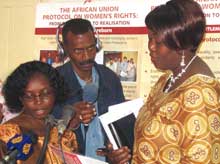
In July 2009, SOAWR, in collaboration with the AU Women, Gender and Development Directorate and UNIFEM, conducted a 3-day stakeholders' meeting on the implementation of the AU Protocol, designed to encourage a multi-sectoral approach to implementation. It brought together representatives of government and civil society organisations from 14 of the 27 countries that have ratified the Protocol. The purpose of the meeting was to support governments to implement the Protocol. The multi-sectoral implementation framework developed by UNIFEM was introduced to the participants as a tool for institutionalising commitment on women's rights across all sectors of government, thereby accelerating delivery. Participants adopted country specific plans for promoting its adoption, and released this communiqué [PDF] containing recommendations and strategies for strengthening the domestication, implementation, and reporting on the Protocol.
Women, Gender, Governance, and Rights
At the African Union meeting in Maputo in July 2003, the AU adopted the "Protocol to the African Charter on Human and Peoples' Rights on the Rights of Women in Africa". The Protocol offers significant potential to guarantee the rights of women. In order to come into force it needed to be ratified by at least 15 countries. Noting the slow pace of ratification of the Protocol, in March 2004, Oxfam GB, EqualityNow, FEMNET, CREDO for Freedom of Expression and Associated Rights, FAHAMU and thirteen civil society organisations that had been working on the Protocol formed SOAWR with the objective of trying to ensure thatmember states that had signed would ratify. On October 26 2005, the Protocol to the African Charter on Human and Peoples’ Rights on the Rights of Women in Africa received its 15th ratification, meaning the Protocol entered into force on November 25 2005.
Oxfam GB, EqualityNow, FEMNET, CREDO for Freedom of Expression and Associated Rights, Fahamu, National Committee for Human Rights, African Centre for Democracy and Human Rights Studies, Cellule de Coordination sue les Pratiques Traditionelle Affectant laSantedes Femmes et des Enfants, Coalition on Violence Against Women, Association des Juristes de Mali, Foundation for Community Development, Sister Namibia, Women’s Rights Advancement and Protection Alternative, Centre for Human Rights, Women in Law and Development in Africa Kafui, Akina Mama wa Afrika, Women in Law and Development in Africa.
FEMNET website on January 10 2006; FEMNET website; email from Caroline Muthoni Muriithi to The Communication Initiative on November 26 2009; and SOAWR website on August 20 2009 and December 8 2009.
- Log in to post comments