










































Research into Open Educational Resources for Development (ROER4D)
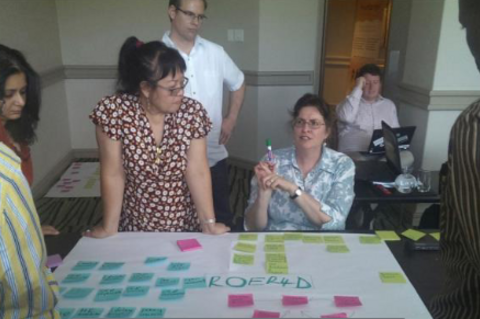
"The ROER4D project objectives are underpinned by developmental imperatives - driven not only by a belief that OER have a role to play in addressing current development needs in education; but also that demonstrating open research practices in project communication and dissemination activities increases its potential of achieving a positive developmental impact." - Michelle Willmers, ROER4D
The Research on Open Educational Resources for Development (ROER4D) project is a global research network on open educational resources (OER) and development. The Hewlett Foundation defines OERs as "teaching, learning, and research resources that reside in the public domain or have been released under an intellectual property license that permits their free use and re-purposing by others." Examples of OER include full courses, course materials, modules, textbooks, streaming videos, tests, software and any other tools, materials, or techniques used to support access to knowledge. Funded by the International Development Research Centre (IDRC), ROER4D aims to provide evidence-based research from a number of countries in South America, Sub-Saharan Africa, and Southeast Asia in an effort to improve educational policy, practice, and research in developing countries by better understanding the use and impact of OER. Specific objectives of the programme are to:
- Build an empirical knowledge base on the use and impact of OER focusing on post-secondary education;
- Develop the capacity of OER researchers;
- Build a network of OER scholars;
- Curate research outputs as open content and, where feasible, share data collected as open data; and
- Communicate research to inform education policy and practice.
The network is coordinated by the University of Cape Town (UCT) in South Africa and Wawasan University in Malaysia. The network is subdivided into 12 sub-projects (and the impact studies strand of sub-project 10 has 8 possible sub-projects of its own), each headed by a research lead within the country or region to which the sub-project refers. These sub-projects (read about them on the ROER4D website) address specific objectives of the overall project, using methodologies appropriate to the subsidiary questions they will be interrogating. Eighty-six researchers and associates from 26 countries are taking part in ROER4D.
Each sub-project is tailored towards a specific research question to discern how OER are being adopted and having an impact in the Global South. Some of the questions include:
- How aware of OER are students and lecturers and what factors enable or constrain OER awareness?
- What OER do they access and why, and what factors enable or constrain OER access, discoverability and frequency of use?
- What OER are lecturers and/or students creating and why, and what factors enable or constrain OER creation, licensing, curation and distribution?
- Why are students and lecturers using or not using OER?
- How and why are students and lecturers reusing, revising, remixing, redistributing OER and what factors enable or constrain OER reuse, curation of derivative works and redistribution?
- What are students and lecturers' perception of the value of OER in addressing key educational challenges?
- What is the impact of changes in practices and/or education policy following the adoption of OER?
One project run by IT for Change (ITfC) is implementing action research on a professional learning communities (PLCs) model for collaborative creation of OER through the Subject Teacher Forum program (STF) in India's Karnataka state. STF is an in-service teacher education programme for high school teachers in Karnataka that was started in 2010-2011 by the Rashtriya Madhamika Shikshana Abhiyana, Karnataka, a programme for the universalisation of elementary education, in collaboration with ITfC. Using the PLCs model, high school teachers of the STF are collaborating to access, create, curate, and publish OER. Teachers across 34 districts have learned to use digital tools and resources in their classroom teaching. The STF now virtually connects 14,000 teachers and teacher educators across the state. Network participants have created and published more than 5,000 Web resources on the Karnataka Open Educational Resources portal. Based on these project outcomes, the PLC model is being replicated in Telengana and proposed in Assam, on behest of the respective state governments.
For the first project objective, building an empirical knowledge base on the use and impact of OER in education, ROER4D has engaged in a wide variety of research communications activities. This includes sharing open access literature and/or reference lists and sharing draft versions of works produced within the network - such as via the ROER4D website. The resources on this page are organised by the 6 strategic areas outlined in the design of the ROER4D project: (i) to develop the knowledge base of OER researchers in the Global South; (ii) to develop the research skills and competencies of OER researchers; (iii) to demonstrate Open Research by sharing project planning and management documents throughout the research process; (iv) to communicate ROER4D's findings, processes and insights throughout the course of the project; (v) to evaluate the operation of the project during the research process in order to intervene effectively when problems arise; and (vi) to organise, store, and curate project outputs to ensure long-term accessibility. Final reports will be released in 2017 for public review. Also available: nearly 600 bibliographic references (as of this writing) openly available to researchers worldwide, showcasing Southern and Northern OER research. They have also already openly shared three data sets from sub-projects, and have plans to openly share the rest as they become ready.
The primary mechanism by which the network team has tried to build research capacity within the ROER4D project has been through an extensive question harmonisation process in which researchers work with each other via synchronous webinars to create a harmonised set of questions for their sub-project survey or interview questions. This process consisted of the team taking these steps: consulted 9 major OER surveys to develop a bank of potential questions in a cloud-based spreadsheet made public with comment rights; discussed question options, chose the best and recorded rationale for decision in a cloud-based document made public with comment rights; shared questions with researchers, showing how they would appear via an online survey site; engaged with researchers online via webinars to harmonise questions; continued discussion off-line via discussion on Sakai-based forum and/or email; piloted survey based on harmonised questions with ROER4D members and other OER colleagues (version 1); assessed results and fed results of pilot survey back to network; revised the questions and shared them with network (version 2); and had researchers present their adaptations of the survey for their specific sub-projects via webinar.
The sub-project teams also meet to share experiences from their research. For example, in January 2016, lead researchers from 6 of the 7 Impact Studies sub-projects met in Colombo, Sri Lanka to critically review methodologies, conceptual frameworks. and project progress. The 3-day event was organised by Wawasan Open University management team and hosted by the Open University of Sri Lanka.
With regard to the objective of building a network of OER scholars, ROER4D activities to help achieve this networking goal include: attending workshops, webinars, meetings, conferences; finding synergies with other OER research projects (e.g., OER Research Hub); finding mutually supportive activities with the GO-GN OER PhD network; tracking growth of the network since the inception of the ROER4D project through visualisations in NodeXL of data captured on a Google Spreadsheet; and encouraging mentors and researchers to participate in social media sites related to the project (e.g. Twitter, Facebook). For example, members of the ROER4D team were invited to a seminar with faculty from the Centre for Research on Activity, Development and Learning (CRADLE) at the University of Helsinki in Finland. The July 2015 seminar, hosted jointly by the School of Education at the University of Cape Town (UCT), the Fundani Centre for Higher Education, the Work-Integrated Learning Research Unit, and the Cape Peninsula University of Technology (CPUT), brought together about 50 people all working with an Activity-Theoretical Approach in some kind of research or in development interventions. This was of particular interest to the ROER4D researchers, as a number of their projects are using Activity Theory as an analytical framework to describe changes stemming from the introduction of OERs in schooling and/or higher education environments. Similarly, on September 4 2015, 2 faculty members from the University of Exeter, United Kingdom (UK) visited the ROER4D Network Hub to present findings from the "Beyond the Digital Divide: Sharing Data Across Developing and Developed Countries" project. While the Beyond the Digital Divide project focus is on open data as a component of open science, there are significant synergies with the ROER4D project in terms of investigating the access conditions and contextual factors that influence the contribution of developing-country scholars to the global knowledge commons.
Education
Higher education plays an important role in helping developing countries reach their development goals. Yet, higher education institutions in many developing countries face a number of challenges. Among them is the growing demand for postsecondary education when most universities lack sufficient funds, human resources, and up-to-date curricula. One potentially effective response to these challenges is OER. OERs are gaining significant reach globally thanks in part to greater access to the internet and new flexible intellectual property licenses. The Massachusetts Institute of Technology (MIT) created one of the world's first OERs (MIT OpenCourseWare) by putting course materials, syllabi, and lectures freely online. The site receives over one million visits per month, of which 27% originate from East and South Asia alone. While OERs are receiving considerable attention in universities, education ministries, and among donors, questions remain about the extent to which OERs help meet the demands for high quality tertiary education in developing countries. Research - especially in the Global South - is needed to move beyond the rhetoric and to establish whether OERs bridge the educational gap, and if so, how and to what extent.
Selected/initial ROER4D research findings:
- The concept of OER is not well understood by students and teachers: One of the sub-project (2)'s large survey of OER use among students and teachers indicates that the concept of OER is not understood under the terms typically used in the OER literature (i.e. reuse, revise, remix, and redistribute). This is even more problematic in languages other than English, such as Indonesian, Portuguese, and Spanish.
- Assumption that all digital resources are OER: Findings from sub-project 5 indicate that while teachers are often willing to share, they often don't understand or use open licensing. Many assume that all digital resources are free to use and share.
- Teachers' understanding of alternative licensing gives students more a active role in creating content: Findings from sub-project 6 indicate that teachers introduced to alternative licensing also share this knowledge with students, resulting in students taking a more active role in creating content.
- Granular OER more difficult to integrate into course materials: Findings from sub-project 7 indicate that OERs broken down into small, separate components are more time-consuming and difficult to integrate into course materials than more comprehensive sets of OER.
IDRC, with additional support from the UK Department for International Development (DFID).
Emails from Liane Cerminara to The Communication Initiative on September 1 2016 and September 14 2016 (including Interim Technical Report, March 31 2016 and other reporting documents and PowerPoint presentations); feedback from Matthew Smith forwarded to The Communication Initiative by Katy Stockton on October 13 2016; and IDRC website and ROER4D website - both accessed on September 16 2016. Image credit: ROER4D
- Log in to post comments