










































Reducing Maternal and Newborn Deaths (ReMiND)
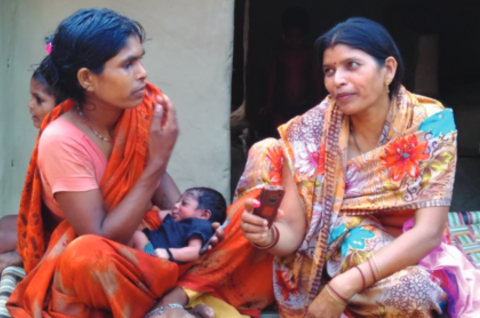
"What was really eye-opening was that with the phone, the illiterate ASHA, who seemed overwhelmed and a bit lost, was transformed to someone with increased skills and confidence, who was effective in her work and respected in her community. - Satish Srivastava, Health and Nutrition Manager, CRS (Lucknow)
Reducing Maternal and Newborn Deaths (ReMiND) project is a counselling and interpersonal communication intervention that uses technology as a support. Considering the poor health indicators in Uttar Pradesh (UP), India, and seeing the unrealised potential of the Accredited Social Health Activist (ASHA) programme, in April 2011, Catholic Relief Services (CRS), Dimagi, and local partner Vatsalya formed the ReMiND project, which has the following objectives:
- Increase ASHAs' coverage (i.e., increase the number of pregnant women who are visited at least once by an ASHA).
- Increase ASHAs' frequency and quality of counselling with their pregnant clients.
- Increase client knowledge of danger signs during and after pregnancy.
- Increase the adoption of key maternal, newborn, and child health (MNCH) and nutrition practices of clients during and after pregnancy (e.g., number of antenatal care visits, Tetanus Toxoid injections, care seeking for danger signs, and appropriate breastfeeding).
ReMiND has a number of key intersecting components that work together to strengthen community-level systems around maternal and newborn health:
- The ASHA app: A phone-based counselling job aid to support the ASHA to mobilise the beneficiary to access health services (implemented in two blocks of UP).
- The Sangini app: An app that helps the ASHA supervisor, called a Sangini, supervise and support the ASHA's work, according to a 10-indicator list (implemented in nine blocks of UP).
- Meeting platforms: Existing meeting platforms are reworked to ensure they are an opportunity for problem solving, support, and learning. There are meetings for ASHAs, for Sanginis, and one for Block Health Education Officers (implemented in nine blocks of UP).
- A training programme to build interpersonal counselling skills and phone literacy.
The apps were developed on the CommCare platform. CommCare has been widely adopted across different sectors in 50 countries. Designed for low-resource settings, the platform empowers frontline workers to collect data and simplify their work.
The integration of information and communication technology (ICT) into this initiative at the community level in select districts of the state of UP, India, is part of a strategy for improving interpersonal communication and supportive supervision in order to strengthen community health systems.
ASHAs use mobile phones operating open-source software that equips them with multimedia job aids to support client assessment, counseling, and early identification, treatment, and/or rapid referral of pregnancy, postpartum, and newborn complications. The main focus is on the ASHA's central task: visiting pregnant women in her coverage area and providing counseling for appropriate health behaviours and referral services. She registers each new mother, entering client data into the phone, and on each subsequent visit, the application walks ASHAs through checklists, questions, and educational prompts to identify current issues, determine if prior treatment was followed, and share new counseling points based on the woman's stage of pregnancy. Once a birth is reported, SMS reminders repeatedly prompt the ASHA to conduct scheduled postpartum visits until that visit is recorded in the system. The system also alerts ASHA supervisors via SMS if ASHAs miss postpartum home visits. The application also guides ASHAs in early identification of problems and supports rapid referral of women and newborns with complications to appropriate care. A range of educational modules present behaviour change messages through use of images and audio, which are fully aligned with government guidance for ASHA pregnancy home visits.
The Data Dashboard is a visualisation tool summarising data collected by the ASHA. The data are transmitted in real time to a CommCare cloud-based server. This allows project supervisors and government health professionals to monitor ASHAs' activities in even the most remote areas and provide timely, effective guidance. Date ranges for key indicators can be selected by quarter. (The goal is to build trust by creating very clear and achievable expectations; an ASHA knows her targets and the supervisor can clearly see if she has achieved them. "This trust and confidence built between the ASHA and the supervisor through the app is visible - and is at the heart of the project's success.")
Central steps have included (for further details, see the reports cited in the Source section, below):
- Initiate - Successful ICT for development (ICT4D) interventions start with a common understanding among all stakeholders of the purpose and scope of the project, roles and responsibilities, and anticipated outcomes. The ReMiND project started out as a testing ground for Dimagi's beta version of their CommCare app. CRS and Vatsalya provided project structure. The partnership allowed Dimagi to build the ReMiND team's capacity in mHealth from the outset. CRS has worked in UP in the area of maternal and child health for many years, with strong networks across a number of districts. Prior to ReMiND, CRS had an SMS (text messaging) reporting system for the Sure Start project. CRS and Vatsalya were also partners in the United States Agency for International Development (USAID)'s Vistaar project (2006-2012), working in Kaushambi, which had a strong focus on strengthening community-level systems through improved supervision. These past projects helped refine the team's focus for the ReMiND project.
- Develop requirements and architect solutions - The ReMiND project worked with different stakeholders to understand system constraints and user needs - clearly defining the requirements for a phone-based solution. When the project started in 2011, the team reviewed a report from the National Health Systems Resource Centre/National Health Mission that identified some of the key reasons for the poor performance of the ASHA programme in UP. There was insufficient capacity, no support, and no management structure. CRS also conducted additional assessments, which backed up these findings. In addition, from 2006 to 2011 (when the Sangini cadre was introduced), no one was checking the ASHA records, and they were largely left to themselves in terms of problem solving. The CommCare ASHA counselling app provides a solution to these systems bottlenecks by supporting improved, structured interpersonal communication between ASHAs and beneficiaries, and consequently between ASHAs and Sanginis. Consulting with different stakeholders to assess needs and opportunities allowed the ReMiND team to get a thorough understanding of the requirements for an mHealth solution, and build broad commitment.
- Design - The ReMiND team created ongoing iterations based on user experience, feedback, and emerging needs. The ReMiND team designed the initial ASHA app collaboratively with Dimagi over a year, working with 10 ASHAs on a daily basis; this made it easy to understand their roles and needs. This close working with ASHAs at the outset was in itself a big step away from traditional programming, as they were usually at the receiving end of a programme - or may have been brought in for a token consultation at the end. All the content was taken straight from the government guidelines, and then converted into an app-based format by Dimagi. Despite working so closely with the ASHAs, after a year of continual iteration, the team found the app was still not suitable. At the first training, it was discovered that only about 35% of the ASHAs were not literate; so, the team had to include more voice components and additional visuals. Initially the voice of one of the Lucknow team members was used for the voice part. But it was quickly realized that it was more compelling to women if it was in a local person's voice, using local vernacular - so they recorded the voice of an ASHA. The women felt like it was their friend talking to them. One of the key ways ReMiND catalyses system transformation is through building capacity. At the project's outset, the Sector Facilitators were ReMiND project staff, providing the main link between the ASHAs and the ReMiND team at headquarters. These project team members accompanied the ASHAs on field visits, helped them with technical issues with the phone, and provided ongoing handholding support. They supported the ASHAs in building their confidence and overcoming caste and social barriers, so they were able to extend their coverage. To create the app that supports this supervisory job role, the ReMiND team approached the staff of the National Health Systems Resource Centre (NHSRC) in 2013 to ask them what they had in mind for the role of the ASHA Facilitator (or Sangini). The NHSRC had developed a list of 10 indicators to define whether an ASHA was functional or not. The ReMiND team took this checklist and put it in an app-based format. The Sector Facilitators were replaced by the Sanginis in 2014. ReMiND then created a new cadre of project staff called Block Mentors, who provide supervisory support to the Sanginis using another app: the Supervisory Monitoring app.
- Deploy - In the ReMiND project, training became a strong focus in building user capacity, and enabled feedback on the extent to which the solution met user needs. Alongside the sector-facilitators, ReMiND also built capacity through training, developing a rigorous training preparation process. Dimagi took the lead in developing the initial training materials, suggesting many components such as using local terms and metaphors for phone features. They had a training preparation checklist, which was combined with CRS' "seven steps" for planning a training, and tailored to the ReMiND project. These were captured in a facilitation guide developed collaboratively by all partners (this is included in the online ReMiND toolkit). The capacity building process started with helping ASHAs to simply feel comfortable with the phone and the new technology. There was a lot of initial discomfort with the phones, and the team had to thoroughly revise the training approach to accommodate the low literacy levels. For the non-literate ASHAs, family members were invited so they could also provide support. They also used a lot of visual material. the ASHAs were trained in small groups of about 15 so they could be given individual attention. Supervisors were also included in the training so they could learn and provide follow-up support where required.
- Operate, maintain, and improve the ICT solution over its life cycle - The ReMiND project made a constant and ongoing effort to understand the needs of ASHAs and Sanginis, and to revise the solution design accordingly. One example of how the app changed with feedback was a reduction in counselling topics. Initially, in the pilot, there was a checklist of health behaviours, and then the ASHAs were supposed to provide counselling on all the topics in the checklist. The shorter protocol is easier and more comfortable for both the ASHA and her client, and the ASHA does not wear out her welcome.
- Capture and share results - Capturing results and lessons learned from the implementation of ICT projects is critical in accelerating adoption and ensuring future success. ReMiND has a comprehensive monitoring and evaluation system that feeds into ongoing quality improvements. The project team compiles monthly and quarterly reports against indicators, for sharing with the team, health managers, government counterparts, and partners. This data is shared in monthly meetings and used for project refinements, performance management and resource allocation. Lessons learned have not just helped internal improvements, but have also made contributions to the mHealth knowledge base (see below).
Health, Women, Children
Twenty-two percent of all children who die worldwide before reaching the age of five are born in India - more than 1.4 million boys and girls each year. With the goal of reducing preventable deaths, the Government of India in 2006 formed a network of 825,000 women who serve as ASHAs in rural communities. ASHAs are volunteer community health workers who act as the key links between rural households and the health system. While this new cadre has the potential to improve health outcomes, its impact is undermined by uneven performance, low levels of literacy, poor role clarity, and no management structure.
Experience from this project has helped CRS, Dimagi, the Ministry of Health in UP, and other partners understand how to implement mHealth projects in different contexts, both within UP and globally. All along, ReMiND mobilised resources and built relationships with research partners to support additional studies and assessments to understand what worked in terms of ICTs and community health workers. Case studies of ReMIND have been included in a number of toolkits and frameworks, such as the World Health Organization (WHO)'s The MAPS Toolkit: mHealth assessment and planning for scale.
CRS, National Health Mission, Dimagi, and Vatsalya. The CommCare Exchange was built with funding from United States Agency for International Development (USAID) Development Innovation Ventures fund (DIV) programme.
New CRS publications - August 2017; and ReMiND website, Six Steps to mHealth Success: How ReMiND Catalyzes System Transformation [PDF], The ReMiND Project: Reducing Maternal and Newborn Deaths [Case Study - PDF], Mapping mHealth Success: The ReMiND project [PDF] - all accessed on August 22 2017. Image credit: Neeraj Sharma/CRS
- Log in to post comments