










































Recruiting Young Gay and Bisexual Men for a Human Papillomavirus Vaccination Intervention Through Social Media: The Effects of Advertisement Content
Ohio State University (Reiter, Katz, Shoben, Paskett); University of Pennsylvania School of Nursing (Bauermeister); University of Minnesota Medical School (McRee)
The aim of this study was to evaluate the effects of different images and text included in social media ads used to recruit young gay and bisexual men for the pilot test of a Web-based human papillomavirus (HPV) vaccination intervention in the United States (US). Gay and bisexual men have high rates of HPV infection and several HPV-related diseases, including anal cancer and genital warts, but studies suggest that fewer than 15% of young gay and bisexual men have received any doses of the HPV vaccine. Web-based approaches, specifically social media sites, represent a promising approach for recruiting young gay and bisexual men for research studies on HPV vaccination. Little is known, however, about how the performance of social media advertisements (ads) used to recruit this population is affected by ad content (i.e., image and text).
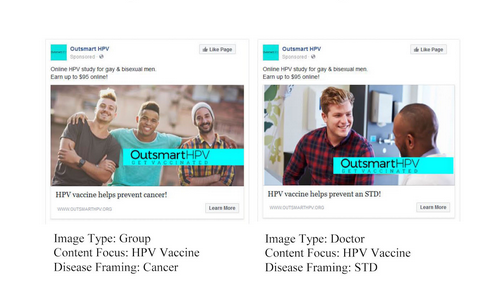
"Outsmart HPV" is a mobile-friendly Web-based HPV vaccination intervention developed for young gay and bisexual men. In July and September 2016, the researchers used paid Facebook advertisements to recruit men who were aged 18-25 years, self-identified as gay or bisexual, were a US resident, and had not received HPV vaccine. The headline ("Earn Up To $95 Online!"), Outsmart HPV logo, and weblink to the project website were identical for all ads. The main text for all ads started with "Online HPV study for gay & bisexual men", but the remaining main text and image varied across the ads using a 4x2x2 factorial experiment design that varied: ad image (a single young adult male, a young adult male couple, a group of young adult men, or a young adult male talking to a doctor), content focus (text mentioning HPV or HPV vaccine), and disease framing (text mentioning cancer or a sexually transmitted infection, or STI). Poisson regression determined whether these experimental factors affected ad performance.
The recruitment campaign reached a total of 35,646 users who viewed ads 36,395 times. This resulted in an overall unique click-through rate of 2.01% (717/35,646) and an overall conversion rate of 0.66% (241/36,395). Reach was higher for ads that included an image of a couple (incidence rate ratio (IRR)=4.91, 95% confidence interval (CI) 2.68-8.97, P<.001) or a group (IRR=2.65, 95% CI 1.08-6.50, P=.03), compared with those that included an image of a single person. Ads that included an image of a couple also had a higher conversion rate (IRR=2.56, 95% CI 1.13-5.77, P=.02) than ads that included an image of a single person. Ads with text mentioning an STI had a higher unique click-through rate (UTCR) compared with ads with text mentioning cancer (IRR=1.34, 95% CI 1.06-1.69, P=.01). The campaign cost a total of US$413.72 and resulted in 150 eligible and enrolled individuals (US$2.76 per enrolled participant).
Pondering these findings, the researchers suggest that ads including an image of a couple may have appealed to the importance of romantic relationships during adolescence and young adulthood. In addition, these ads could have prompted potential participants to think about the health of their sexual partners, which may have been motivating; previous research suggests that young sexual minority men view the protection of their partners' health as an advantage of HPV vaccination. Ads that included an image of a group of young adult men may have affected potential participants' perceived social norms about the topic and the study. From the researches' perspective, future studies that recruit through Facebook should use ads that feature multiple individuals in the target age range and should feature individuals who are racially or ethnically diverse, as was done in this study, so that the ads are relatable and appealing to a wide audience.
In terms of the content included in the Facebook ads, ads with main text mentioning an STI had a higher UCTR compared with ads mentioning cancer. Past research suggests that adolescents and young adults tend to focus on potential short-term vs. long-term consequences as compared to older adults, and potential participants likely perceived STIs to be a more relevant and immediate health outcome than cancer.
The researchers conclude that Facebook ads are a convenient and cost-efficient strategy for reaching and recruiting young gay and bisexual men into research studies. Recruitment via community settings (e.g., community events and organisations) has been a frequently used approach, but it may oversample individuals who are more involved with the lesbian, gay, bisexual, and transgender (LGBT) community. Some individuals may also be less willing to self-identify as gay or bisexual (or disclose same-sex behaviour or attraction) when recruited in-person compared with other approaches. Furthermore, an estimated 72% of adult internet users in the US report use of Facebook, and the social media platform has more than 6 million sexual minority users in that country.
"To help optimize ad performance among this population, researchers should consider the importance of the text and image included in the social media recruitment ads."
JMIR Public Health Surveillance 2017;3(2):e33. doi:10.2196/publichealth.7545
- Log in to post comments