










































Public Participation in Local Governance Programme
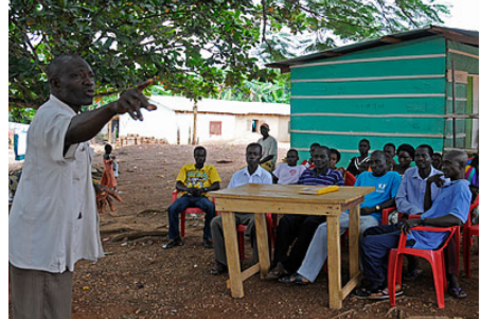
Using the rights-based approach, the interventions of the PPLG are designed to create community awareness of civil society's rights and obligations in the decentralised governance system. The programme is implemented in all districts of the Upper East Region, the East Gonja district, and the Tamale Metropolitan area in the Northern Region, as well as in the Ashaiman Municipality in the Greater Accra Region. This geographic mix was chosen to provide a framework for learning how experiences promoting good governance in predominantly rural settings can be scaled up to urban and peri-urban settings.
The programme activities are organised around four pillars, each with a key outcome:
For increased citizen participation in local governance
PPLG is designed to support:
- civil society groups' engagement in advocacy to influence local governance policies and programmes;
- civil society's active participation in policy dialogue with local government institutions; and
- civil society's active involvement in monitoring, evaluation, and follow up on decentralisation policies and programmes.
Strong Civil Society Organisations who can mobilise their communities and hold local government accountable
PPLG is designed to support organisations and their activities in order to:
- mobilise their constituencies in engagement processes;
- become actively involved in networking and forming of alliances to increase their bargaining power; and
- influence and demand accountability from the Assemblies and the sub structures in the management of public resources.
Local government structures that work according to their mandate and collaborate with civil society
PPLG supports:
- the revitalisation of the zonal, town, and area councils for them to function according to their mandate;
- the Regional Coordinating Council (RCC) to engage regularly with district and sub-district authorities to ensure these structures are functioning according to the law;
Women who are organised and participate in decision-making processes.
PPLG supports local authorities and civil society in order to:
- organise women's groups to network and form alliances to increase their bargaining power; and
- promote and actively increase women representation in local government structures.
Governance, Rights
IBIS website on December 8 2011.
- Log in to post comments