










































Preventing Conflict, Transforming Justice, Securing the Peace: A Global Study on the Implementation of Security Council Resolution 1325
"This Study reinforces the [United Nations] Security Council's original crucial recognition of the power of engaging women in peace with compelling proof. It shows that women's participation and inclusion makes humanitarian assistance more effective, strengthens the protection efforts of our peacekeepers, contributes to the conclusion of peace talks and the achievement of sustainable peace, accelerates economic recovery, and helps counter violent extremism." - Phumzile Mlambo-Ngcuka, United Nations Under-Secretary-General and Executive Director of UN Women
The UN Security Council's High-level Review on the women, peace, and security agenda commemorates the 15th anniversary of UN Security Council resolution 1325, which recognised the role of gender equality and women’s leadership in international peace and security. Coinciding with the review is the launch of this report, which the Security Council invited the Secretary-General to commission in resolution 2122 (2013). It brings together research on the relationship between women's empowerment and gender equality and peace, compiling multiple examples of good practice. It also examines implementation and enforcement of the women, peace, and security agenda, along with the incentives and accountability measures that could motivate all actors to comply with these norms and live up to their promises.
The report provides context, such as the fact that, over the last 15 years since resolution 1325 was adopted, the percentage of women in peace talks has stagnated in single digits, with national dialogues and decisions in conflict-affected countries routinely dominated by a small group of male leaders. Only 3% of the military personnel in UN missions are women. Prior to the adoption of Security Council resolution 1325, 11% of peace agreements made a reference to women or gender. Since then, this percentage has increased to 27%, yet this is still low. Findings in the study highlight that when women are at the peace tables, their participation increases the probability of a peace agreement lasting at least 2 years by 20%, and 35% over 15 years. Furthermore, evidence reflected in the study shows that States that have higher levels of gender equality are less likely to resort to the use of force in relation to engagement with other States - making gender equality a powerful tool of conflict prevention. Yet under-investment in gender equality continues, with only 2% of aid to peace and security in fragile states in 2012-2013 targeting gender equality as a principal objective.
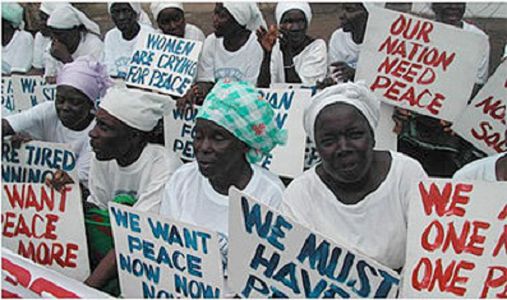
What exactly does women's participation in peace processes look like, and what is the compelling argument for advocating for it? Chapter 3 of the report explores these and other questions in detail. This chapter presents a growing body of research that connects the inclusion of women in peace processes, including national dialogues and post-conflict implementation of peace accords, with more durable and stable peace. (Oft-cited in this chapter is research undertaken by the Graduate Institute of Geneva/Inclusive Peace and Transition Initiative's Broadening Participation Project from 2011 to 2015 that involved an in-depth analysis of 40 peace processes since the end of the Cold War.) It also highlights both good practice and implementation gaps, and proposes comprehensive recommendations on the way forward. It is noted here that women have always participated in peace negotiations and peacebuilding, but usually at the informal level and rarely visible to the formal peacemakers and keepers of peace. Women have surrounded buildings to make leaders stay in the room, such as in Liberia; they have elected themselves as a third force, such as in Northern Ireland; they have demanded that justice be part of any peace process, such as the Mothers of the Plaza de Mayo; they have rallied the country with calls for peace, like the Women in Black in Serbia. The present programmes put forward by the international community to include women in formal peace processes tend to be extremely narrow: just to bring a female body to the table with some technical expertise. "[T]hough this does have a direct impact, there must be a collective commitment and a qualitative change in the understanding of 'inclusive' politics in the context of conflict situations...". As noted here, one of the most repeated effects of women's involvement in peace processes, as highlighted in the 40 case studies referenced above, was pushing for the commencement, resumption, or finalisation of negotiations when the momentum had stalled or the talks had faltered. This shows the impact of women bringing a particular quality of consensus building to public debate, not necessarily on issues, but on the need to conclude talks and implement agreements.
Yet, across the 40 case studies, women's inclusion was often contested, rarely a natural and unforced element of proceedings, and mostly initiated and achieved via concerted pressure and lobbying by women's organisations within the country, rather than by the conflict parties, the mediators, or the organisers of the negotiations. These and other barriers to participation outlined in the chapter can be softened through political will, which is applied by parties to political settlements and their supporters when they proactively engage women leaders and women's organisations in dialogue to resolve conflict, especially when this is perceived as alien to local political practice. Political will is also exercised by mediators and political actors when they craft coalitions and support the emergence of new political forces that are inclusive and democratic. A series of specific recommendations is outlined on pages 58-59, such as: "develop and fund a strategy of long-term support to build the capacity of women's networks to engage in political dialogue; strengthen the gender awareness of mediators, facilitators, and conflict parties; address practical issues that may limit women's engagement - from granular details such as procedures for circulation of agenda and materials to bigger issues like the use of local languages; and protect women activists from potential backlash."
The report includes a detailed series of recommendations based on all the chapters of the report. For example, all key actors must play a role in involving women in peacebuilding, including civil society organisations, youth, and the media: "Media organizations, both public and private, should be encouraged to advocate for and give visibility to issues relating to women, peace and security. In addition, they should respect a code of ethics that proscribes hate speech and the stereotyping of women and their communities." Ideas for building a strong gender architecture at the UN are included.
The report concludes with a call to action: "In all previous generations, when the world was at war, where there was increased militarization and terrible violence, women have come forward as peacemakers and peacebuilders. Today is no exception. It still happens at the local level, whether in Syria or the DRC [Democratic Republic of the Congo]. The international world, by embracing 'celebrity culture' has forgotten these women, and allows them to remain invisible. It is important to turn the spotlight again onto these women peacebuilders, to support and fund their efforts. Networks must be created at the local, regional and international level, so that their voices and activities can reach a climax and stem the current tide of recurrent militarization and mindless violence."
Click here to download the report in several languages. Join the conversation around the High-level Review on women, peace, and security on Twitter using the hashtags #1325at15 via @UN_Women
Press Release sent from UN Women to The Communication Initiative on October 16 2015. Image credit: GBM News
- Log in to post comments