










































Policy Analysis and Advocacy Decision Model for HIV-Related Services: People Who Inject Drugs
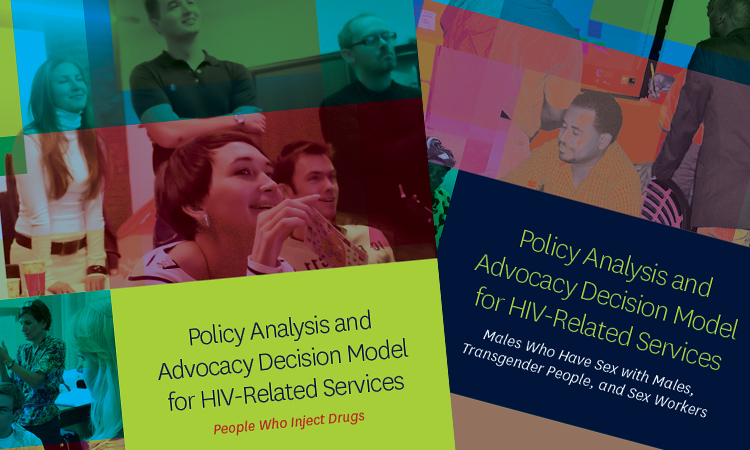
Based on the observation that "[b]iological, behavioral, and structural factors put people who inject drugs (PWID) at higher risk for HIV transmission than other individuals, even in generalized epidemics", this decision model is designed to help country stakeholders build a public policy foundation that supports the access to and implementation and scale-up of evidence-informed services for PWID. The model provides tools to help advocates, policymakers and decisionmakers, national committees and advisory boards, programme developers, service providers, clients, nongovernmental organisations (NGOs), and other stakeholders identify and address the policy barriers to PWID services.
This collection of tools was designed by the United States (US) Agency for International Development (USAID)-funded Health Policy Project and the Eurasian Harm Reduction Network to help stakeholders create an inventory of country policies, analyse these policies against international best practices and human rights frameworks, assess policy implementation, and create a strategic advocacy plan. The primary goal of the model is to identify the policies that most directly affect access to and sustainability of key PWID services and the needs and opportunities for policy advocacy that will improve access to services. While intended for global application, the decision model pays special attention to the policy issues facing Eastern Europe and Central Asia.
Stakeholders can use the tools to identify restrictive, poorly written, and absent policies that impact the access to and sustainability of key services for PWID, including HIV counselling and testing, antiretroviral therapy (ART), hepatitis and tuberculosis services, opioid substitution therapy, and needle and syringe programmes. These services are analysed within the settings of community-based programmes, pre-trial detention, prison, and institutions that have custody of minors. There are more than 1,300 policy points for analysis. Policy areas include: service coordination; data use and decisionmaking; participation of PWID in decisionmaking, service delivery, and evaluation; consent; personal data; stigma and discrimination; criminal sanctions; gender-based violence; human rights; procurement and supply management; eligibility; funding; and service delivery protocols.
The model is organised into two chapters. The first chapter provides background information on the overall policy framework, the decision model's components, and additional advocacy strategies. The second chapter includes 4 sets of tools that collect various quantitative (inventory) and qualitative (interviews) data on policy language and implementation, collate the quantitative data for comparison (matrix), and provide basic steps to create an advocacy strategy and set priorities (worksheets). In addition to the type of information collected, the decision model provides levels of detail appropriate to different kinds of stakeholders - from an inventory of detailed language that identifies specific clauses to change, to an assessment of policy implementation that identifies barriers to programme access and implementation, to an overview of policy documents that can identify gaps in the overall policy matrix (see Table 1).
A companion decision model geared specifically toward males who have sex with males (MSM), transgender people, and sex workers is also available; see Related Summaries below for access.
Click here in order to access various focus briefs related to this publication, as well as to access the full PDF decision model in English and Russian.
Publishers
English, Russian
266
Emails from Sarah McNabb to The Communication Initiative on September 27 2013 and October 3 2013.
- Log in to post comments