










































Onelove Campaign Lesotho
From February to September 2009, 12 60-minute talk shows were broadcast on the national radio and television stations in Lesotho. The format of this show is a combination of recorded personal stories and live discussions between a presenter, an expert, and telephone call-ins from members of the public with a story to share. A total number of 124 Basotho women and men called in to air their opinions on different topics that were discussed. All the shows were recorded on CD and DVD. Working with one of the popular local jazz musicians, Phela also developed a Onelove song which was used as a signature tune on the shows.
Four PSAs were created and broadcast on the national radio station (Radio Lesotho) and on 3 other radio stations - namely, Moafrika FM, Harvest FM, and the popular youth radio station PC FM. Two new PSAs dealing with migration and inter-generational sex have been developed and will also be aired.
Five billboards with 5 different messages on MCP were developed and erected in all the district towns of Lesotho. The messages on these billboards covered issues such as intergenerational relationships and cultural practices related to extramarital affairs. These billboards were removed in June 2009, and new ones covering issues of alcohol abuse, communication about sexuality, HIV and sexually transmitted infections (STIs), and intergenerational sex have been developed to replace them.
The campaign is also distributing a 4-page pamphlet on Onelove which gives basic information on MCP and is meant to raise awareness of the link between the high incidence of HIV and the practice of having multiple concurrent partners. The pamphlet is inserted inside Phela's booklet "Men, Women and HIV and AIDS". Click here to download the pamphlet in PDF format.
In November 2009, a second booklet called "Relationships Made Easy" was produced and more than 406, 000 copies distributed throughout Lesotho.
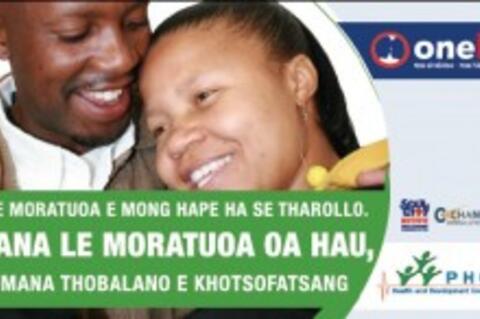
A series of posters, copies of which were published as a Flickr slideshow here, were developed. The translation of the message pictured above is: "having another sexual partner is not liberation. Talk to your lover so that you can find ways to sexually satisfy each other."
A Onelove radio drama was broadcast in October 2009. This 45-episode drama aimed to encourage people to reduce the number of partners. After every fifth episode of the radio drama, a competition was run where listeners could answer a question by short message service (SMS) and receive a prize. According to the organisers, the response to the competition was immense, which they believe is an indication of the popularity of the show. The drama is supported by a marketing campaign that includes radio, sports events, and newspaper adverts.
Phela, in partnership with C-Change, has established a community outreach programme to complement the media components. 560 community dialogue facilitators in different parts of the country were trained. These facilitators carry out dialogues in their respective communities over a period of 8 weeks. The facilitators have mentors who monitor and support them on a continuous basis. So far (as of May 2010), community dialogues have taken place in 5 districts which are most affected by HIV and AIDS - Maseru, the capital, Leribe, Butha-Buthe, Mokhotlong, and Mafeteng.
A 15-minute video documenting the successes of the Onelove activities since its inception in February 2009 was also produced.
From March to May 2010, the OneLove campaign in Lesotho broadcast the "Love Stories in a Time of HIV and AIDS" series, a collection of 10 short films produced in 10 SADC countries as part of the OneLove Campaign. A repeat broadcast is planned for the second half of 2010. The series included the OneLove Lesotho film "Monna oa Motsamai - The Travelling Man" which was produced by Phela Health and Development Communications. The film tells the story of Motsami Raliselo, who leads a double life, often leaving his wife and children to travel for work to Lesotho where he also has another sexual partner. The film deals with his reaction when he finds out that he is HIV positive. DVDs of the film are also being distributed and used by organisations in their community outreach programmes.
In conjunction with the broadcast of the series and as a marketing and monitoring tool, the OneLove Lesotho campaign ran a 15-minute radio talk show programme. A summary of a film shown the previous week would be given by a Phela Officer in the first 8 minutes, followed by listener call-ins with questions and comments. At the end of the programme, a competition question was asked and the winners of the previous week's competition announced. At the same time the date and time of the next film was advertised. According to Phela, the radio programme received a total of 124 calls, and a total of 2,700 SMS competition entries were received.
The "Meet Joe" booklet, which is being used across most OneLove campaigns in the region, was distributed in collaboration with two migrant worker recruiting agencies. Events were held in three districts where migrant workers could view the "Meet Joe" PSA on DVD, participate in educational talks, and receive copies of the booklets. Other stakeholders were invited to talk about other aspects of HIV. These were Population Services International (PSI) and Lesotho Planned Parenthood Association (LPPA) who demonstrated and distributed condoms, and also provided Voluntary Testing and Counseling (VTC) on site. The "Meet Joe" PSA is also being broadcast on national television.
HIV/AIDS
Lesotho is rated the country with the third-highest prevalence, now estimated at 29%. It is further estimated that 1 in 3 people between the ages of 15 and 49 years in Lesotho is HIV positive. The prevalence is particularly high in urban areas, with levels at 28.8% compared to 21.8% in the rural areas (with a considerable variation in prevalence rates by district).
C-Change, Soul City, Social Surveys, and CARE.
Emails from Hope Dolo of Phela Health and Development Communication to Soul Beat Africa on October 22 2009; and Onelove Lesotho website December 8 2009, and email from Hope Dolo on May 14 2010.
Comments

One Love Campaign
This was a very comprehensive campaign; touched all age groups and used a variety of media houses. It has been the most popular as far as I have known about HIV and AIDS. Job well done Phela! Keep the fires burning.
However I would love to know the source for the 29% prevalence for Lesotho. I think it's stands at 23.2% currently.
Moeti Mohoang
onelove campaign
i found this programme very helpful, but to a certain percentage in Lesotho. Because other people specially in rural areas, still does not understand how HIV/AIDS get to a human being, but lets hope for the best for Phela programmes, although we will see a change afer some years.to me it was very helpful, but for thosewho doesn't know about it,Phela has to work on it.
- Log in to post comments