










































Nokia Mobile Learning for Mathematics
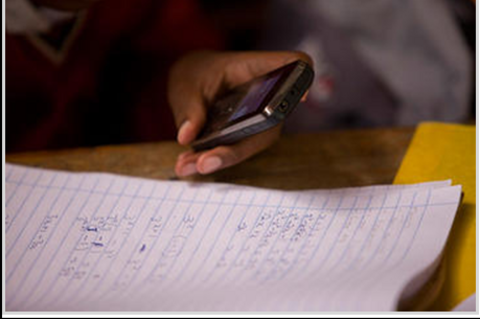
The first part of the project involved developing mathematics learning materials that were suitable for viewing on cell phones. Organisers say it was sometimes a challenge, for example, to keep the information short for the small size of a cell phone display, which also meant that the resolution of graphics and mathematical symbols was limited, so the types of questions in the exercises and tests reflect these constraints. Multiple-choice was the dominant question type, but spot-the-error, and step-by-step questions (which show the first step in a multi-step procedure with students asked to select what the next step would be) were also developed. In this way the content was divided into small manageable components, even though the complete question contained many layers of detail. With this project, organisers say students can practise mathematics exercises from a cell phone at any time and receive immediate feedback, while teachers only need a two-day training course to learn how to use the new service.
The project uses social networking tools, such as the popular South African mobile chat platform, MXit, to allow groups to collaborate. Students need a cell phone that can access the internet, and organisers say many of them already use MXit to chat with friends. To complement the cell phone content, the project team set up a dedicated website using Moodle (an open source application to develop online learning sites) to allow students and teachers to track progress and activities on the web. The site also allows teachers to assign and monitor homework with little extra effort. The system makes it easy for teachers to see which students are having problems and identify areas that are causing difficulties.
Teachers receive a two-day orientation session, taught by project team members and teachers involved in the original pilot project. An e-learning co-ordinator or curriculum advisor from the local district education authority provides further support.
Nokia provided each school with a "mobi-kit", comprising a lockable case containing ten cell phones, all of which can be charged simultaneously from a single electrical point. Students who do not have their own cell phone, or are unable to borrow one at home, can at least have mobile access while at school. The teachers can also use the exercises and theory lessons in a classroom even if the students do not have cell phones, and make use of the tests to set ad hoc exams.
Students participate by first downloading the MXit application onto their phones (if they don’t have it already). This allows them to chat with their friends who are displayed as contacts within MXit. The students simply have to accept "MoMaths" as one of their contacts. They can then choose to work through short theory sections, or answer questions from a database of approximately 10,000 questions, categorised by topic and degree of difficulty.
The students receive immediate feedback on multiple-choice practice exercises, and can compare results with classmates in their school or other participating schools nationally. They can see if their topic scores improve as they repeatedly practise the exercises and can opt to take a test choosing their level of skill – easy, medium, or difficult – to assess their performance on a particular topic, and compare this to other students’ results.
Organisers say that a strong advantage of the project is that such a short training course appears to be adequate for teachers. This is also an advantage of using cell phone technology in educational programmes. Other benefits include lower costs compared to computer-based schemes, using social networking applications that are already popular with young people, and constant accessibility. This is reflected by the fact that 82% of student use/participation occurred outside school hours and continued during weekends and holidays.
Education
In general, organisers say the project was well received by teachers and school principals. They valued the additional practise that it gave their students, as well as the ability to monitor performance and give immediate feedback. The overriding concern from school staff was the lack of access to cell phones for some learners. An evaluation of the project, however, noted that this was not a necessary condition for regular use of the service, as 27% of regular users reported borrowing a cell phone or using the mobi-kit phones. Conversely, having a cell phone did not necessarily result in regular use of the service, as 39% of learners who described themselves as not being regular users had their own cell phones.
During the test period, there were more than 100,000 visits to the service, with students completing over 10,000 tests. According to organisers, competency in mathematics rose by 14% in all levels - among those who were good at the subject previously as well as those who were less proficient. The evaluation found that two-thirds of the teachers used the service, while about a quarter used it regularly. Many students, whose teachers did not use the service frequently, still used it independently.
Most teachers (79%) strongly agreed or agreed that the two-day teacher training equipped them with all they needed to know about the project. They reported this immediately after the training session, and reiterated the same views six months later. Organisers say this is significant, as research shows that teachers involved in schemes using computers to support learning and teaching often complain about a lack of adequate training. It also highlights a potential key difference between mobile technology and computer technology.
By the end of the second term of using the service, most teachers also agreed that the project had had a significant impact on their students’ attitude to mathematics, as well as on their own roles as mathematics teachers. The majority of teachers and principals in the case study schools indicated that they would like to continue using the service beyond the trial. Slightly more than half of the case study schools indicated that they would be willing to buy a mobi-kit for school use.
For more information contact:
Riitta Vanska
Senior Manager, Mobile and Learning Solutions
Nokia Corporation
riitta.vanska@nokia.com
Nokia, Neil Butcher and Associates
ICT Update website on March 3, 2011.
- Log in to post comments