










































Meeting the Educational Needs of Children with Disabilities: A Gap Analysis covering Bhutan and the Maldives
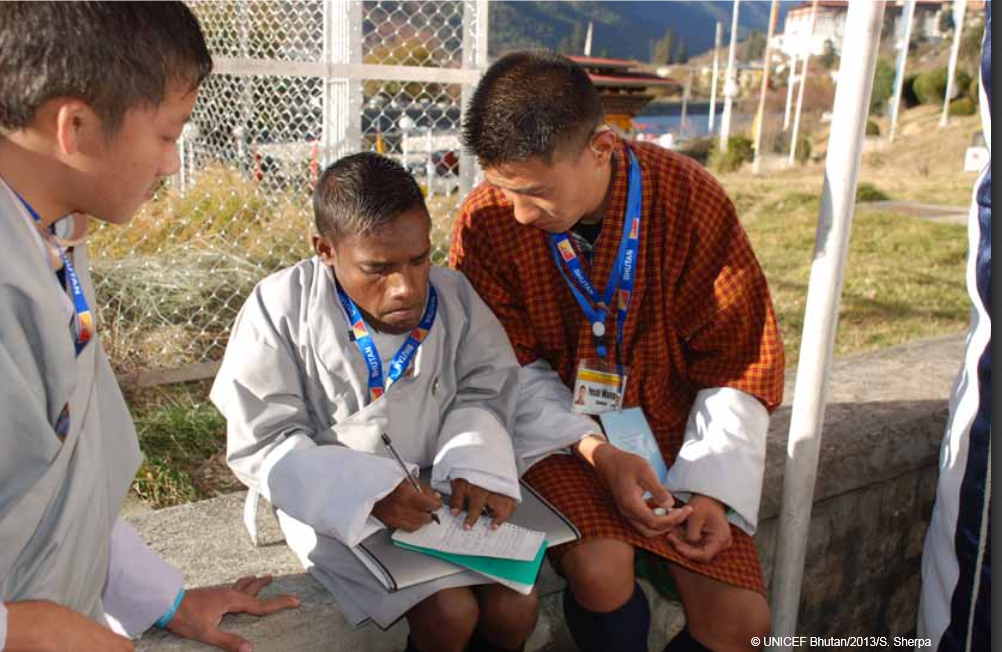
"How can government, civil society and UNICEF in three countries of South Asia work to successfully implement policy which includes children with disabilities and special needs in education?"
With this question in mind, working in collaboration with the Enabling Education Network (EENET), the United Nations Children's Fund (UNICEF) examined how the educational needs of children with disabilities were being met in Bhutan and the Maldives (also in Bangladesh, not covered in this report), and what prospects there are for UNICEF to work with national governments and development partners to implement inclusive education policies. The needs assessment was designed to inspire joint action in response to challenges such as "lack of appropriate facilities and learning materials, lack of trained teachers to meet special educational needs, inflexibility of the school system, stigma and a host of other actors." The assessment also complements the Rights, Education and Protection (REAP) project for children with disabilities, which is funded and implemented as a collaboration between Australia's Department of Foreign Affairs and Trade and UNICEF. The report includes several recommendations linked to improving access, policy and legal accountability, early childhood development (ECD) and early diagnosis, assessment (school tests), teacher training and motivation, school quality, collaborative practices, and areas for further research.
To begin the needs assessment, a consultative steering group was set up, composed of UNICEF and government education representatives from each country and from the UNICEF Regional Office for South Asia (ROSA). Participants began with a literature review of policy and practice documents from each country related to global learning on inclusive education policy and practice. (Key documents were shared more widely with UNICEF ROSA's regional network.) Subsequent country visits involved participatory techniques that included observation of schools and classes where disabled children are being taught, combined with semi-structured interview and focus group discussions with a range of stakeholders in the education of children with disabilities. These stakeholders included parents, children, head teachers, special educational needs (SEN) teachers, mainstream teachers, MoE officials, and representatives from non-governmental organisations (NGOs).
"The literature review and country visits for Bhutan and the Maldives revealed that both countries were making substantial efforts to change their education systems to better include children with disabilities....In Bhutan, while the legislative and policy framework is not yet that well-established, a wide range of technical improvements had recently been made to teacher training and practice which, while not yet reaching the majority of schools, provided a good starting point for upgrading inclusive teaching. Excellent collaboration between health and education ministries and other agencies have led to a new rapid assessment system for early diagnosis and referral of young children affected by disability. This system offers useful learning for other countries, particularly those with remote populations.
MoE staff in both countries had been very effective in using their personal and professional networks to share ideas and practices among teachers and policy makers. With additional planning support, this could have been built on more strategically.
The openness and willingness of stakeholders to listen to each other and work together appeared to be one of the most important factors in making change happen. The relatively small size of both countries may be a factor in such positive collaboration. In particular, there are already positive links and networks of support within the MoE, and between the MoE and other education stakeholders and other government departments. UNICEF has a close and positive working relationship with MoEs in both countries and has been credited with supporting collaborative efforts around inclusive education.
Both countries were experiencing problems in scaling up the significant innovations and good practices which had been piloted in schools. This was partly due to challenging conditions in each country for bringing teachers and other actors together, but also appeared linked to using a 'pilot school' based approach without clear and costed plans for spreading practice from pilot schools to other schools. There are lessons here for how UNICEF supports IE [inclusive education] initiatives in the region....Other key challenges included a lack of understanding on how to strengthen schools so that child-friendly, inclusive approaches become normal. There is also a need to show what the future for disabled young people can be after school."
Recommendations across various landscapes are provided, such as within the categories of:
- Education Access - Example from Bhutan: "Meeting the educational needs of children with disabilities in South Asia inclusive schools with other local schools that have not yet begun (or are not as far along in) their journeys towards inclusion. Such linking can allow schools to support each other by sharing training and experience, pooling resources, etc. If the current form of school provision - in which model special schools are meant to support mainstream schools in the same local area to become more inclusive - is to be continued in Bhutan, the relationship between special and inclusive schools needs to be looked at carefully. It is important that such relationships be mutually beneficial, drawing on the strengths of both the inclusive and special schools....It cannot be taken for granted that special schools will necessarily be able to support inclusive schools to be more inclusive of children with disabilities (or support mainstream schools to become inclusive schools) without on-going support from the government, NGOs, UNICEF and Community Based Organisations (CBOs). This necessitates a coordinated effort between governmental, non-governmental and CBOs, and the careful monitoring and planning of activities for example, exchange visits for teachers, organised training, collaborative activities for teachers, children and parents."
- Policy and Legal Accountability Recommendations - Example from Bhutan: "It is recommended that the language and terminology around SEN [Special Educational Needs] and inclusion be discussed openly during meetings/workshops/trainings so that common understandings can be reached. This is also part of the awareness raising/advocacy that needs to be done to further develop inclusive education. Alongside a review of language and terminology, it is important that existing policy be reviewed and changed or adapted using an 'inclusive lens', drawing on Bhutan's policy makers increasing knowledge and experience of inclusive education."
- ECD and Early Diagnosis Recommendations - Example from the Maldives: "Particular attention is needed for hearing impaired students who have not had the opportunity to develop the complex levels of Dhivethi (the national language) and English written languages needed for examinations....More focused planning by teachers to boost gaps in students' foundational learning skills will be needed....This will need clear and collaborative planning across all teachers working with such students....More thinking is needed on the variety of roles that SEN teachers can play in improving teaching practice across and between schools, rather than only running direct SEN classes. It will be important to bring SEN teachers together and support them to work in different ways in different contexts."
- Teacher Training Recommendations - Example from Bhutan: "Although there is much training to be had abroad, what about local training? What exists? What can be further developed, tapping into existing networks of support? What are the core teacher competencies that need to be promoted and supported through teacher education as a basis for all inclusion (e.g. teacher research/reflection, child-centred teaching and learning, positive discipline, differentiated approaches to teaching/learning, etc.)?"
- Teacher Motivation Recommendations - Example from Bhutan: "It is recommended that the MoE in consultation with other education stakeholders (including the Ministry of Labour and Ministry of Finance) continue to develop strategies for recruiting, motivating and supporting teachers and ultimately retaining high-quality teachers in the profession."
- School Quality Recommendations - Example from the Maldives: "Develop networks of teachers who would lead on whole school development and self-assessment across the Maldives."
- Collaborative Practice Recommendations - Example from Bhutan: "The MoE is interested in working more closely with the Ministry of Labour and Human Resources (e.g. in relation to providing enough well trained teachers to support inclusion)....More work should be done in considering the strategic linkages (e.g. how 'informal' school exchanges can be recognised, supported and more formalised in connection with the Educational Monitoring and Support Division of the MoE, and with other Divisions in the MoE) and how these can be further developed....More work should be done to further build on existing networks (formal and informal) involving the Teacher Education Board, UNICEF's Consultative Group For Inclusive Education and other (nascent) networks between the MoE, UNICEF and NGOs to ensure that there is proper time and space for such collaborative relationships to develop."
- Research Recommendations - Example from Bhutan: "More work should be done on mapping existing strengths, resources and connections that will support inclusion, as well as the barriers and challenges preventing inclusion (particularly for children with SEN). This should involve meetings and consultations with as wide a range of stakeholders as possible, including from the MoE, teacher education sector....Quantitative and qualitative research are both important....Research, training and advocacy should be developed and practiced as being intrinsically linked as this will work towards changing attitudes and opening up spaces and opportunities for inclusion as well as supporting and furthering existing inclusive practices. [Also needed:] More support for action research at the school community level and greater efforts to account for such research within policy and practice planning."
In sum: "The analysis found that there are strong policy intentions and significant good practices in each country. There are many examples of good, collaborative practices between education stakeholders which can be supportive of each country's inclusive education aspirations. The range of good practices and collaboration seen during the country visits, and the inventiveness with which some stakeholders had tackled inclusion problems, indicated that both countries had made good progress in adapting principles of inclusion to their own context. The commitment and innovation shown by individuals within schools, Ministries and NGOs was impressive, particularly in the Maldives. This indicates that national capacity to solve remaining challenges is good in both countries. In fact, findings from this research provided less of a gap analysis than a list of opportunities, where recent progress could be built on to expand inclusive education across the school system."
After the assessment was conducted, a sub-regional workshop was held in Paro, Bhutan, in December 2013 to enable practitioners and policymakers representing the Ministry of Education (MoE), UNICEF, NGOs, and other agencies from 6 countries in South Asia - Bangladesh, Bhutan, India, Maldives, Nepal, and Sri Lanka - to process learning from the needs assessment and come up with shared action plans for strengthening the education of disabled children based on the assessment's findings. UNICEF country teams committed to work with Ministry of Education staff and other agencies to take forward detailed plans for 2014 and beyond.
UNICEF Education Newsletter, October 15 2014.
- Log in to post comments