










































Masculinities, Faith, and Peace (MFP)
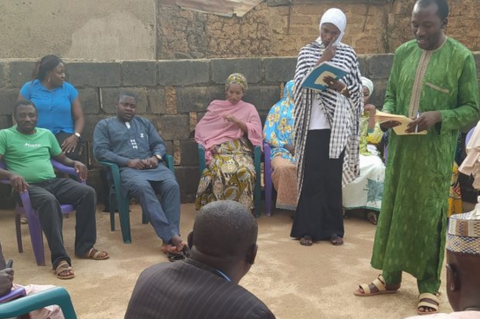
"MFP has enabled local communities across the faith divide to co-create pathways for the transformation of harmful social norms."
The Masculinities, Faith, and Peace (MFP) project, implemented from 2018-2021 by the Institute for Reproductive Health (IRH) at Georgetown University and partners, aimed to reduce sexual and gender-based violence (SGBV), increase healthy timing and spacing of pregnancies (HTSP), and improve inter-religious relationships in mixed Christian and Muslim communities in Plateau State, Nigeria. It did so by addressing social norms that shape inequitable gender relations and prevent the use of modern methods of child spacing. The focus of MFP was on couples at key life-stage transitions - newly married couples and first time parents - and their religious and community leaders.
MFP is a research-led adaptation of the Transforming Masculinities (TM) intervention conducted in rural, eastern Democratic Republic of the Congo. TM, described at Related Summaries, below, uses a process of participatory scriptural reflection and dialogue with religious leaders and congregants to identify, create, and embrace new, positive masculine identities. IRH and partners built on the original curriculum to include components on family planning (FP) and sexual and reproductive health (SRH) education and explore linkages to FP clinics and services in Plateau State, Nigeria. MFP also engages religious leaders in peace-building and violence prevention activities to improve social cohesion.
In the spirit of TM, MFP was grounded in community participation: It engaged congregational leaders, young couples, and their wider Christian and Muslim congregations to challenge norms associated with unhealthy behaviour and to forge healthier norms and behaviours. Baseline research activities conducted by IRH with Population Council-Nigeria from April to June 2019 (click here [PDF] for a report) demonstrated the importance of religion (i.e., scripture, influence of religious leaders and congregation members, church attendance) in these communities and its influence on FP use, intimate partner violence (IPV), gender equality, and masculinity. Thus, to begin the process, religious leaders, from the local to national level, were trained on the MFP curriculum and participated in peacebuilding and leadership training.
The MFP intervention lasted one year in the selected implementation congregations, and comparison was then made with the control congregations to assess its progress and impact. In each of five implementation communities, one church and one mosque participated in workshops or small-group discussions, called "community dialogues", which are 9-week cycles drawing on scriptural reflections of gender equality, SGBV, positive masculinities, FP, and inter-religious relationships. The dialogues were facilitated by "gender champions", whom religious leaders had selected from their congregations for trainings. (For each congregation, there was an equal number of male and female gender champions.) Each cycle of community dialogues also included a health talk from a trained FP provider on modern FP methods, their side effects, and common myths and misconceptions; after this talk, participants received a referral card to access further counseling and FP methods, if desired, from local health centres. To foster improved inter-religious relationships between Christians and Muslims, MFP facilitated a joint celebration at the end of each community dialogue cycle with the participating mosque and church in each community.
To bring about a change in social norms, MFP messages were diffused beyond young couples involved in the community dialogues to all congregation members through:
- Talks delivered by religious leaders at congregational meetings;
- Group discussions led by religious leaders;
- Couples sharing their stories of change in congregational meetings; and
- Community mobilisation events held jointly by the participating mosque and church in each community focused on MFP themes.
SGBV, HTSP, Gender Equity, Social Cohesion
Context for MFP implementation:
Nigeria's population is almost evenly split between Christians and Muslims. Inter-religious conflict between Muslim and Christian communities has led to violence, lowered social cohesion, and disrupted health service delivery. Conflict at the interpersonal, family, and community level is driven in part by social and gender norms. Some of these norms also endorse high fertility rates and low FP use. Virility is a key masculinity characteristic, and women gain their social worth as child bearers. Correspondingly, communities assign social status to men and women who have large families and expect newlyweds to start a family immediately. In much of sub-Saharan Africa, including Nigeria, men commonly make decisions as head of household, including those related to health care and FP use. If women transgress their expected gender role to support their husbands through bearing and raising children, society sanctions the use of GBV. Therefore, a large family upholds both men's and women's expected gender roles and influences the use of GBV.
Use of modern FP was 14.4% in Plateau State in 2018. Research shows that misperceptions around modern FP and male partner disapproval contribute to low uptake levels. According to a study in Kaduna State, the top two reasons for non-use of FP among women who did not desire a pregnancy soon were the belief it was "unnecessary" in addition to religious or cultural opposition. Early pregnancy and child marriage curtail girls' educational and vocational opportunities, contribute to the intergenerational cycle of poverty, and lead to reduced SRH.
Selected lessons learned:
The evaluation (see excerpted impact data at Related Summaries, below) demonstrates that MFP project activities led to improved individual attitudes and confidence, communication between husbands and wives, and community visibility and acceptance supporting increased FP use, males taking part in childcare and household work, and reduced violence within relationships. Selected learnings:
- Churches and mosques responded positively to hosting FP talks from health providers. Participants who attended the talks were more likely to visit health facilities for child spacing methods and were seeking support. However, financial barriers remained a challenge when participants sought to access services. Future programming should consider this constraint when selecting health facilities and should ensure that any financial costs are explained to participants during the health talks.
- Unmarried gender champions initially faced criticism that they would not be able to understand the content owing to their marital status. Faith leaders and gender champions need high-quality training and ongoing input so they are able to communicate effectively with their congregations and communities on the topic of FP and other topics.
- Community mobilisation events reportedly brought about excitement among both faiths and enabled greater togetherness, with many participants saying they would like more time for the social activities. Future programming should consider finding sustainable, low-cost, or self-funded activities that can be continued beyond the project.
- IRH found that the Technical Advisory Group (TAG), composed of health professionals, lawyers, and scholars, was a significant support alongside the faith leaders for the effectiveness of this norms-shifting intervention. For example, the TAG worked to ensure the project had legitimacy with both faiths, owing to the mixture of Christian and Muslim members in the TAG, and were able to respond to concerns raised amongst members of both faiths. In future scale-up opportunities, a TAG group will need to be as representative as possible in order to retain legitimacy and to provide ongoing direction.
IRH website, April 6 2022; and email from Jamie Greenberg to The Communication Initiative on April 6 2022. Image credit: IRH
- Log in to post comments