










































Lessons from Adapting the Transforming Masculinities SGBV Behavior Change Approach to Address Family Planning in the Democratic Republic of Congo
Consultant (Asghar); Institute for Reproductive Health (IRH), Georgetown University (Kohli)
"...seeks to contribute to a growing literature and demand to understand which interventions work for whom, in which settings, and the need for guidance on how intervention adaptation can maintain program successes across populations and geography."
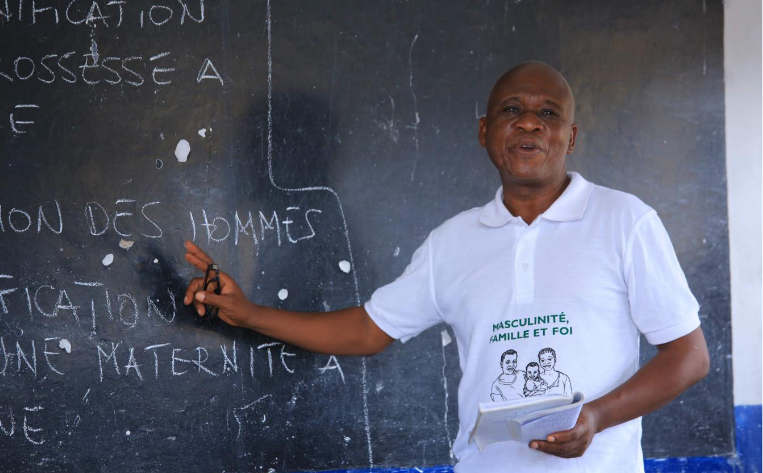
Even with careful efforts to understand social norms and intentional focus on institutional-and individual-level changes, a range of programme design, implementation, and contextual factors can influence programme impact. These factors are important to consider when adapting a programme in another setting. Prepared by the Institute for Reproductive Health (IRH) as part of the United States Agency for International Development (USAID)-funded Passages Project, this report explores learnings from adapting a social norms intervention seeking to prevent and respond to sexual and gender-based violence (SGBV), called Transforming Masculinities (TM), in rural Democratic Republic of Congo (DRC) to address family planning (FP) in urban Kinshasa, DRC through an adaptation called Masculinité, Famille et Foi (MFF).
The report first provides an overview of the main objectives of the analysis and the TM approach, including key evaluation results. (See Related Summaries, below.) In short, TM applied a gender-transformative, faith-based approach to transform social norms that underpin SGBV and gender equality. The premise of this approach is that faith leaders can be gatekeepers that directly influence the beliefs and behaviour of followers; the congregation is a social and community space that influences individual behaviour, with group cohesion created and maintained through shared beliefs and values. The TM approach was grounded in four key principles: promotion of gender-equitable role models for men and women aged 18 and older; the restoration of positive roles of men in their families and communities; engagement of community leadership in preventing and addressing SGBV; and intervention at multiple levels of the social ecology within villages to promote gender equality. It included activities such as trained faith leaders delivering gender-equitable sermons rooted in scripture, gender champions from within their congregations facilitating community dialogues, community action groups planning mobilisation activities, and a Healing of Memories workshop conducted with survivors of SGBV and influential community members engaged in support provision. An evaluation of TM in eastern DRC found that, among men and women who had been in a relationship in the previous year, there was a 57% decline in women's experience of intimate partner violence (IPV) and a 66% decline in men's perpetration of IPV.
Following this discussion, the report introduces adaptations made to create MFF (the adapted approach that addresses FP) and key results from a randomised controlled trial (RCT) evaluation. (In addition to Related Summaries, below, see Table 1 in the paper for information on goals and programme design from both TM and MFF and Table 2 for a description of project outcomes and mechanisms of change for both projects. In Table 2, adaptations specific to MFF are listed in green font). In short, in bringing the project from rural, eastern DRC to urban and peri-urban Kinshasa, MFF collaborated with the Eglise de Christ au Congo (ECC) and adjusted the population coverage area to support implementation of the project within ECC church communities. Engagement with the ECC congregational network allowed for scale-up in Kinshasa. In addition to the original TM content, the MFF training and transformation process included content and reflections on reproductive health and FP. To strengthen linkages to health services, MFF trained health hotline operators from Association de Santé Familiale (ASF) to provide information and support to young adults with FP- and IPV-related questions. MFF did not include a focus on addressing IPV-related stigma or service provision for IPV survivors. As a result, some TM activities were not included in the adaptation, such as community action groups and Healing of Memories workshops. Evaluation results showed that MFF yielded key successes for FP: Community dialogue group participants in intervention congregations reported a 33% increase in use of modern contraception and greater intention to use modern contraception, as compared to members of congregations in the comparison group. However, the diffusion survey did not reveal changes in behaviours or norms related to IPV among the wider congregation.
The report then explores programme design, implementation approaches, and contextual differences that help understand the programme adaptation and distill learnings for future project adaptations. Briefly:
- An examination of programme design revealed four key areas that may have been barriers to seeing change on IPV in the MFF adaptation: definition of community, intended population for community dialogue groups, identification and engagement of reference groups, and diffusion activities. Sample insight: "How norms and reference groups operate in urban settings where networks are more dispersed and individuals move through different communities/networks is not well understood and may affect norms and behavior change programming."
- The analysis identified three programme implementation factors that may have influenced outcomes: fidelity to intended messaging on gender equality, topical focus on key outcomes of interest, and programme duration. Sample insight: "When it came to norms supporting IPV, MFF ethnographers found that some Faith Leaders used messaging that reinforced shared responsibility for harmony in the home, thereby rationalizing the use of IPV as normal, and placing responsibility for such violence on women or external forces (i.e., evil forces) and not on husbands. Some emphasized that women should practice forgiveness in response to IPV rather than accountability."
- Contextual factors, including boundedness of the network, scope for norms change, and complexity of norms as a driver of behaviour change, may have affected whether MFF could achieve shifts in IPV norms and outcomes. Sample insight: "In a more bounded network (like rural eastern DRC [where TM was implemented]), social norms may have a stronger effect on behavior than in a more porous network (like Kinshasa [where MFF was implemented]). This is because the values of the social sphere may be more homogenous, and because when a dominant or influential subgroup adopts a new norm, it more easily diffuses throughout the network..."
Overall: "[F]aith institutions have potential for influencing shifts in norms and behaviors related to IPV and family planning. Yet, how these norms influence behavior, how well faith-based norms communicate the expectations and values of the members of a congregation, and how much people adopt faith-based norms in their private behaviors versus public behaviors will affect the intervention's ability to instill new norms and behaviors. Similar information is not available from eastern DRC. Finally, interventions of longer duration and increased layering may be needed in an urban environment to address these varying spheres of influence and reference groups."
The report closes with recommendations for developing and adapting programming that seeks to include social norms change as a key strategy to prevent and reduce SGBV and FP, including:
- Programme design - example recommendation: Interventions incorporating more visible rewards or sanctions for positive behaviour may be effective. In TM, the visible and tangible forms of support for survivors provided by community action groups may have complemented messaging by faith leaders within the congregations to demonstrate not just through words, but through action, that community leaders care about supporting survivors and do not condone SGBV.
- Programme implementation - example recommendation: Interventions seeking to address both SGBV and FP should ensure that content on both topics is complementary and mutually reinforcing. Highlighting SGBV/FP linkages throughout the curriculum may enhance opportunities to reflect upon and change values and behaviours related to violence and unhealthy timing and spacing of pregnancies.
- Contextual considerations - example recommendation: Interventions seeking to address FP may benefit from including family members beyond women's partners/husbands. For example, this analysis found that faith leaders may have greater influence in rural than urban contexts and that parents and parents-in-law were influential reference groups for men and women in urban Kinshasa.
In conclusion, while the MFF adaptation did not achieve similar results in SGBV as TM in an urban setting, it improved voluntary FP uptake. In light of that experience, other programme adaptations may want to consider that, "In addition to measuring impact, investments in adaptation and monitoring may ensure that positive findings can be replicated and identify barriers to change. For adaptation of programming seeking to shift social norms on SGBV, a thorough understanding of social norms and networks which goes beyond naming specific norms towards identifying which networks are influential, how densely connected networks are, how people are networked, and how social norms and reference groups influence behaviors, can lead to improved project design."
IRH website, March 28 2022. Image credit: IRH
- Log in to post comments