










































Implementing Comprehensive HIV and STI Programs with Men Who Have Sex With Men: Practical Guidance for Collaborative Interventions
"Despite major scientific advances in the fight against HIV and AIDS, health departments around the world lack the necessary know-how to deliver responsive sexual health services targeting men who have sex with men. This and other barriers like criminalization, stigma and violence exacerbate worsening health outcomes among men who have sex with men." - Dr. George Ayala, Executive Director of MSMGF
The Global Forum on MSM and HIV (MSMGF) observes that men who have sex with men (MSM) have played a central role in designing and implementing HIV prevention, treatment, care, and support programmes since the start of the HIV epidemic. The MSM Implementation Toolkit (MSMIT) seeks to honour and support the legacy forged by MSM at the community level, giving particular attention to programmes run or led by MSM themselves. A key feature of the tool is case examples of successful programme approaches from around the world, showing how they tackled challenges and found creative solutions to providing programmes in environments with few resources, or where there are legal or social obstacles to providing services to MSM.
In providing operational guidance on the design and implementation of HIV and sexually transmitted infection (STI) programmes working to reach gay and bisexual men and other MSM worldwide, the MSMIT is designed for use by: public health officials and managers of HIV, AIDS, and STI programmes; non-governmental organisations (NGOs), including community and civil society organisations; and health workers. It may also be of interest to international funding agencies, health policymakers, and advocates.
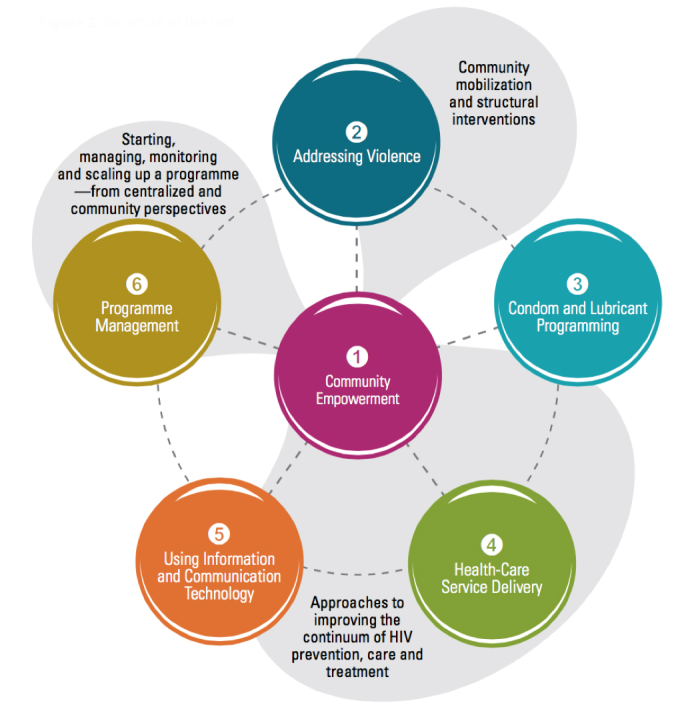
The first 2 chapters describe approaches and principles to building programmes that are led by MSM. Explicitly or implicitly addressing the 2011 Guidelines for HIV and STI Prevention and Treatment Among MSM or the 2014 Consolidated Guidelines for Key Populations, chapters 3, 4, and 5 describe approaches to implementing recommended interventions for HIV prevention, care, and treatment. Chapter 6 describes how to manage programmes and build the capacity of organisations of MSM. (See Figure 2.). More specifically:
- Chapter 1 - Community Empowerment - describes how empowerment of MSM is both an intervention in itself and is also essential to effective planning, implementation, and monitoring of all aspects of HIV and STI prevention, treatment, and care.
- Chapter 2 - Addressing Violence - focuses on the need of MSM to be protected from violence, discrimination, and other forms of human rights violation.
- Chapter 3 - Condom and Lubricant Programming - presents a detailed description of how to plan and implement the provision of condoms and lubricants, using the approaches outlined in the previous chapters. The chapter covers planning for and managing adequate supplies, multi-level promotion of the commodities, and creating an enabling environment.
- Chapter 4 - Health-Care Service Delivery - presents detailed descriptions of fundamental prevention, care, and treatment interventions, incorporating the approaches outlined in the previous chapters. The services described include sexual and risk minimisation, anal health and STIs, voluntary HIV testing and counselling, pre- and post-exposure prophylaxis (PReP), antiretroviral therapy (ART), and treatment of STIs and of co-infections such as tuberculosis and viral hepatitis, mental health, and substance use. The chapter also addresses community-led service delivery and safe spaces.
- Chapter 5 - Using Information and Communication Technology (ICT) - describes the ways in which MSM currently use ICT, and how ICT can be used for outreach, support, and advocacy for MSM.
- Chapter 6 - Programme Management and Organizational Capacity-Building - provides practical guidance on planning, starting, scaling up, managing, and monitoring an effective programme from 2 perspectives: (i) a large, multi-site programme with centralised management and multiple implementing organisations, and (ii) local community groups seeking to start or expand services.
The development of this tool was supported by the United Nations Population Fund (UNFPA), the United States Agency for International Development (USAID), the World Health Organization (WHO), the World Bank, and the Bill & Melinda Gates Foundation in close partnership with over 100 experts from around the world. MSMIT translations were supported by Bridging the Gaps, an international key populations programme led by Aids Fonds Netherlands and funded by the Dutch Ministry of Foreign Affairs. MSMGF offers online learning opportunities on the MSMIT, including a number of YouTube videos and e-books available at MSMGF's e-learning platform, CPR. Access this platform, which is supported by the Levi Strauss Foundation, Bridging the Gaps, and LINKAGES, funded by U.S. PEPFAR through USAID, under Related Summaries, below.
Publishers
English, French, Portuguese, Spanish, Russian
264 (English)
Email from Nadia Rafif to The Communication Initiative on January 18 2017; and MSMGF website, January 19 2017.
- Log in to post comments