










































Human Papillomavirus Vaccine Uptake After a Tailored, Online Educational Intervention for Female University Students: A Randomized Controlled Trial
University of Michigan Medical School (Bennett, Patel, Carlos, Zochowski, Chi, Dalton); University of Michigan (Pennewell)
"Increasing vaccine uptake among young adults likely requires a multifaceted approach."
This study evaluated the effect of MeFirst, an individually tailored, online educational intervention, on human papillomavirus (HPV) vaccine-related knowledge, vaccination intention, and uptake among previously unvaccinated female university students in the United States (US). The idea was to explore whether an online intervention could potentially reach many women who otherwise may not receive health messaging (e.g., from their clinicians) related to HPV vaccination.
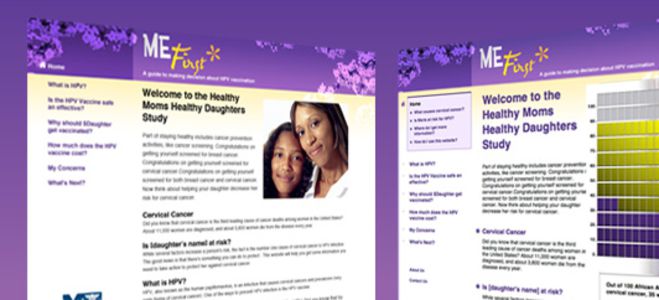
All female students aged 18-26 years who reported being unvaccinated against HPV at a midwestern US university were invited via email to enroll in the study. Participants completed a 144-question online survey that assessed baseline HPV vaccine-related knowledge, attitudes, and vaccination intention. Participants (n = 661) were then randomised to receive either the MeFirst intervention or a standard Centers for Disease Control and Prevention (CDC) information factsheet on HPV vaccine (control). MeFirst was a unique, tailored website automatically configured for the individual participant based on their baseline survey responses. It consisted of 7 tailored topic webpages that the participant could toggle through using a navigation bar. The topic pages had factual information on HPV and the HPV vaccine, as well as suggestions for how to talk to a doctor about the vaccine. Tailoring was multifaceted but focused on barriers to vaccination the participant had previously endorsed, such as perceived susceptibility, and included addressing the participant by their first name, using their doctor's name, and displaying background photos of young women of the same self-identified racial background as the participant. In total, up to 160 items could be tailored to the participant on their individual MeFirst website.
Vaccine uptake and repeat knowledge and attitude measures were assessed with online surveys 3 months following the intervention and analysed using logistic regression models. Half of participants (332/661, 50.2%) responded to the 3-month follow-up survey and reported their HPV vaccine status; the other half was lost to follow-up.
Three months after intervention, there was no difference in HPV vaccine uptake among participants randomised to the MeFirst intervention compared with controls (chi-squared = 0.09, p = 0.76); 8.4% of all participants initiated the vaccine series. The proportion of all participants with a high level of knowledge increased from 32% at baseline to 50% at 3 months (McNemar's statistic = 33.4; p < 0.0001). This increase in knowledge is not associated with intervention assignment. Risk perception and intention to be vaccinated did not change significantly from baseline to 3 months in either group. Of participants who intended to undergo HPV vaccination at baseline, 82.4% remained unvaccinated 3 months later.
Secondary outcomes and multivariate model may provide clues about why this intervention was not associated with vaccine uptake. First, both intervention groups showed significant improvement in knowledge at 3 months following the intervention, but knowledge change was unassociated with uptake; this would suggest, as others have, that increasing knowledge by itself is insufficient to increase vaccine uptake (i.e., behaviour change) in the absence of additional measures such as explicit provider endorsement of vaccination or systems improvement to provide immediate vaccination once readiness to vaccinate is identified. Second, intention was significantly associated with uptake; MeFirst may have failed to affect uptake because it failed to impact intention. The adult population in the study may have already been firm in their intentions about vaccination, highlighting the need for continued work increasing uptake among the paediatric population.
According to the researchers, future interventions should seek to reach both sexes and should consider decreasing practical barriers to uptake. For example, future research efforts could consider interventions to increase convenience of vaccine administration, like on-site vaccination at community events, such as freshman move-in day for university communities.
Journal of Women's Health 24(11): 950-957. doi: 10.1089/jwh.2015.5251. Image credit: University of Michigan Center for Health Communications Research (CHCR)
- Log in to post comments