










































How Behavioral Economics Can Inform the Next Mass Vaccination Campaign: A Narrative Review
New York University Grossman School of Medicine
"The next mass vaccination campaign must address the behavioral barriers to vaccinating the public."
Historical and current events have shown how failing to consider features of human behaviour - from individual biases in information processing to the relationships between people and policymakers - can impede public health efforts. The field of behavioural economics draws on psychological insights into human behaviour to analyse decision-making. It can explain why people hesitate to vaccinate and what strategies can encourage vaccination. This article argues that vaccination campaigns need to deliver processes and information necessary to help people decide to vaccinate, employing both "nudges" (promoting action) and remove "sludge" (breaking down blockers) to influence decisions. Such strategies must be put in place both systemically and acutely, as outlined here.
To begin, the article examines how behavioural economics can explain how the "5Cs" of vaccine hesitancy - confidence, complacency, communication, convenience, and context - have contributed from a broad perspective to public health failures beyond vaccination and what limitations these factors pose for future vaccination campaigns:
- Confidence stems from trust in the science and practice of vaccination. Health entities undermine public trust when enacting policies that violate the public's confidence, especially within vulnerable communities, and contradict ethical principles (e.g., the 1979 Belmont Report). For example, the United States (US) Central Intelligence Agency (CIA) used a Hepatitis B vaccination campaign involving health workers in Pakistan to collect intelligence on Osama bin Laden's location and social circle. Although these efforts did not significantly contribute to the mission that killed bin Laden, the Taliban leveraged knowledge of the ruse to spread distrust in vaccination, leading to sharp declines in households seeking formal healthcare, including oral polio vaccine (OPV), in regions with dominant Taliban influence. As of late 2021, polio was still endemic in regions of Afghanistan and Pakistan with a strong Taliban presence. In the case of the COVID-19 vaccine, trustors (i.e., people who need to be vaccinated) may not comply if they perceive the vaccines as unsafe due to insufficient safety data from clinical trials or years of commercial use. Building public confidence in vaccination requires ethical guidelines and risk minimisation for the public to submit to vaccination and health worker intentions willingly.
- An individual's own cognitive biases and social influences can create complacency. For example, seeing oneself as healthy, not susceptible to significant illnesses, or strong enough to fight disease (an optimism bias) is not useful when a new pathogen emerges, such as COVID-19.
- Communication failures create complacency and low confidence in vaccination. Good communication must involve clear and accessible descriptions of vaccine technologies, how scientists and manufacturers conduct safety tests, and how regulatory agencies approve candidate vaccines. Education has limits, given the twin problems of misinformation and disinformation. Disinformation plays into confirmation bias (the tendency to seek or recall information affirming one's values) and hinders any scientifically correct information to persuade non-vaccinated individuals.
- Even if a vaccination campaign contains the proper components, it may fail in terms of context (the wrong time or place). US President "Ronald Reagan's 1985 public acknowledgment of the HIV/AIDS crisis came after a close friend passed away of AIDS and after years of the federal government...failing to acknowledge what the scientific and caregiving communities had known: with more than 50 thousand infected people, HIV/AIDS was not a 'gay plague'. Had anti-LGBTQIA+ sentiments not persisted amongst influential decision-makers earlier in the crisis, a more vigorous response could have started earlier..."
- When interventions do not occur within a context for meaningful impact, convenience determines whether people seek care. Behavioural economics explains that people tend to place greater value on the present relative to future benefits because time is considered costly and inconvenient (i.e., a present bias). Barriers to vaccination that create a present bias will hinder individuals from enjoying the long-term benefits of vaccination, decreasing the overall perceived need for and, thus, the value of vaccination.
"Despite hindering modern vaccination campaigns, the five 'C's arise from natural behavioral safeguards. Confidence should never be blindly placed in external entities. Complacency decreases anxiety. Biases of convenience come with evolutionary survival skills. Relying upon context prevents irrelevant decisions, and communication with like-minded individuals fortifies identity. Behavioral economics can guide how to leverage or combat these safeguards for optimal behavior. Designing the next vaccination campaign requires exploring how to facilitate or impede decision-making and to impact choice structure or information."
In that context, the author notes that both removing sludge and introducing nudges are crucial to public health efforts like vaccination.:
- Sludge creates friction against beneficial behaviours. Sludge (e.g., poor infrastructure) within initiatives can induce the 5"C"s - for example, by increasing complacency in decision-making because the optimal choice is not made visible.
- Nudges facilitate beneficial action by removing disparities underlying choice by compensating for individual factors that inhibit choices (e.g., socioeconomic status). When they integrate the context of the decision-maker, nudges can strengthen communication, break complacency, improve confidence, and increase convenience.
The author explain that "Policymakers can impact choice by altering the structure of the decision ('moving the hand') or the description of the options ('moving the mind')....Moving the hand targets decision-driving behaviors; moving the mind targets design elements of the decision process impacting information about choices, changing how information is processed when deciding to vaccinate....When designing and implementing the next vaccination campaign rooted in behavioral economic principles, a policymaker's interventions fall into a two (integrating nudges or removing sludge) by two (changing task structure or changing information delivery) grid."
The article goes on to present examples closest to each "quadrant": (i) integrating nudges into task structure; (ii) removing sludge from task structure; (iii) adding nudges to task information; and (iv) removing sludge from task information. Informational nudges need to make a choice seem actionable and provide momentum to act. For instance, as an example of (iii), the author notes that outcomes are more likely if individuals feel close (figuratively or literally) to someone spreading information about the action (i.e., the distance bias). Messaging from relatable figures in a community, such as local leaders or midwives, can motivate behaviours like vaccine uptake, for example, as seen in the successes of polio vaccination. Such messaging can create momentum by offering clear direction to act upon the outcome and by providing a sense of autonomy for decision making.
Next, the author asks: Should public health campaigns include incentives? While internal incentives motivate self-interest, extrinsic incentives provide a material reward for an outcome (positive incentives) or threaten punishment (negative incentives). The discussion focuses on positive extrinsic incentives. When determining whether to employ such incentives, it may be useful to remember that individuals' relationships to incentives depend on biases, like loss aversion, reference points of value, and discounting of future rewards.
Looking ahead, the author stresses that preparing for the next mass vaccination campaign involves improving choice structure and information presentation to facilitate access and remove barriers to vaccination. The foundation should be built on systemic changes, such as ancillary improvements in internet infrastructure, national security, and civil rights. Acute promotional strategies and incentives (e.g., nudges) will magnify the effect of the deeper, longterm public health efforts on promoting vaccination. Further research using behavioural economics to implement mass vaccination might involve asking:
- How behavioural economics implementations of interventions allow for vaccine equity;
- How can we prevent desensitisation to the value of a reward (sustainability); and
- How robust experimental designs can help optimise a vaccination campaign for public health constraints and adapt it to different requirements.
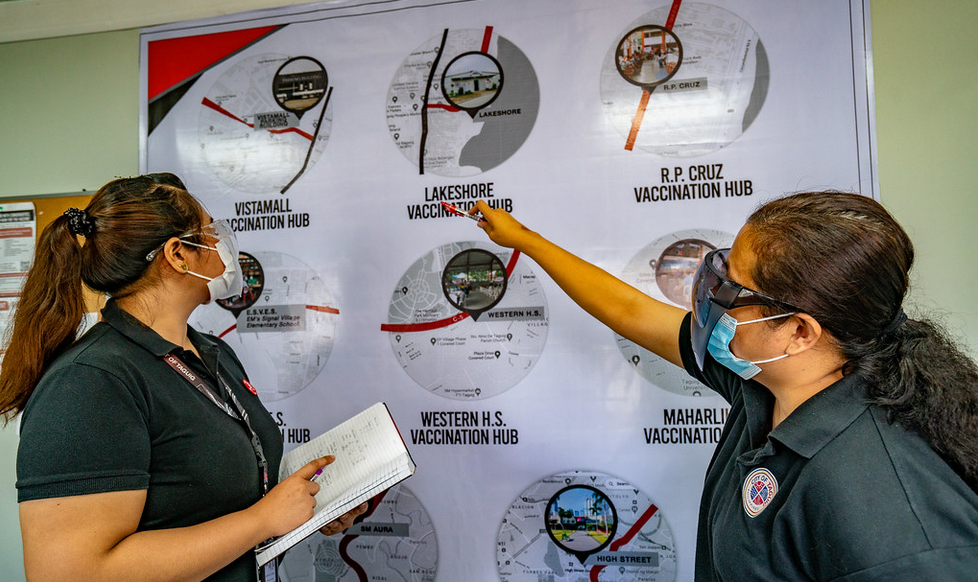
Preventive Medicine Reports, Volume 32, April 2023, 102118. https://doi.org/10.1016/j.pmedr.2023.102118. Image credit: Asian Development Bank via Flickr (CC BY-NC-ND 2.0)
- Log in to post comments