










































Hear Our Voices - Practitioner's Toolkit
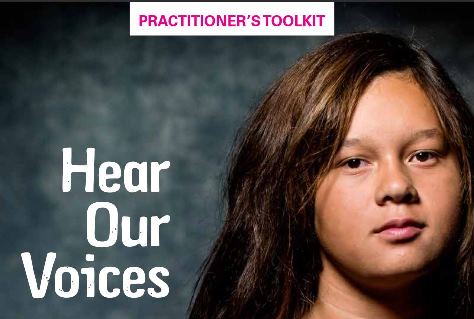
Part of the "Because I am a Girl" project, "Hear our Voices" from Plan International comprises study results presented as a video, a technical report, a summary report, and this toolkit intended to provide a means for collecting "consistent, disturbing illustrations of the most pressing concerns for adolescent girls, giving powerful insights into the issues facing them, in their own words." These tools may be of interest to: international development practitioners working with adolescent girls, monitoring and evaluation specialists, research specialists, and others working in related fields. The kit recommends staff training to use the tools due to questions on issues sensitive to young people, particularly girls ages 12-16.
The "Hear Our Voices" practitioner's toolkit introduces the programme feedback tools used: the Girls Empowerment Star and School Equality Scorecard. "Plan developed the tools to ask adolescent girls and boys about their experiences of girls’ empowerment and gender equality in schools. They are based on 'participatory numbers' methodology [and are] the basis for a major 11 country study in 2013, spanning four regions of the world." The tools contain: key questions and response options; a process summary of a five-step implementation process for quick reference; guidance note with tool discussion prompts and detailed instructions for implementation, documentation, and reporting; observer worksheets for a translation workshop of key questions and response options and for a tally chart to document individual ratings from focus groups to support quantitative data entry, analysis, and reporting on a form to document focus group key themes, high and low scores, and variation in participants’ responses; and the Plan Programme Unit Report Form.
The toolkit advises on use in terms of adaptation of the kit and on ensuring statistical comparability: "To guide the process and ensure coherent management, Plan managed their multi-country study by forming an international study team...[i]n each study country, Plan also formed a short term cross-disciplinary team with expertise in areas such as child protection and participation, gender, monitoring and evaluation, community development facilitation, and programme management. All this has clear budget implications.....Either non-probability (purposive, convenience), or probability (random) sampling strategies can be designed to guide selection of communities, schools and participants. Results from studies with non-probability sample designs cannot be generalized to any wider population other than the study participants. Findings generated using a probability sample design may allow for generalization of results to a wider population. Statistical advice will be needed to achieve this."
Example questions include, for example:
Girls Empowerment:
- Do girls and boys share household work equally, including childcare?
- Do girls decide if they get pregnant?
- Do girls feel safe in this community?
School Equality:
- Do girls participate in class as often as boys?
- Are there toilets at school that girls feel comfortable to use?
- Are girls as safe as boys on their way to and from school?
Publishers
English, French, Spanish
18 pages - Hear Our Voices - Practitioner's Toolkit
15 pages - Girls Empowerment Star
14 pages - School Equality Scorecard
Plan International website, October 27 2014.
- Log in to post comments