










































Gaming Our Way to a Better Future
Serious Games Initiative in the Science and Technology Innovation Program, Woodrow Wilson International Center for Scholars
"By their very nature, videogames can engage players in ways that enable players to make their way through the intricacies of policy problems. As players begin to understand them in all their complexity, games may well help their governments forge solutions."
This policy brief discusses the possibilities of video games as a medium for involving citizens in learning about and engaging in complex policy challenges. "The strength of the video game at communicating and addressing complex policy issues is in its very bones." It is a system: a "group of interacting, interrelated, or interdependent elements that come together to create a complex whole." The outcomes are not decided by a single player; they are called "emergent" outcomes and parallel policy outcomes in how they are created: "policies also can be seen as systems-structures created by the interrelated rules, regulations, and other mechanisms by which policymakers try to close a gap between reality and a goal. A policy’s interrelated structures create an extended system that determines or shapes the user’s experience, which differs depending on choices and context."
The video game structure allows for direct experience of ramifications and enhances the view of what happens further along in the application of policies, called "topsight": "Video games are very good at making complexity accessible by providing a platform that combines the big picture with layers of underlying detail." Games give the players agency, whereas in other media they are observers. With other media, the audience chooses to watch and likely filters out what it doesn't want to see or believe. "Games permit players to step out of their own shoes and inhabit the role of another. Well-designed games oblige the player to set down stakes in that other role, behaving like and seeing the world through the eyes of that other."
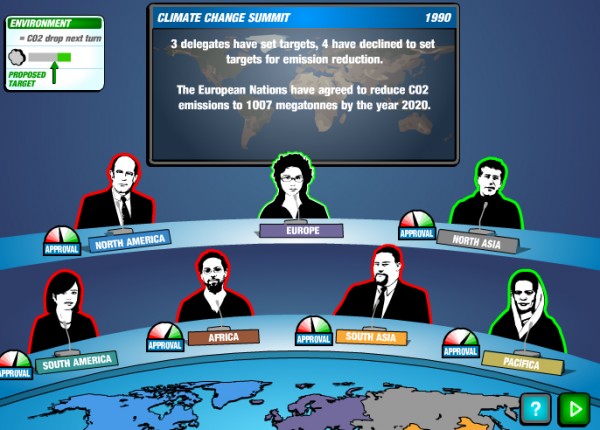
The author notes that young people are "digital natives" who are comfortable with information and communication technology (ICT). In addition, in the United States, many are disengaged and disenchanted with government and civic action. However, "[p]olicy analysts, policy foundations, and policymakers themselves have begun to see the potential of games for engaging the public." For example, economists are studying virtual economies in online games; a Wilson Center online game, Budget Hero, gives a data flow for deicisonmakers on fiscal policy. The Serious Games movement, through conferences and government connections, now, as stated here, "needs to continue refining its vision and strategy, and it must secure the public and private financing that will make this work possible."
The Wilson Center website, March 24 2014.
- Log in to post comments