










































A Game, a Passport, and a Poster: Changing Contraceptive Attitudes, Intentions, and Behaviors Among School Girls in Urban Burkina Faso
International Center for Research on Women - ICRW (Hinson, Schaub); Pathfinder International (Angelone, Tamboura-Diawara, Brooks, Abga, Trasi, Diabri); London School of Hygiene and Tropical Medicine (Pliakas); Impact Epilysis (Pliakas); REM Africa (Nourou)
"Behavioral solutions like the game, health passport, and poster can complement existing demand-generation interventions and connect youth to youth-friendly health facilities so they can make informed decisions that benefit them."
Family planning (FP) plays a powerful role in enabling women and men to achieve their desired family size and build more equitable societies. In Burkina Faso, nearly one in 2 girls will be married, and one in 4 will become pregnant, before their 18th birthday. However, 83% of sexually active young women aged 15-24 have never used a modern contraceptive method. Implemented in Burkina Faso, as well as in Ethiopia and Bangladesh, the (re)solve project was designed to examine barriers that prevent women from using contraception, drawing on behavioural science to design, test, and evaluate products and services that address these barriers. The primary hypothesis of this impact evaluation was that Burkinese girls who were exposed to the (re)solve solution would be more likely to report accurate perceptions about sex and contraception, form intentions that match their risk status, and seek more information and/or contraceptive services at a health centre, compared to similar girls who were not exposed to this solution.
With Bill & Melinda Gates Foundation funding, (re)solve collaborators Pathfinder International, Camber Collective, the International Center for Research on Women (ICRW), and ideas42 undertook a 4-stage process in Burkina Faso (click here [PDF] to learn more) in order to address the bottlenecks that influence girls at various decision points:
- Decision to get pregnant (Girls do not explicitly think about the consequences of sex.)
- Decision to use contraceptives (Girls do not think they need to consider using contraceptives, because they perceive a low risk of pregnancy.)
- Decision to visit a health facility (Girls do not go to the health facility for fear that others will find out that they are interested in or using contraceptives.)
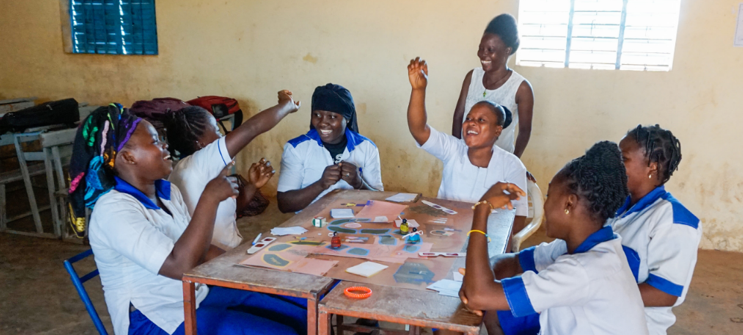
The (re)solve team assessed each bottleneck for relevance to the problem of contraceptive nonuse, evidence of its existence, and feasibility to address. The design and user-testing phase of the project involved several steps: ideation (during which the team, schoolgirls in 4ème (9th grade) and 3ème (10th grade), and health workers generated potential solutions to address the prioritised bottlenecks), prototyping of top-scored ideas, and user testing. The final solution set consisted of: a participatory board game (La Chance), which was designed to correct myths and misconceptions and to increase pregnancy-risk perception; a health passport meant to ease girls' access to health facilities; posters in health facilities that normalised consultations for adolescent girls; and name tags that identified youth-friendly health care providers. (re)solve also trained participating healthcare professionals on how to provide youth-friendly services (YFS) and oriented them to the solutions and their rationale.
Regional Health Directorates and secondary-education departments facilitated the introduction of the (re)solve solutions in health facilities and schools, respectively. In addition to the YFS training conducted between September and November 2019, (re)solve staff oriented providers to the project and the solutions, which were then implemented in 16 secondary schools: 8 each in Bobo-Dioulasso and Ouagadougou. Schools were assigned 2 facilitators who each played 1-2 games per day. (re)solve oriented the principal, parent-teacher association, and parents to the game and addressed questions and concerns. More than 3,000 girls played La Chance, and facilitators distributed more than 11,000 passports between December 2019 and mid-March 2020, when schools closed as a result of the COVID-19 pandemic.
The study used a mixed-method cluster randomised trial (CRT) design involving 32 schools (16 in Bobo-Dioulasso, 16 in Ouagadougou). Half of the schools in each city were randomly assigned to receive the (re)solve intervention; the others were assigned as control schools. The researchers conducted: 2,372 quantitative surveys at baseline and 2,072 at endline (87.4% retention rate) with a cohort of girls ages 14 to 18 in 4ème and 3ème; 48 in-depth interviews with girls at baseline and 41 at endline; 35 endline in-depth interviews with implementing staff; and 14 endline key informant interviews with stakeholders. The results showed the following:
- 96.2% (N=947) of intervention-school girls reported ever playing the game, and 96.7% (N=950) received a passport. The majority received either two (97.2%, N=803) or more than two (14.1%, N=143) passports to give to other girls, as was intended. The majority of girls (41.9%) reported giving at least one passport to a peer at a different school, followed by an older family member (29.9%). Ninety-one percent (N=923) saw the posters in school.
- Among intervention-school girls, there was a statistically significant increase in the percentage reporting ever having gone to the health facility for sexual and reproductive health (SRH)-related reasons, from 6.3% to 32.2% (P<.001). During the game and in subsequent conversations with facilitators, girls asked questions about contraception, menstruation, and sexual health. Some girls gained enough confidence to visit health centres and ask follow-up questions, which helped reduce misconceptions and fears (e.g., that contraception can cause interfertility). This "outcome cannot be overstated within the broader context of provider bias toward adolescents seeking contraceptives." In addition, 45% of intervention-school girls said they intended to visit a health centre for contraceptive information or services but had not yet gone because of school, COVID-19, or other reasons.
- Many respondents of all types noted that a major barrier to visiting health centres has been girls' fear of being seen and their interest in or use of contraception being discovered by their families. However, the anonymity and confidentiality associated with the passports appeared to counter these fears, as did the attitudes of the health workers, who put the girls at ease. A 16-year old girl in 3ème in Bobo-Dioulasso recalled, "The agents welcomed me as soon as I presented my passport to them. They gave me a place.... I was comfortable, because all the questions were confidential. I felt satisfied."
- There were positive trends in contraceptive attitudes among intervention-school girls. Between baseline and endline, the percentage of intervention-school girls who agreed that contraception causes infertility decreased from 81.8% to 77.6%. Likewise, the percentage of intervention-school girls who agreed that "contraception is the best option for me" increased from 72.7% to 83.6%. At endline, there were statistically significant differences between the intervention and control groups in level of agreement with both statements (both p<.001).
- The percentage of intervention-school girls reporting confidence to get and use contraception rose from 54.9% to 74.6%. At endline, a statistically significantly larger proportion of girls in the intervention group reported the confidence to obtain and use contraception, compared with girls in the control group (74.6% compared to 63.0%, P<.001). Relatedly, intervention-school girls reporting agreement that healthcare workers do not like to give contraceptive advice to unmarried girls decreased from 39.4% to 27.2%.
- Between baseline and endline, the percentage of girls in the intervention group who agreed that it is not normative for unmarried girls to use contraception decreased from 32.1% to 17.7%. At endline, a statistically significantly smaller proportion of girls in the intervention group reported they agreed contraceptive use for unmarried girls is not normative, compared with girls in the control group (17.7% compared to 28.4%, P<.001). One 19-year old respondent in 3ème in Ouagadougou said, "Contraception! It's for all girls. It's a choice. If you want, you can go on use it, and if you don't want, you leave it." Adults responded similarly.
- Girls from intervention schools had higher odds of reporting an intention to use contraception in the next 3 months compared to girls in the control schools (aOR=1.59, 95% CI 0.97-2.61), but the relationship did not reach statistical significance in any of the adjusted risk models, or when stratifying by sexual activity. The researchers suggest that this finding is likely due in part to the fact that respondents were young, not yet sexually active, and do not yet perceive contraception as an immediate need. However, the fact that at this young age and level of sexual naivety, girls are beginning to ask questions, gain factual information, and challenge previously held misconceptions and negative attitudes about adolescent contraceptive use suggests they might be primed to take up a method when they are ready to become sexually active.
- The (re)solve solution set was found to be highly acceptable among adolescent girls and other key stakeholders. Most girls reported enjoying playing the game, learning through play, and interacting with facilitators.
The evaluation report closes with recommendations for future iterations, wrap-around services, and additional user groups for the solution set. For instance, (re)solve collaborators see potential for expanding the (re)solve solutions to other schools and new audiences, such as older and younger girls, out-of-school girls, and boys. Programme participants echoed similar calls for replication and expansion. The intervention will need to be further contextualised and adapted to the needs of each new group, and the board game, passport, and posters might need to be re-designed to reflect the behavioural bottlenecks new audiences encounter. The researchers note that any scale-up efforts and future evaluations will require close coordination between and oversight from the Ministries of Health and Education.
In conclusion: "(re)solve places women and girls at the center.... This evaluation of the (re)solve intervention for Burkinabé schoolgirls adds to the evidence base on fun, participatory, and feasible approaches to motivate unmarried girls to seek and act on accurate information about SRH and contraception."
Pathfinder website, June 9 2022. Image credit: Pathfinder
- Log in to post comments