










































Factors Associated with Incomplete Childhood Immunization in Arbegona District, Southern Ethiopia: A Case-Control Study
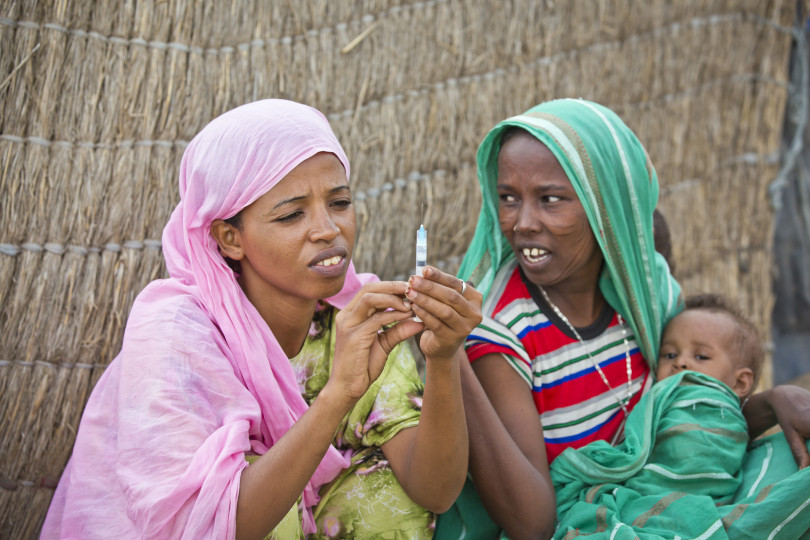
Yirgalem Medical Science College (Negussie); Jimma University (Kassahun, Assegid); University of Michigan Medical School (Hagan)
"To reduce the number of children with an incomplete immunization status, the district needs to consider specific planning for mothers with risk profiles, and focus on strengthening health communication activities to increase immunization awareness and address concerns of vaccine side effects at community level."
Noting that, in Ethiopia, the Expanded Program on Immunization (EPI) schedule is rarely completed, and the full immunisation rate is only 24%, this study sought to identify determinant factors of incomplete childhood immunisation in Arbegona district, Sidama zone, southern Ethiopia. A community based unmatched case-control study was undertaken from January 15 to February 15 2014 among randomly selected children aged 12 to 23 months and with a total sample size of 548 (183 cases and 365 controls). Qualitative data were also generated through focus group discussions (FGDs) and in-depth interviews.
A child is considered fully vaccinated if he/she has received: a Bacillus Callmete Guerin (BCG) vaccination against tuberculosis; three doses of pentavalent vaccine (DPT-Hep B-Hi-b) to prevent diphtheria, pertussis, tetanus, Haemophilus influenzae type b, and hepatitis B; at least three doses of polio vaccine; and one dose of measles vaccine. The incomplete immunisation status of children was significantly associated with young mothers (AOR (adjusted odds ratio) = 9.54; 95% CI (confidence interval) = 5.03, 18.09), being born second to fourth (AOR = 3.64; 95% CI = 1.63, 8.14), and being born fifth or later in the family (AOR = 5.27; 95% CI = 2.20, 12.64) as compared to being born first, a mother's lack of knowledge about immunisation benefits (AOR = 5.51; 95% CI = 1.52, 19.94), and a mother's negative perception of vaccine side effects (AOR = 1.92; 95% CI = 1.01, 3.70).
Specifically, communication-related findings include:
- Of the mothers, 101 (55.5 %) mothers of the cases and 263 (72.6 %) of the controls knew about immunisation; only half of the mothers of both groups knew the schedule of at least one type of vaccine. Eighty-one (30%) and 23 (22%) mothers of the cases and controls who knew about immunisation, respectively, knew about the measles vaccine, yet almost all mothers of the cases (98.9%) and control (98.2%) didn't know the polio or pentavalent vaccine schedules.
- Half of the mothers from both groups had a positive attitude towards the last received child immunisation service.
- In FGDs held with HEWs, participants indicated that mothers fear some common vaccine side effects, even if they are advised of this. As a result, they may postpone, or not come back for, the next scheduled vaccination when they see common vaccine reactions. One HEW stated that "there were occasions in which we mobilize the community for immunization campaign and vaccines were not available when mothers came to immunize their child, and this is a big challenge and mothers may refrain from vaccinating their child in other immunization campaigns." The discussants also stated that some mothers migrate from one place to another within the district and this favours a default on their child's immunization.
- In FGDs, health professionals agreed that most health professionals are aware of the internal referral system. They check the immunization status of children who come for other child health services and refer to the immunisation room when necessary. Most health professionals also advise mothers who come for maternity services to vaccinate their child. Most of the participants, however, said that there are gaps from professionals in informing parents about common vaccine side effects. They also mentioned that mothers' knowledge of, and compliance with, the immunization schedule is very poor.
- In-depth interviews were conducted with the Head of District Health Office, District Health Office experts, and Heads of Health Centers. The interviewees reiterted that vaccine stock-outs and mothers' relocating are the main problems in EPI service delivery and are possible reasons for incomplete immunisation status of children. Heads of the Health Centers also felt that there are gaps in health professionals informing mothers of vaccine side effects and the schedule of subsequent vaccines.
To address these issues, the authors suggest integrating the EPI service into other elements of primary health care, considering specific planning for mothers with risk profiles, and focusing on health communication activities.
BMC Public Health (2016) 16:27. Image credit: PATH/Jiro Ose
- Log in to post comments