










































Evidence Review: Child Marriage Interventions and Research from 2020 to 2022
"Despite the increased attention to child marriage over the past two decades, very little has focused on what works to prevent and respond to it."
The interconnectedness of child marriage to gender inequality, education, livelihoods, health rights, social norms, and beyond is increasingly recognised and understood as a means of problem diagnosis and treatment, both in humanitarian and development settings. This review looks at evidence on proven and promising interventions to prevent child marriage and support girls who are - or have been - married, divorced, separated, or widowed and/or who are young mothers, and it makes suggestions for future research, programming, funding and policy.
The review was prepared by Amy Harrison, with support from the Child Marriage Research to Action Network (CRANK) advisory team: Jean Casey, Arwyn Finnie, and Jacky Repila from Girls Not Brides: The Global Partnership to End Child Marriage; Satvika Chalasani from the United Nations Population Fund (UNFPA) - United Nations Children's Fund (UNICEF) Global Programme to End Child Marriage; and Manahil Siddiqi from UNICEF Innocenti, The Strategic Technical Assistance for Research (STAR) Initiative to End Harmful Practices. The CRANK is a joint initiative of Girls Not Brides: The Global Partnership to End Child Marriage and the UNFPA-UNICEF Global Programme to End Child Marriage.
The research conducted for the report was desk-based, drawing on open-source literature available in English and published (with a few exceptions) between January 2020 and September 2022. Its scope included interventions ranging from large-scale, public systems and services-focused interventions, to medium-, smaller-scale and community-based programming. Interventions that had an impact on child marriage as a primary, secondary, or unintended outcome were also included.
Some key takeaways, which are illustrated in the report through examples from the literature, include:
- Education: There is increasing evidence that a focus on girls' education can be pivotal to the success of multicomponent interventions, given its central role in preventing early marriage and its connections with other sectors - as per the socio-ecological framework. For example, in More Than Brides Alliance's "Marriage: No Child's Play" programme, implemented in India, Mali, Malawi, and Niger from 2016 to 2020, the greatest reduction in child marriage prevalence was seen in India, where child marriage declined by 69% in intervention areas - in part due to its success in increasing and sustaining girls' enrolment in school. Gender-transformative approaches to education programming may have greater potential to meaningfully influence supply- and demand-side barriers to girls' education and to prevent child marriage.
- Livelihoods and economic rights: Poverty is a key driver of child marriage. There is evidence that large-scale programming aimed at reducing household insecurity can reduce child marriage prevalence - but that engagement with underlying social norms may be important to prevent unintended increases in child marriage where the practice is deeply entrenched. Pairing social protection or cash transfer interventions with a component that aims to shift restrictive norms around traditional gender roles can have a transformative, longer-term effect on perceptions around girls' and women's worth and may improve adolescent girls' and women's access to life skills opportunities and employment. State-driven efforts to improve women's security and equality in the world of work are likely necessary to enable sustainable demand side-driven change.
- Sexual and reproductive health and rights (SRHR): Female health workers can increase trust in and uptake of services and can act as role models in a way that may have a positive impact on girls' and adolescents' broader wellbeing and development. Notably, increasing adolescent girls' SRHR knowledge and ability to exercise their rights is only achievable by combining demand- and supply-side interventions. Engaging with restrictive gendered norms and power dynamics as part of the delivery of comprehensive sexuality education (CSE) to girls and boys can help to address the stigma and shame that exists around adolescent girls' sexuality and improve access to SRHR. The SRHR needs of married girls and young mothers may be most effectively addressed through multi-component programmes that also address the psychosocial, economic, and norms-based barriers they may face in accessing healthcare.
- Voice, choice, and agency: Designated safe spaces can be girls' and adolescents' only opportunity to feel secure, able to make choices that affect their lives, and connect with a range of support services and activities. Where girls' empowerment interventions promote group solidary among adolescent girls and also link into community structures and traditions, there is potential to shift harmful practices around child marriage in a way that is both scalable and sustainable. Involving girls in the design, running, and monitoring of empowerment or safe spaces is recommended as a means of ensuring that spaces meet their needs and do not mirror the restrictive norms they face in everyday life. Grounding activities in local systems and context and supporting girls to access programme activities - including through financial support for girls and their caregivers, and through engagement with husbands, male family members, and community members - are key ingredients for programme success.
- Shifting individual and collective norms: The evidence suggests that communication-based norm change interventions can have a positive impact in shifting attitudes and behaviour around child marriage but likely need to engage at multiple levels, using a variety of mediums. There are various examples of promising practices that create significant change in attitudes and behaviours through sustained community engagement, comprehensive sexuality education, and critical reflection on harmful gendered norms. Engaging boys and men as potential allies for change, as a key focus within a whole-household or whole-community approach, is likely important for shifting harmful norms or sustaining behaviour change over the longer term.
- Women's rights organisations (WROs) and feminist movements: There is an ever-growing evidence base showing the influential role WROs and feminist movements can play in pushing for and achieving tangible progress towards gender equality.
- Legal frameworks and gender-responsive budgeting: Advocacy and campaigning around legal reform in support of addressing child marriage may have greater impact when focused on the drivers of child marriage, rather than on child marriage itself: Engagement on issues such as girls' rights to education may have a greater indirect impact and come with less risk of causing harm to girls. While there is a link between minimum age of marriage laws and reduced prevalence, laws should only be considered as one part of a holistic response that includes other thematic, awareness-raising, or norms-based elements.
- Intersectionality and inclusion: Working alongside and learning from disabled people's organisations and other by-and-for organisations is an important and effective way of ensuring activities are designed and implemented in a genuinely inclusive manner. Stigma, discrimination, and bias can exist within implementing teams, as well as communities, and these factors needs to be addressed to ensure marginalised groups are not faced with the same stigma they experience in everyday life.
- Climate change, conflict, and crises: Available evidence demonstrates a positive association between extreme weather patterns and early marriage, though more research is needed - e.g., on how best to address child marriage in the context of climate change. In humanitarian settings, actors may not be able to shift deeply-held social norms through immediate response efforts, but they can still play a critical role in preventing child marriage. Supporting humanitarian teams across different response areas to understand, identify, and respond to the risks around child marriage is critical to ensuring that a "do no harm" approach is followed.
A series of recommendations completes the report. For example:
- Research - e.g., explore the relationship between individual and collective norms and how and why interventions effective at shifting norms on one level may not be effective on another, drawing on learning from other research programmes on taking social norms programming to scale, including the Community for Understanding Scale (CUSP), What Works II programme, Spotlight Initiative, and the Social Norms Learning Collaborative.
- Programming - e.g., include community engagement (including with boys and men, and traditional and religious leaders) and consultation with adolescent girls as a core element of programming.
- Funding - e.g., require potential funding recipients to demonstrate commitment to centring girls' voices and to gender-equitable attitudes as part of a transformative approach to funding allocation.
- Policy and advocacy - e.g., look for opportunities to embed adolescent girls' and women's empowerment and gender-transformative approaches into emerging priority/work areas, particularly around green growth, eco-tourism, or renewable energies, when engaging with national governments and donors.
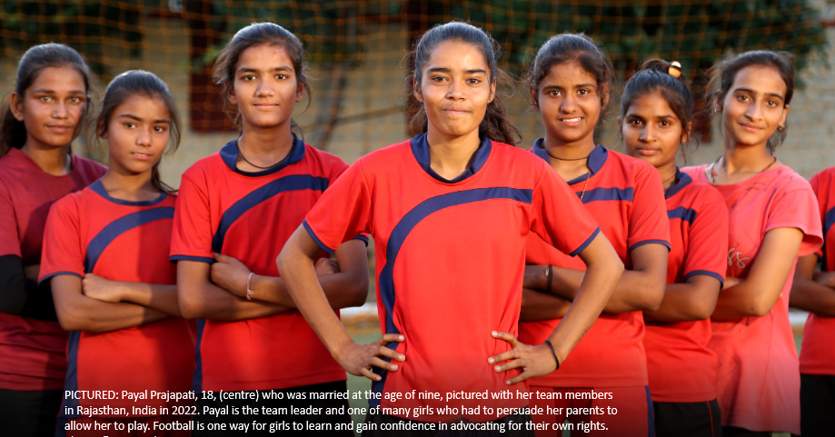
Girls Not Brides website - sourced from an email from Emma Sadd to The Communication Initiative, January 10 2023; and email from Emma Sadd to The Communication Initiative on August 15 2024. Image caption/credit:: "Payal Prajapati, 18, (centre) who was married at the age of nine, pictured with her team members in Rajasthan, India in 2022. Payal is the team leader and one of many girls who had to persuade her parents to allow her to play. Football is one way for girls to learn and gain confidence in advocating for their own rights." Photo: © UNICEF/UN0723910
- Log in to post comments