










































Educating Healthcare Providers to Increase Human Papillomavirus (HPV) Vaccination Rates: A Qualitative Systematic Review
Harvard Medical School
"...provider-specific educational interventions to improve provider knowledge and quality recommendations are a powerful tool in increasing vaccine uptake."
Despite the potential for vaccines to decrease human papillomavirus (HPV)-related diseases, the United States (US) will fall short of meeting the Healthy People 2020 goal of an HPV vaccination rate of 80%. Various educational and delivery methods have been developed to improve HPV knowledge among adolescents and parents, such as information sheets, slide presentations, and brief educational videos. Similarly, due to the role of healthcare providers (HCP) in the acceptance and uptake of the HPV vaccine, national organisations, such as the Centers for Disease Control and Prevention (CDC), and regional groups have developed provider-specific educational resources (e.g., didactic presentations, group sessions, webinars, videos, clinical vignettes, and simulations, with or without hardcopy handouts). This qualitative systematic review sought to understand the knowledge gaps of HCPs and to determine whether these align with existing resources.
After a systematic search, 40 studies that described the knowledge and attitudes of providers and/or impact of educational interventions were ultimately included in the review. There were 30 descriptive studies (21 surveys, 4 qualitative studies using semi-structured interviews, and 5 mixed-methods studies) and 10 interventional studies (5 randomised trials and 5 quasi-experimental pre-test/post-test design). The details of the descriptive and interventional studies - e.g., with key findings - are summarised in Table 1 and Table 2, respectively. In addition, websites of American organisations with an interest in HPV vaccination were manually searched for provider resources.
Thematic analysis revealed the following key areas of focus in addressing provider knowledge gaps: HPV knowledge, HPV vaccine knowledge, provider self-efficacy and normative beliefs, gender differences and sexuality, and communication strategies. The latter included: initiating conversation, presumptive approach, motivational interviewing techniques, formulating a strong recommendation, addressing parental hesitations and concerns, addressing negative media and dispelling myths, time management, and delivering tailored information that is sensitive to cultural differences and health disparities (e.g., immigrants, minority or low-income groups).
Key findings from the 30 descriptive studies included in the review:
- HCPs' knowledge on HPV was generally low, with a correspondingly low vaccine recommendation rate.
- Studies highlighted the importance of exploring HCPs' personal motivations in vaccine recommendation, which consist of the providers' personal belief in vaccine benefit, belief that recommendation will effect change, and perceived importance of adhering to professional society recommendations. When HCPs internalise the subjective norms of their colleagues and profession (i.e., other providers and societal recommendations from the CDC), they tend to vaccinate at higher rates.
- HCPs' level of comfort in the discussion of sexuality issues surrounding the vaccine and concern of sexual behaviour after vaccination was a point raised in the studies. HCPs who state that parents worry that vaccination will promote sexual activity and are uncomfortable discussing sex with their children report this as a significant barrier to vaccination.
- There is an educational gap in practical communication strategies to disseminate knowledge and counsel parents and patients. Lists of perceived parental concerns, some of which stem from the media, can be found in several studies and may serve as a useful starting point for creating provider-specific educational resources.
- Parents and patients who are non-English speaking, from immigrant populations, or from minority or low-income groups require tailored communication approaches and additional attention from the provider. For example, a study of the North Plains American Indian population highlighted the need for educational materials in their native language as well as outreach to elders, who are important opinion leaders in their community.
All 10 of the interventional studies included an educational presentation, while 4 of the 5 randomised trials included additional interventions such as practice-specific fact sheets, a parental education website, disease images depicting diseases associated with HPV, decision aid for HPV vaccination, repeated contact with providers, individualised feedback, provision of continuing medical education (CME) credits, and electronic health record (EHR) prompts.
Analysis of these studies demonstrated that provider-specific interventions are effective in improving provider knowledge, as well as vaccine series initiation and completion. In addition to educational presentations, training in communication approach (e.g., the "presumptive approach") was demonstrated to impact vaccine initiation rate. Although the results are encouraging, they had moderate risks of bias, and the details of the educational content included and how this content was determined was not detailed.
Multiple American organisations with an interest in HPV have created publicly accessible online resources that in large part align with the resource gaps identified in this study. (Table 3 maps the themes identified from descriptive studies to provider-specific resources from national organisations.) To cite a few examples:
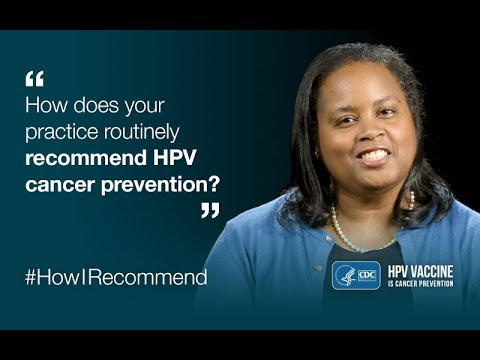
- The CDC website includes clinician factsheets, resources on answering parents' questions (e.g., the #HowIRecommend video series), HPV coverage data, schedules and recommendations, and resources translated into Spanish.
- The American Academy of Pediatrics (AAP) HPV Champion toolkit includes printable resources, social media resources to share messages on HPV vaccine, videos, a sample Plan-Do-Study-Act improvement cycle for implementing office change, and teaching tools to provide education to colleagues.
- The AAP "HPV Vaccine: Same Way, Same Day" is a free downloadable App consisting of brief, interactive role-play simulation to help the user practice introducing the vaccine and addressing concerns of parents who are hesitant about the vaccine.
Some of the review findings related to these national resources include:
- Although society recommendations are widely available, and encouragement to adhere to guidelines is explicit, the impact of provider recommendation is not emphasised; nor are provider personal beliefs and biases explored.
- While there are some resources available addressing gender differences and discussion of sexual issues surrounding the vaccine, as well as communication strategies, not all organisations address these gaps.
- The frequency of utilisation and efficacy of these resources have largely been unreported.
Reflecting on these findings, the researchers conclude that "Coordinated efforts are needed to evaluate provider-specific educational resources to improve vaccine uptake in the US." Some suggestions to accomplish this:
- While parts of presentations tailored to local needs are often required, uniformity in the message may be achieved by using standardised slide decks created by national organisations. The authors of the review indicate that providers are more likely to act upon information that is sourced from professional society recommendation and guidelines. However, only 2 studies in this review explicitly referenced the CDC in the design of their intervention. There is room here for further investigation.
- Like other medical interventions, evidence for the efficacy of educational interventions is needed to maximise use of limited financial and human resources. The relative contribution of provider education compared with the other initiatives (e.g., telephone reminders) could be further explored.
- Studies prior to the extended vaccine recommendations for boys consistently demonstrated that HCPs were more likely to recommend the vaccine to girls than boys; more than a decade later, this gender bias persists, highlighting the need for targeted educational interventions.
- Although campaign messages such as "You are the key" seemingly promote the importance of provider recommendation, the literature shows that HCPs remain skeptical of their ability to convince parents and patients. Thus, future educational efforts could emphasise self-efficacy and explicitly convey the evidence of the positive impact that providers have on vaccine uptake.
- Communication strategies - specifically, how best to initiate the conversation - warrant further exploration. An effective interaction can address the concerns of parents and motivate a hesitant parent towards vaccine acceptance, but providers need support in achieving this communication task during short consultations. Role-playing and video-recorded scenarios, when combined with practice with standardised patients, have been shown to be more effective than traditional didactic methods. This challenges organisations to explore alternative methods to offer education on communication strategies to diverse HCPs moving forward.
"The thematic analysis to map learning needs to existing resources illustrated in this review may be a useful method moving forward to inform future educational resource development and curriculum design."
Vaccine: X https://doi.org/10.1016/j.jvacx.2019.100037. Image credit: CDC
- Log in to post comments