










































DFID's Blogs on CEFM: Policy Strategies
"Imagine your life if you were married at 15, against your will, to an abusive husband. It’s the same for almost all the women you know. Your education came to an abrupt end once you were married, and you’re not allowed to have a job – other than having babies, that is. And because you got married young, you’re probably experiencing some sexual and reproductive health problems." Lynne Featherstone, Ministerial Champion for Tackling Violence Against Women and Girls Overseas
The Department of International Development (DFID) United Kingdom (UK) Girl Summit 2014 has focused attention on both the practice of female genital mutilation (FGM) and child early and forced marriage (CEFM), with the intent of uniting individuals, organisations, and governments to end the practices. This group of bloggers gathered by DFID presents a range of perspectives and approaches as detailed below:
- One year on from the Girl Summit: are we any closer to ending child marriage? - Blogger Lakshmi Sundaram, Executive Director Girls Not Brides, states that: "Working on a taboo subject can be isolating and demoralising and, as evidenced by the experience of some Girls Not Brides members focused on ending child marriage within their communities, even life-threatening." She cites empowering girls and ending CEFM as a path to "improved educational attainment, higher earnings and greater health-seeking behaviour." The message from her organisation to Girl Summit 2014 attendees was that political leaders need to back up their words and commitments with long-term funding and comprehensive, integrated strategies and programmes. Here she analyses progress one year out: 1) The UN Human Rights Council unanimously adopted a resolution "recognising child marriage as a violation of human rights, which was co-sponsored by more than 85 countries from every region of the world." 2) At the regional level, both the African Union and the South Asian Association for Regional Cooperation have taken on the issue, with “some progress” in strategy development. She suggests further progress can be made if a proposed target on ending CEFM is included in the final Sustainable Development Goal framework. Cross-sectoral national action plans and careful measurement can help to develop courses of action that work in each country.
- Ending child and early forced marriage in Mozambique - Lynne Featherstone, Ministerial Champion for Tackling Violence Against Women and Girls Overseas, begins by presenting statistics on the incidence of CEFM as a global issue, e.g.: "Girls who give birth under-15 years of age are 5 times more likely to die in childbirth than girls in their 20s." She welcomed the Mozambique government representatives to Girl Summit 2014 as a way to 'break the silence' on CEFM in Mozambique because "African leadership such as this is fundamental if we are to work together to bring an end to CEFM...." She cited partnerships among aid organisations as crucial in partnering to stop the practice.
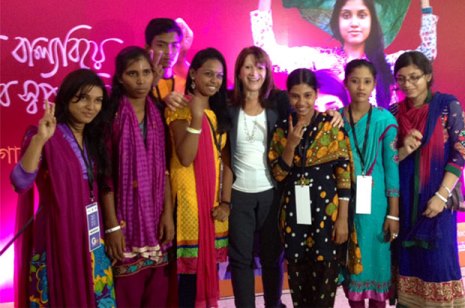
- Ending child marriage in Bangladesh: girls not brides - Lynne Featherstone states that the coalition between DFID and The United Nations Children's Fund (UNICEF) in bringing together stakeholders in the issues of FGM and CEFM helped to "mobilise domestic and international efforts to end child, early and forced marriage." At the "follow-up Bangladesh Girl Summit, ...Bangladeshi ministers, civil society, women and young people united against child marriage and discussed how to tackle it, from the community to the national level.” She cites the example of a women's group in Dhaka that protected a member from CEFM by convincing her father that she would be better off being educated and contributing to the family through her work. Thus, "helping to set up and train even more community groups like the one that helped Shabnaz" is a strategy in urban areas. Bangladesh is also strengthening its law against CEFM with higher penalties, while lowering its legal age from 18 to 16. However, there is a commitment to re-examine that legislation to retain the higher age of marriage.
- An adult decision - Harriet Macdonald-Walker writes about Zimbabwean girls' lower earning potential, lower educational levels, and shorter life expectancy associated with CEFM. Though marriage decisions are part of protected rights, a third of Zimbabwean girls are not making them for themselves. Legislation on rights of girls, particularly those below the legal age of adulthood (18 years of age) is being written. Amongst those who attended the Girl Summit 2014 were members of the Musasa Project, which works with the most vulnerable girls and women in Zimbabwe to provide services to survivors of gender-based violence, and CAMFED, which supports girls through secondary school education and their transition to adulthood by working with their communities, families and peer groups.. Local services and advocacy can respond to girls' needs according to local cultural and social norms. Girls who marry later, completing their education, can be role models, offering evidence on quality of life resulting from delaying marriage. The challenge is to lift the "veil of secrecy" on CEFM and bring about community discussion to tackle the issue.
- Why DRC [Democratic Republic of Congo]’s youth need to take a stand to empower girls' lives - Cleo Blackman, Programme Manager, DFID DRC, describes a government commitment to legislation on revising the Family Code to strengthen child protection. However, she states that changing the way that the society sees girls is needed, requiring "[l]ong-term investment in demonstrating girls' value - economically, socially, politically." UNICEF sent 2 youth reporters to London, UK, for the Girl Summit to report on the Summit and return home to instigate a movement in support of girls. In a country where rights for girls and women are scarce, alternatives to early marriage are needed: education, work, opportunities to own land, open a bank account, etc. Much can be learned from organisations already working in DRC, starting with finding out what girls think. DFID, in partnership with Girl Hub and other organisations, plans to "generate knowledge and evidence about what works to empower girls and change the attitudes, behaviours and norms that negatively impact on their lives.”
One year on from the Girl Summit: are we any closer to ending child marriage?, July 22 2015; Ending child and early forced marriage in Mozambique, May 13 2015; Ending child marriage in Bangladesh: girls not brides, October 31 2014; An adult decision, August 8 2014; and Why DRC’s youth need to take a stand to empower girls' lives, August 8 2014, accessed on August 10 2015. Image credit: Monica Allen
- Log in to post comments